
High Security Turnstiles in the UAE: Balancing Safe Passage With Protection
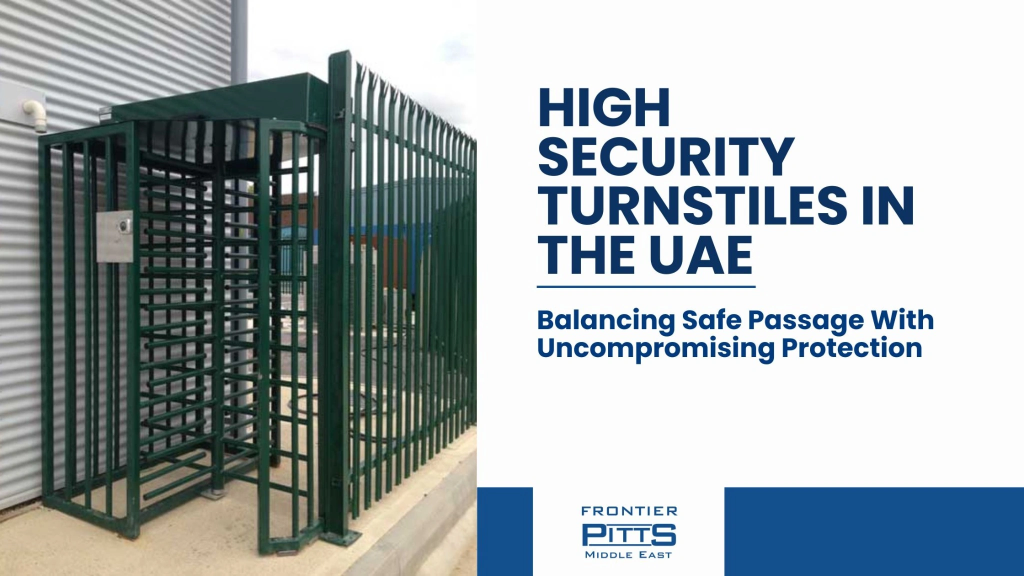
A high security turnstile is an access control barrier independently tested against forced physical attack, most commonly certified to LPS 1175 by the UK’s Loss Prevention Certification Board. As a UAE-based manufacturer, Frontier Pitts Middle East supplies LPS 1175-rated turnstiles including the Terra Diamond, Platinum B3, and FPT1 Full Height models that combine tested resistance with accessible, high-throughput entry for staff and visitors.
What Is a High Security Turnstile?
A high security turnstile is built to resist deliberate forced entry not just to log who taps a card. That’s the key difference from a standard access turnstile, and it’s the first thing to clarify for anyone specifying one.
At Frontier Pitts Middle East, our high security range including the LPS 1175 Terra Diamond Turnstile and the LPS 1175 Platinum Turnstile B3 – is independently tested and rated against LPS 1175, the UK standard that measures how long a barrier resists attack using hand tools, power tools, and other forcible methods. The higher the security rating within LPS 1175, the longer and more determined an attack has to be before the barrier gives way.
For sites that need a complete physical block rather than a waist-height barrier, our FPT1 Full Height Turnstile adds a floor-to-ceiling rotor ideal for perimeters where climbing over or ducking under isn’t an option.
Real-world example: A data centre client in the UAE needed an entry point that could hold up against sustained, deliberate forcing attempts while still processing hundreds of authorised staff during shift changes. The LPS 1175 Platinum Turnstile B3’s 120° rotor design gave them both the tested resistance rating and the throughput speed they needed without adding a second manned checkpoint.
Why LPS 1175 Certification Matters
LPS 1175 isn’t a marketing label. It’s an independently verified standard issued by the Loss Prevention Certification Board (LPCB), part of the BRE Group, one of the world’s most established building and security testing authorities. When a turnstile carries this rating, an accredited lab has physically attacked the product and recorded exactly how long it withstood the attempt, under defined tools and conditions.
For procurement teams and consultants specifying security equipment across the GCC, this gives a transparent, comparable benchmark instead of taking a supplier’s word for it, the decision is backed by tested data.
Accessibility: Security and Inclusion Reinforce Each Other
A well-specified turnstile protects a site and welcomes the people who are meant to be there. In our experience, the two goals reinforce each other rather than compete.
Here’s how we approach it on every project:
- Clear lane widths for wheelchair users and those with mobility aids, alongside high security lanes
- Low-force or motorised operation so users don’t need to push against heavy resistance
- Intuitive signage and lighting at the point of entry, reducing hesitation and queuing
- Integration with access control (card, biometric, PIN) so authorised staff move through in seconds
What to do if your site has mixed traffic: If a facility handles both high-footfall staff access and occasional visitor or contractor entry, we typically recommend pairing a high security turnstile lane with a supervised wide lane nearby. This keeps the secure lane fast and consistent, while still accommodating deliveries, equipment, or visitors who need extra space.
Turnstile Types at a Glance
| Type | Best For | Security Level | Notes |
|---|---|---|---|
| LPS 1175 Terra Diamond | High-footfall secure entrances | High | Balances speed with resistance to forced entry |
| LPS 1175 Platinum B3 | Data centres, critical infrastructure | Very High | 120° rotor, tested to LPS 1175 |
| FPT1 Full Height | Perimeters, unmanned access points | Very High | Floor-to-ceiling barrier, deters climbing |
Choosing a Turnstile Manufacturer in the UAE
Specifying a turnstile is a long-term decision most stay in service for a decade or more, often running continuously. A few questions worth asking any manufacturer before you commit:
Quick specification checklist:
- Is the turnstile independently certified (e.g., LPS 1175), with test documentation available on request?
- Does the manufacturer offer local support, spare parts, and maintenance in the UAE?
- Can the lane width and rotor type accommodate wheelchair and mobility-aid users?
- Is the turnstile compatible with your existing access control system (card, biometric, PIN)?
- Does the supplier provide installation and commissioning support on-site?
- Is there a clear warranty and service agreement in place?
As a UAE-based manufacturer and supplier, we handle the full lifecycle in-house specification, certification documentation, installation, and ongoing maintenance so clients across government, aviation, industrial, and commercial sectors have one point of contact throughout.
Keeping Turnstiles Running Smoothly
A few habits we recommend to every site team we work with:
- Schedule routine maintenance checks moving parts and access control integrations benefit from regular inspection, especially in high-footfall sites.
- Test the rotor resistance periodically to confirm it still performs as specified.
- Review signage and lane assignments if visitor patterns change, such as after a new building extension or event.
- Keep staff briefed on how to assist users who need extra time or space at the entry point.
A Note on Transparency
Every LPS 1175-rated product we supply comes with its certification documentation, so consultants and end clients can verify the rating independently rather than relying on a claim alone. If a project has specific compliance requirements, our team is glad to walk through the relevant standard in detail before specification is finalised.
Next Steps
If you’re specifying a single high security turnstile for a data centre, or planning access control across a multi-building government campus, here’s how to move forward:
- Share your site requirements (footfall, lane count, access control system) with our team.
- Request certification documentation for the LPS 1175-rated model you’re considering.
- Book a consultation for a site-specific recommendation and installation timeline.
Reach out to Frontier Pitts Middle East to get started. www.fpgulf.com
FAQs
1. What does “LPS 1175 rated” mean for a turnstile? It means the turnstile has been independently tested by an accredited lab and holds up against forced entry attempts for a documented period, using defined tools and methods.
2. Are high security turnstiles slower than standard ones? Not necessarily. Motorised and biometric-integrated turnstiles like our LPS 1175 range are designed to process authorised users quickly while still resisting forced entry.
3. Can turnstiles be made accessible for wheelchair users? Yes. Pairing a high security lane with a wider, low-force or supervised lane is a common and effective approach used across our UAE installations.
4. What’s the difference between a tripod, full-height, and high security turnstile? Tripod turnstiles suit moderate-security, high-traffic areas. Full-height turnstiles like our FPT1 add a complete physical barrier. High security models such as the LPS 1175 Platinum B3 are tested specifically against forced entry.
5. How long do commercial turnstiles typically last? With regular maintenance, well-built turnstiles commonly remain in service for 10+ years, even in continuous, high-footfall use.
6. Do turnstiles integrate with existing access control systems? Yes. Our turnstiles are designed to work with card readers, biometric scanners, and PIN-based systems already in use at a facility.
7. What sectors in the UAE use high security turnstiles most? Data centres, government buildings, airports, industrial sites, and critical infrastructure facilities are among the most common users of LPS 1175-rated turnstiles.
8. Is LPS 1175 the same as PAS 68 or IWA 14-1? No. LPS 1175 measures resistance to forced physical attack, while PAS 68 and IWA 14-1 measure vehicle impact resistance – these apply to different product categories such as bollards and road blockers.
9. What maintenance does a high security turnstile need? Routine inspection of the rotor mechanism, locking components, and access control integration helps keep performance consistent, especially in high-use environments.
10. Can Frontier Pitts provide certification documents for turnstile projects? Yes. We provide LPS 1175 test documentation for every applicable product, so project consultants can verify compliance directly.
11. How do I choose between the Terra Diamond and Platinum B3 turnstiles? The Terra Diamond suits high-footfall secure entrances, while the Platinum B3’s 120° rotor and higher resistance rating make it well suited to critical infrastructure like data centres.
12. Does Frontier Pitts install and commission turnstiles on-site in the UAE? Yes. As a UAE-based manufacturer and supplier, we manage specification, installation, and commissioning directly with our clients.
Sources
- Loss Prevention Certification Board (LPCB) / BRE Group — LPS 1175 standard for security ratings of physical barriers
- Frontier Pitts Middle East product documentation — fpgulf.com/products-category/turnstiles
Follow Frontier Pitts Middle East on Google
Add fpgulf.com as a Preferred Source to see more of our latest insights on hostile vehicle mitigation, security bollards, road blockers and high-security access solutions in Google Search.