
High-Security Bollard Installation Guide 2026: UAE & Middle East
Last updated: August 2026
High-security bollards are an important component of hostile vehicle mitigation (HVM), helping protect pedestrians, buildings, critical infrastructure and controlled-access sites from unauthorized or hostile vehicle intrusion.
However, specifying a crash-rated bollard is only one part of the process. Effective high-security bollard installation requires the correct threat assessment, impact-tested product, foundation design, site conditions, spacing, drainage, access-control requirements and installation configuration.
For projects in the UAE and wider Middle East, specifiers should also understand the transition from legacy PAS 68 and IWA 14 ratings to the current ISO 22343 vehicle security barrier standards, as well as applicable local requirements such as SIRA approval in Dubai.
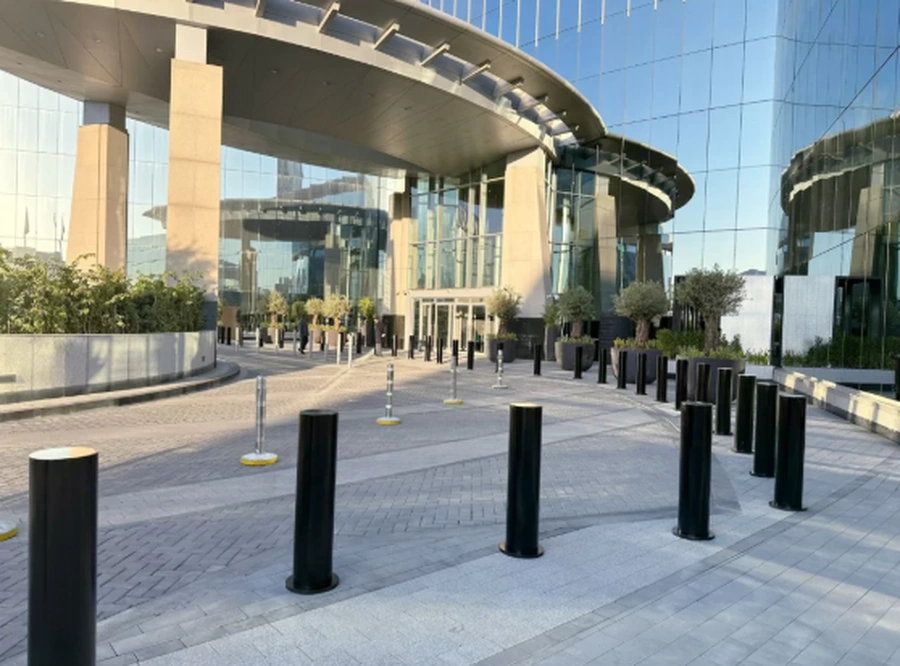
What Is Required for High-Security Bollard Installation?
High-security bollard installation requires selecting a vehicle security barrier with the appropriate tested impact performance and installing it according to the configuration represented by its technical documentation and test evidence.
The specification should consider:
- Assessed vehicle type and mass
- Potential vehicle approach speed
- Impact angle
- Required penetration performance
- Foundation and ground conditions
- Underground utilities
- Pedestrian and emergency access
- Frequency of authorized vehicle access
- Drainage and environmental exposure
- Local regulatory and project requirements
ISO 22343-1:2023 specifies performance requirements and the vehicle-impact testing method for vehicle security barriers. ISO 22343-2:2023 provides guidance on their selection, installation and use.
2026 Update: ISO 22343, PAS 68 and IWA 14 Explained
Vehicle security barrier standards have evolved, so project documentation should distinguish between current standards and legacy test classifications.
| Standard | 2026 Status | Purpose |
|---|---|---|
| ISO 22343-1:2023 | Current | Performance requirements, vehicle-impact testing and performance rating |
| ISO 22343-2:2023 | Current | Guidance for selection, installation and use of vehicle security barriers |
| PAS 68:2013 | Withdrawn | Legacy UK vehicle security barrier impact-test specification |
| PAS 69:2013 | Withdrawn | Legacy UK guidance for selection, installation and use |
| IWA 14-1:2013 | Withdrawn | Legacy international vehicle-impact testing and rating framework |
| IWA 14-2:2013 | Withdrawn | Legacy international application guidance |
PAS 68:2013 and PAS 69:2013 were withdrawn by BSI on 25 October 2023. IWA 14-1 and IWA 14-2 have also been withdrawn and superseded by the ISO 22343 series.
This does not mean that every previously tested PAS 68 or IWA 14 product suddenly has no performance evidence. Existing test reports document how those systems performed under the standard used at the time of testing. Whether a legacy rating is acceptable for a new project should be confirmed with the relevant client, consultant or authority.
Important Specification Principle
Do not write simply:
“PAS 68 bollard”
or:
“ISO 22343 bollard.”
The meaningful information is the complete tested performance classification, including vehicle type or mass, impact speed, impact angle and measured penetration.
A standard defines the test method. It does not mean every product tested to that standard has the same stopping performance.
What Can Crash-Rated High-Security Bollards Do?
Crash-rated bollards are designed to provide documented resistance against a defined vehicle-impact threat.
Depending on the product, tested systems may address different combinations of:
- Vehicle mass
- Vehicle type
- Impact speed
- Impact angle
- Penetration distance
- Foundation configuration
For example, Frontier Pitts’ Terra Static Jupiter has legacy PAS 68 test evidence at 7.5 tonnes and 80 km/h, while the Terra Shallow Jupiter has an IWA 14-1 classification based on a 7.2-tonne vehicle at 80 km/h. These are product-specific ratings rather than universal PAS 68 or IWA 14 performance levels.
The Frontier Pitts range also now includes products documented against the newer ISO 22343 framework, reflecting the industry’s transition toward the current international standard.
Start With the Vehicle Threat, Not the Bollard
One of the most important steps in HVM design is determining what vehicle threat the site actually needs to resist.
The strongest or highest-rated bollard is not automatically the best solution.
A project should first establish an operational requirement based on questions such as:
What vehicle could realistically approach the site?
A passenger car, pickup, delivery vehicle and heavy truck present very different impact conditions.
How fast could that vehicle realistically travel?
Road geometry, turns, gradients, existing street furniture and approach distance can significantly influence achievable speed.
Where could an impact occur?
A vehicle may approach a perimeter directly or at an angle.
How much penetration can the protected site tolerate?
The distance between the barrier line and the asset being protected is an important design consideration.
Does the location require authorized vehicle access?
Permanent pedestrian areas may be suited to static bollards, while entrances used by authorized vehicles may require automatic or removable systems.
ISO 22343-2 specifically addresses the process of selecting and applying vehicle security barriers based on operational requirements.
Types of High-Security Bollards
| Bollard Type | Typical Application | Main Consideration |
| Static Bollards | Permanent perimeter and pedestrian protection | No routine vehicle access through protected line |
| Automatic Bollards | Controlled vehicle entrances | Requires actuation, controls, drainage and maintenance |
| Removable Bollards | Occasional or temporary access | Operational procedures are important |
| Shallow-Mount Bollards | Utility-dense or restricted excavation sites | Foundation must match tested configuration |
| Architectural / Sleeved Bollards | Public realm and design-sensitive sites | Decorative treatment should not alter tested structural system |
Static Bollards
Static bollards provide permanent protection and are commonly used at pedestrian zones, building frontages, government facilities and perimeter boundaries.
Their relatively simple mechanical configuration can make them appropriate where routine vehicle passage is not required.
Automatic Bollards
Automatic rising bollards combine hostile vehicle mitigation with controlled vehicle access.
They may be integrated with:
- RFID
- ANPR
- Card readers
- Intercoms
- Traffic lights
- Security control systems
- Remote-control stations
The bollard itself is only one part of an automatic installation. Power, hydraulic or electromechanical equipment, drainage, safety devices and control logic must also be considered.
Shallow-Mount Bollards
Shallow foundations are particularly valuable in established urban environments where utilities, structural slabs, drainage or existing infrastructure restrict excavation.
For example, Frontier Pitts’ Terra Shallow Jupiter is designed around a 200 mm foundation depth, while the Terra Shallow Venus uses a 300 mm shallow foundation. The dimensions are product-specific and should never be treated as generic installation depths for other HVM bollards.
High-Security Bollard Applications in the Middle East
High-security bollards may form part of perimeter protection strategies for:
| Environment | Typical Security Objective |
| Government and diplomatic facilities | Reduce unauthorized vehicle intrusion |
| Airports and transport hubs | Protect high-footfall areas and controlled entrances |
| Critical infrastructure | Protect operational assets and restricted zones |
| Oil, gas and energy facilities | Secure strategic vehicle approaches |
| Hotels and commercial developments | Combine vehicle control with pedestrian accessibility |
| Stadiums and event venues | Protect crowd areas while maintaining movement |
| Financial districts | Protect building approaches and controlled access |
| Public spaces | Separate pedestrian areas from vehicle routes |
The required impact performance should be determined by the project’s threat assessment and operational requirements rather than by facility type alone.
SIRA-Approved Bollards: What UAE Projects Need to Know
SIRA — the Security Industry Regulatory Agency — regulates applicable security systems in the Emirate of Dubai.
It should therefore not be described as the UAE’s national HVM certification authority.
For bollard equipment certification, SIRA currently requests supporting information including accredited impact-test documentation, international certification and a detailed examination report. Its Security Plans Certification service also has a specific process for Hostile Vehicle Mitigation Bollards.
As of SIRA’s approved-bollard list dated 31 March 2026, Frontier Pitts products listed include:
- Terra Quantum Bollard
- Terra Venus Bollard
- Terra Jupiter Bollard
- Terra Shallow Venus Bollard
- Terra Neptune Bollard
The latest SIRA list and the exact product certificate should always be checked during specification rather than assuming approval applies to every bollard in a manufacturer’s range.
Projects outside Dubai may be subject to different authority, consultant, client or sector-specific requirements.
High-Security Bollard Installation Process
1. Site Survey
The installation process should begin with a detailed site assessment.
The survey should identify:
- Vehicle approaches
- Pedestrian routes
- Existing kerbs and structures
- Underground utilities
- Drainage
- Road levels
- Access restrictions
- Available foundation space
2. Threat and Operational Assessment
Determine the vehicle threat and required performance before selecting the bollard.
This prevents both under-specification and unnecessary over-specification.
3. Confirm the Tested Configuration
Request the complete test documentation and manufacturer’s technical drawings.
The proposed installation should reflect the configuration represented by the tested system, particularly where certified impact performance is required.
4. Foundation and Civil Design
Foundation requirements vary significantly between products.
Review:
- Excavation depth
- Foundation dimensions
- Reinforcement
- Concrete requirements
- Existing structural slabs
- Ground conditions
- Nearby utilities
- Finished surface levels
Do not substitute a generic bollard foundation for the manufacturer’s tested or engineered design.
5. Drainage and Environmental Design
Drainage is particularly important for automatic rising bollards because accumulated water can affect underground equipment.
Site design should consider surface water, groundwater conditions and local drainage requirements.
6. Electrical and Control Integration
Automatic systems may require integration with:
- Power supplies
- Control cabinets
- Access control
- Safety loops
- Photocells
- Traffic signals
- Emergency controls
- Security management systems
7. Installation and Alignment
Bollards should be installed according to approved drawings, with correct positioning, levels, alignment and spacing.
Any changes caused by unexpected site conditions should be reviewed before installation continues.
8. Testing and Commissioning
Automatic systems should undergo functional testing and commissioning.
Project handover should include relevant test records, operating documentation, maintenance requirements and as-built information.
Middle East Installation Conditions
High-security bollards installed in the UAE and GCC operate in demanding environments.
Extreme Heat
Automatic bollards, hydraulic systems, electrical panels and controls should be selected and installed with local operating temperatures in mind.
Dust and Sand
Dust ingress can affect mechanical and electrical systems. Appropriate enclosures, seals and preventive maintenance help support long-term reliability.
Coastal Corrosion
Projects near the Gulf coast should consider humidity, salt exposure and corrosion protection when specifying materials and finishes.
Drainage
Although the region is associated with dry conditions, intense rainfall events can create significant localized water accumulation. Underground bollard systems therefore still require appropriate drainage planning.
Existing Utilities
Urban projects frequently encounter electrical, telecommunications, drainage, irrigation and other underground services. Shallow-mount solutions can be useful where excavation depth is restricted.
How Bollard Spacing Should Be Determined
Bollard spacing affects both vehicle protection and pedestrian accessibility.
Spacing should account for:
- Vehicle dimensions
- Tested system configuration
- Pedestrian movement
- Wheelchairs and mobility requirements
- Emergency routes
- Site security requirements
There is no single spacing dimension that should automatically be applied to every high-security bollard project.
The manufacturer’s tested arrangement, project design requirements and applicable authority guidance should be reviewed before finalizing spacing.
High-Security Bollard Project Timeline
The following can be used as an indicative planning range only. Actual schedules depend on approvals, product availability, civil works, project scale and site access.
| Project Phase | Indicative Duration |
| Site Assessment & Survey | 2–3 weeks |
| Design Development | 3–4 weeks |
| Manufacturing & Delivery | 6–16 weeks |
| Installation | 1–6 weeks, site dependent |
For urgent or phased projects, early coordination between the client, security consultant, civil contractor, MEP team and HVM supplier can reduce redesign and installation conflicts.
Cost: Look Beyond the Bollard Purchase Price
The initial bollard price is only one part of the total project cost.
A meaningful lifecycle comparison should consider:
- Civil works
- Excavation
- Utility diversion
- Drainage
- Controls
- Installation
- Commissioning
- Preventive maintenance
- Spare parts
- Operational downtime
- Future replacement requirements
Static bollards generally have fewer operating components than automatic systems, while automatic bollards provide significantly greater access flexibility.
Shallow-mount systems may also reduce excavation requirements where conventional deep foundations would conflict with existing infrastructure.
Documentation Checklist for Specifiers and Consultants
For a high-security bollard project, request documented evidence rather than relying on terms such as “heavy duty,” “anti-terror” or “crash resistant.”
A technical submittal should normally identify:
- Product model
- Applicable impact-test standard
- Complete impact-test classification
- Test certificate or accredited laboratory documentation
- Detailed test report where required
- Foundation and installation drawings
- Product data sheet
- Materials and finish
- Automatic system controls, where applicable
- Maintenance requirements
- SIRA approval documentation where required for a Dubai project
- Project-specific drawings and method statements
This creates a clear evidence trail for consultants, contractors, authorities and asset owners.
Why Installation Experience Matters
Impact-tested equipment must still be integrated into a real site containing roads, utilities, structures, drainage, pedestrians and other security systems.
Frontier Pitts Middle East provides services including site surveys, design, engineering, manufacturing, civil and electrical services, installation, project management, maintenance and repair support.
For complex HVM projects, engaging the barrier specialist during the design stage can help identify foundation conflicts, access requirements and interface issues before construction begins.
Frequently Asked Questions About High-Security Bollard Installation
1. What is the current standard for crash-rated bollards in 2026?
ISO 22343-1:2023 is the current international standard covering impact-performance requirements, vehicle-impact testing and performance ratings for vehicle security barriers. ISO 22343-2:2023 provides guidance on selection, installation and use. PAS 68 and IWA 14 remain relevant when reviewing products originally tested under those earlier frameworks.
2. Is PAS 68 still valid for high-security bollards?
PAS 68:2013 was withdrawn by BSI in October 2023. Products previously tested to PAS 68 can still have documented test evidence showing their performance under that standard, but acceptance for a new project should be confirmed with the project’s consultant, client or relevant authority.
3. How deep should a high-security bollard foundation be?
There is no universal foundation depth for high-security bollards. Foundation depth depends on the product, tested configuration, impact requirement and site conditions. Shallow-mount products may use foundations of only a few hundred millimetres, while other systems require substantially different civil designs.
4. Does every high-security bollard in the UAE need SIRA approval?
No. SIRA regulates applicable security systems in Dubai rather than acting as a UAE-wide certification authority. Projects in Dubai should confirm applicable SIRA requirements, while projects elsewhere must follow the relevant emirate, authority, client and consultant requirements.
5. Should I use static or automatic HVM bollards?
Use static bollards where permanent vehicle exclusion is required and automatic bollards where authorized vehicles need frequent controlled access. Automatic systems offer operational flexibility but also require power, controls, safety devices, drainage and scheduled maintenance.
6. Can incorrect installation affect crash-rated bollard performance?
Yes. The bollard, foundation and supporting installation form a complete security system. Changing the tested or engineered configuration without appropriate technical review can mean that the installed system no longer represents the configuration for which the published impact performance was demonstrated.
Final Recommendation
A high-security bollard should never be selected only by appearance, diameter or a generic claim that it is “crash rated.”
For a defensible HVM specification, verify:
Threat → Standard → Complete test rating → Foundation → Installation configuration → Site constraints → Regulatory requirements → Documentation.
For 2026 projects, ISO 22343 should be considered the current international reference for vehicle security barrier impact testing and application, while existing PAS 68 and IWA 14 test evidence should be clearly identified as legacy classifications.
For Dubai projects, verify the latest SIRA requirements and product approvals before final specification.
Technical References
This guide has been updated using authoritative standards and regulatory information from:
- International Organization for Standardization — ISO 22343-1:2023
- International Organization for Standardization — ISO 22343-2:2023
- International Organization for Standardization — IWA 14-1:2013 status
- British Standards Institution — PAS 68:2013 status
- British Standards Institution — PAS 69:2013 status
- Security Industry Regulatory Agency, Dubai — Security Equipment and Devices Certification
- Security Industry Regulatory Agency, Dubai — Security Plans Certification
- SIRA — List of Approved Bollards, 31 March 2026
- Frontier Pitts Middle East product test documentation and technical specifications
Speak With Our High-Security Bollard Specialists
Get technical support with product selection, impact ratings, shallow foundations, SIRA requirements in Dubai, access control and installation planning.
Book a Project Consultation
Email: sales@frontierpitts.ae
Follow Frontier Pitts Middle East on Google
Add fpgulf.com as a Preferred Source to see more of our latest insights on hostile vehicle mitigation, security bollards, road blockers and high-security access solutions in Google Search.