
Understanding Impact Ratings
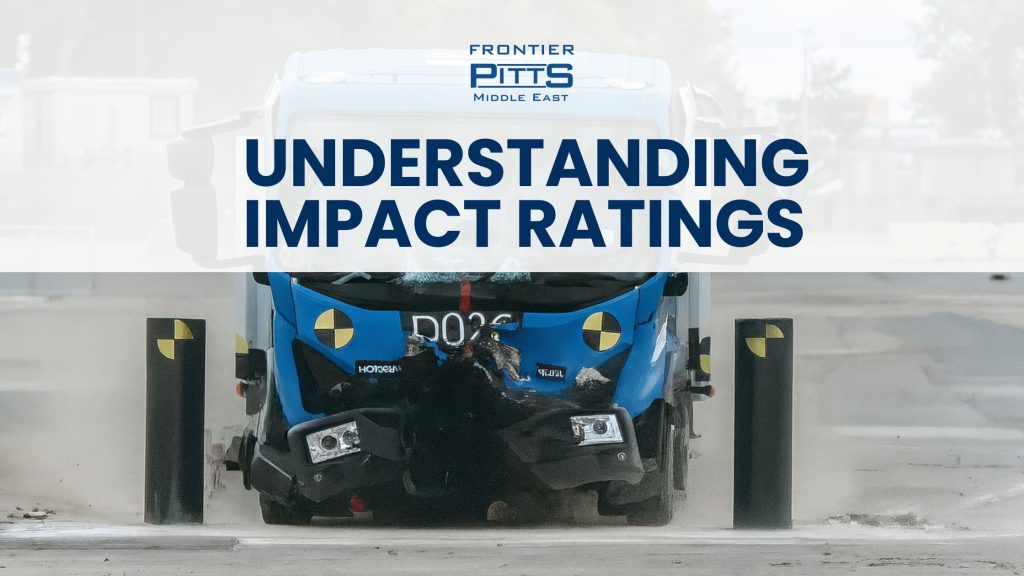
An impact rating is a certified score that proves a security barrier can physically stop a vehicle of a defined weight travelling at a defined speed. Ratings are determined through independent, full-scale crash testing by accredited laboratories. In the UAE and GCC, the three standards you will encounter most are PAS 68 (BSI, UK), IWA 14-1 (ISO, global), and LPS 1175 (LPCB, for intrusion resistance). Procurement of barriers without a valid rating certificate is not compliant with SIRA, Abu Dhabi Civil Defense, or UAE Federal Traffic Law requirements.
If you manage a high-security facility in the UAE whether that is an airport, government building, oil and gas plant, logistics hub, or military base you have almost certainly seen a string like this on a product datasheet:
| V/7500[N2]/80/90:0.0/25 |
What does it actually mean? And more importantly, does the barrier in question genuinely stop a 7,500 kg truck travelling at 80 kph, or is that just marketing language?
This guide answers both questions. It explains what impact ratings are, how the three main standards work, how to read a rating code line by line, and what your specific facility type actually requires. We have included a comparison table, a pre-procurement checklist, and real-world scenarios drawn from projects across the UAE, Saudi Arabia, and Oman.
Why Impact Ratings Exist and What They Actually Prove
Vehicle-as-weapon attacks have driven security barrier regulation for decades. The frequency and scale of such incidents, from government compound breaches to public space attacks forced international standards bodies to develop a rigorous, independently verifiable testing framework.
The core problem was simple: a steel post, a concrete block, or an unrated bollard can look formidable. Under real vehicle impact, many of them move, tip, or fragment. The impact rating system exists precisely to separate barriers that actually work from those that merely look the part.
A barrier with a valid PAS 68 or IWA 14-1 certificate has been physically crash-tested at an accredited laboratory. A vehicle of the specified mass was driven into it at the specified speed. The penetration was measured. That result is documented and verifiable.
A barrier without that certificate regardless of what the manufacturer’s brochure states — has not been proven to perform. It is not an HVM system.
What regulators in the UAE require
Impact ratings are not optional for most major projects in the UAE. The following authorities specify or mandate certified HVM products:
- SIRA (Security Industry Regulatory Agency, Dubai) required for all security-classified installations across Dubai emirate
- Abu Dhabi Civil Defense mandatory for government, military, and critical infrastructure projects in Abu Dhabi
- Dubai Municipality specifies crash barrier compliance on high-risk road and access corridors
- UAE Federal Traffic Law (amended 2023, Cabinet Resolution) mandates compliant protective systems on federal roads and around critical infrastructure
- CPNI (UK Centre for the Protection of National Infrastructure) applied on internationally linked UAE projects such as embassies, consulates, and NATO-adjacent facilities
| Example: A logistics operator in Dubai engaged a local supplier for what was described as a ‘security bollard’ at a warehouse entrance. The bollard had no crash certificate. During a routine site inspection prior to handover, the Abu Dhabi Civil Defense representative rejected the entire installation. The project was delayed six weeks and the bollards replaced at the operator’s cost. The replacement a certified IWA 14-1 bollard cost roughly the same as the original. The lesson was not about price. |
The Three Main Impact Rating Standards
Most GCC procurement specifications reference one or more of three standards. Here is what each one covers and when you will encounter it.
PAS 68 — the UK benchmark
Published by the British Standards Institution (BSI), PAS 68 is the most widely specified standard across UAE and GCC government projects. It defines exact test conditions: the vehicle mass and type, the impact speed, the angle of approach, and the maximum permitted penetration distance after impact.
PAS 68 also measures the dispersion distance of any debris weighing more than 25 kg — a consideration that matters in pedestrian-dense environments such as mall entrances, public plazas, and transportation hubs.
A typical PAS 68 rating looks like this: V/7500[N2]/80/90:0.0/25. The next section of this guide decodes that string completely.
IWA 14-1 — the global standard
IWA 14-1 was published by the International Organization for Standardization (ISO) to unify vehicle security barrier testing on a global basis. It draws from both PAS 68 and ASTM F2656 (the US standard) and covers nine vehicle categories ranging from approximately 1,500 kg to 30,000 kg.
IWA 14-1 is the preferred standard for international infrastructure projects — airports, embassies, data centres, and cross-border facilities. It is accepted alongside PAS 68 across all GCC markets.
One technical distinction worth knowing: IWA 14-1 measures penetration from the front face of the barrier, which includes the barrier’s own thickness. PAS 68 measures from the rear face. The same physical vehicle stop can produce a higher-looking penetration figure under IWA 14-1. Do not compare penetration numbers across standards without accounting for this difference.
LPS 1175 — forced-entry resistance
LPS 1175 is published by the Loss Prevention Certification Board (LPCB) and tests something entirely different: the resistance of a barrier, gate, or turnstile to manual forced entry using tools.
It is rated SR1 through SR4 (Security Rating 1 to 4), with SR3 and SR4 approved for government and defence use. LPS 1175 does not test vehicle impact at all — it measures how long a product withstands attack from hand tools, power tools, and specialist equipment.
Many high-security sites in the UAE require both a crash rating (PAS 68 or IWA 14-1) and an LPS 1175 rating on their gates and turnstiles. These are complementary, not interchangeable.
PAS 68 vs IWA 14-1 vs LPS 1175 — Side-by-Side Comparison
| Standard | Governing Body | Vehicle / Threat | Speed Range | Best Used For | GCC Accepted |
| PAS 68 | BSI (UK) | Vehicles 2,500-7,500 kg | 40-80 kph | UAE/GCC government projects; most widely specified | Yes |
| IWA 14-1 | ISO (Global) | Vehicles 1,500-30,000 kg; 9 categories | 16-112 kph | Airports, embassies, international infrastructure | Yes |
| LPS 1175 | LPCB (UK) | Manual attack (tools & time); not vehicle impact | SR1-SR4 (time-based) | Gates, turnstiles, pedestrian access control | Yes |
Note on IWA 14-1 penetration values: Because IWA 14-1 measures from the front face of the barrier (including barrier thickness), penetration figures may appear higher than an equivalent PAS 68 test result for the same physical stop. Always compare like-for-like when evaluating products across standards.
How to Read an Impact Rating Code — Step by Step
When you receive a product datasheet or tender specification, the rating code will typically appear in this format:
| V/7500[N2]/80/90:0.0/25 |
Here is what each element means.
Step 1 — Vehicle class (V)
The first letter identifies the vehicle category. V indicates a standard goods vehicle. Other codes include C (car), N (bus/coach), and H (heavy goods vehicle). For most critical infrastructure in the UAE, V at 7,500 kg is the minimum required class.
Step 2 — Vehicle mass (7500)
The number immediately following the vehicle class is the gross vehicle mass in kilograms. The most common specification in UAE government and critical infrastructure tenders is 7,500 kg — broadly equivalent to a fully-laden light truck or large SUV convoy.
Step 3 — Penetration classification ([N2])
The bracketed code indicates how far the vehicle travelled beyond the barrier after impact:
- N1 — vehicle stopped within 1 metre of the barrier face. Required for airport terminals, government entrances, and the highest-risk perimeters.
- N2 — vehicle stopped between 1 and 7 metres. Acceptable for perimeter roads and secondary access points at lower-risk sites.
- N3 — vehicle stopped between 7 and 30 metres. Generally not acceptable for occupied buildings or dense pedestrian areas.
- Failure — vehicle travelled more than 30 metres. Not a compliant HVM barrier.
Step 4 — Impact speed (80)
The speed in kph at which the test vehicle struck the barrier. Common test speeds are 48 kph, 64 kph, and 80 kph. The UAE’s highest-risk facilities — defence compounds, airport perimeters, oil and gas access gates — typically specify 80 kph as the minimum.
Step 5 — Impact angle (90)
The angle at which the vehicle struck the barrier, measured in degrees from the barrier face. 90 degrees is a straight-on, perpendicular impact — the most demanding test condition.
Step 6 — Penetration and debris distances (0.0/25)
In PAS 68 ratings, the colon introduces two final values: the measured penetration distance in metres (0.0 means no penetration), followed by the maximum debris dispersion distance in metres (25 means debris was found up to 25 metres from the point of impact). Debris distance matters significantly when the barrier is adjacent to pedestrian zones.
| Decoded: V/7500[N2]/80/90:0.0/25 A vehicle (V) weighing 7,500 kg struck this barrier at 80 kph, head-on (90 degrees). The vehicle was stopped with zero penetration beyond the barrier. Debris of more than 25 kg was dispersed up to 25 metres. Classification: N2 (0-7 m) — in practice N1 performance at the measured penetration distance. |
Which Impact Rating Does Your Facility Actually Need?
The right rating depends on two things: the type and size of vehicle threat you are defending against, and the consequences if the barrier fails. Here is a practical breakdown by facility type.
Airports and seaports
Terminal perimeters and access roads at airports and seaports are among the highest-risk environments in the UAE. A successful vehicle breach at an airport entrance can kill dozens and halt operations for days.
Minimum specification: IWA 14-1 or PAS 68, 7,500 kg at 80 kph, N1 penetration (zero). Products commonly deployed: zero-penetration crash-rated road blockers, certified rising bollards, crash-rated sliding gates at vehicle access lanes.
Government buildings, embassies, and military bases
These facilities often carry dual certification requirements. The vehicle perimeter requires PAS 68 or IWA 14-1 at the highest threat level, while the gates and access control points also require LPS 1175 SR3 or SR4 for manual intrusion resistance.
Government-approved supplier lists and CPNI guidance typically apply. Procurement teams must confirm that the supplier is explicitly listed — not merely that the product carries a compatible certification.
| Scenario: A UAE government ministry issued a tender for a new perimeter gate. Three suppliers quoted. Only one had a product certified to both PAS 68 (vehicle impact) and LPS 1175 SR3 (manual intrusion) as the specification required. The other two quoted barriers certified to PAS 68 only. Both non-compliant bids were rejected at evaluation stage. The specification had been clear; the suppliers had simply not read it carefully. |
Oil, gas, and utilities facilities
Energy infrastructure in the UAE — refineries, processing plants, pipeline terminals, power generation — is classified critical national infrastructure. Perimeter protection must reflect that classification.
Typical specification: IWA 14-1 at 80 kph for access gates and main perimeter barriers; HVM road blockers at primary access points. Hydraulic systems are preferred over electromechanical for reliability under UAE temperature extremes (45°C+).
Public spaces, malls, and transport hubs
The proliferation of vehicle-as-weapon attacks in urban environments has made rated perimeter protection standard practice at major UAE retail, hospitality, and transport destinations. The key considerations here are aesthetics (bollards must be discrete but effective), debris management (pedestrian density means N1 penetration and low debris dispersion matter), and foundation constraints (many Dubai and Abu Dhabi developments sit above podium slabs that prohibit deep-foundation systems).
For constrained foundation conditions, shallow-mount IWA 14-1 or PAS 68-certified bollards and barriers provide identical crash performance to standard deep-foundation products — without structural modification to the slab.
Logistics centres and industrial depots
These sites combine two requirements that are sometimes in tension: high operational throughput (barriers must cycle quickly for constant vehicle movement) and genuine HVM performance. The answer is automated, certified barriers with high duty-cycle ratings — not standard traffic barriers with HVM branding applied.
Specification should define both the crash rating (PAS 68 or IWA 14-1 at the appropriate speed) and the operational duty cycle required.
Common Mistakes When Specifying Impact-Rated Barriers
These are the errors we see repeated most often across UAE and GCC projects. None of them are complicated they are process failures, not knowledge failures.
Mistake 1 — Accepting brochure claims instead of test certificates
Any barrier without an original, accredited laboratory crash test certificate is unrated regardless of what the product page states. Always request the full test report, issued by the certifying laboratory (BSI for PAS 68, an ISO-accredited body for IWA 14-1). A certificate reference number with no underlying document is not sufficient.
Mistake 2 — Specifying the wrong penetration class
N3 penetration (up to 30 metres) may be acceptable for a secondary perimeter road far from occupied buildings. It is not acceptable for an airport terminal entrance, a government gate, or any location where vehicle penetration beyond a few metres causes casualties or enables a secondary attack. Define the consequence of failure before selecting the penetration class.
Mistake 3 — Confusing IWA 14-1 and PAS 68 penetration values
Because IWA 14-1 measures from the front face of the barrier and PAS 68 measures from the rear face, a barrier with IWA 14-1 N2 performance is not directly comparable to a barrier with PAS 68 N2 performance. If your specification switches between standards mid-tender, get a technical clarification from the manufacturer before evaluating bids.
Mistake 4 — Ignoring UAE site conditions
Foundation depth, soil type, and groundwater levels in the UAE differ significantly from European conditions. Coastal sites (Dubai Marina, Abu Dhabi Corniche, Oman’s Muscat waterfront) introduce salt-air corrosion risk. Summer temperatures regularly exceed 45 degrees Celsius, which degrades hydraulic fluids not rated for those conditions. Specify barriers and hydraulic systems that are explicitly validated for GCC environmental conditions.
Mistake 5 — Treating impact rating as a one-time purchase decision
A certified barrier that is not maintained to the manufacturer’s schedule will eventually fail to perform to its rated standard. Hydraulic cylinder seals degrade. Sand accumulates in mechanisms. Electronics fail in unventilated cabinets. The procurement decision is the beginning of the barrier’s lifecycle, not the end. Build a maintenance programme into the project budget from day one.
| Real-world scenario: A government facility in Abu Dhabi had installed PAS 68-certified hydraulic bollards four years prior. During an unannounced Civil Defense inspection, three of the eight bollards failed to deploy due to hydraulic seal failures. The facility’s insurance and compliance status were immediately affected. No incident had occurred — the failures were purely maintenance-related. The remediation cost exceeded the original installation by 40%. |
Impact Ratings and UAE Compliance: What Authorities Actually Require
Compliance in the UAE is not a single layer. It operates at federal level, at emirate level, and at project-type level. Understanding which layer applies to your facility is essential before issuing a specification.
- Federal level: UAE Federal Traffic Law (Cabinet Resolution 2023) mandates compliant crash barriers on federal roads and around critical national infrastructure. This applies across all seven emirates.
- Dubai: SIRA approval is mandatory for security systems on classified installations. SIRA maintains an approved products and suppliers list. If a product is not on the list, it cannot be used on a SIRA-governed project regardless of its international certification.
- Abu Dhabi: Abu Dhabi Civil Defense governs certification and approval for security barrier systems. Their inspection process includes documentation review, site inspection, and operational testing.
- International-linked projects: UK government sites, embassies, and CPNI-governed installations apply CPNI guidance alongside or in place of UAE domestic requirements.
A qualified barrier manufacturer operating in the UAE should be able to navigate all three compliance layers, provide the correct documentation for each authority, and support the approval process. If they cannot, that is a risk your facility bears.
How a Certified Barrier Manufacturer Approaches Impact-Rated Projects
Working with a certified barrier manufacturer — rather than a reseller or a trading company — makes a material difference to project outcomes in the UAE. Here is what the process should look like.
- Site assessment: Physical survey of the facility, foundation conditions, approach geometry, and operational requirements.
- Threat definition: Documented threat level agreed with the client — vehicle mass, speed, angle, and specific access points to be protected.
- Standard selection: PAS 68 or IWA 14-1 (or both) recommended based on the threat profile and applicable authority requirements.
- Product specification: Specific barrier products with full certification documentation provided — not model numbers with a request to trust the brochure.
- Civil design: Foundation drawings prepared by a qualified structural engineer, accounting for UAE soil conditions and any existing infrastructure constraints.
- Installation: Certified installation teams with appropriate security clearances for the facility type.
- Commissioning: Full operational testing and authority inspection support.
- Maintenance: Scheduled maintenance programme agreed before handover, including parts availability and emergency response times.
Frontier Pitts Middle East is the regional arm of the UK’s leading certified barrier manufacturer — 50+ years of manufacturing experience, with IWA 14-1, PAS 68, and LPS 1175 certified products across bollards, barriers, road blockers, gates, and turnstiles. Our team is based in Abu Dhabi and supports projects across the UAE, Saudi Arabia, Oman, and the wider GCC.
Frequently Asked Questions
Q1. What does an impact rating like V/7500[N2]/80/90:0.0/25 mean?
It means a vehicle (V) of 7,500 kg struck the barrier at 80 kph, head-on (90 degrees). The penetration classification is N2 (1-7 m), but the measured penetration was 0.0 m. Debris of more than 25 kg was found up to 25 metres from the barrier. This is a PAS 68 rating. The step-by-step decoder earlier in this guide breaks down each element in full.
Q2. Is PAS 68 or IWA 14-1 required for UAE government projects?
Both are accepted across the UAE and GCC. PAS 68 is the most commonly specified standard on UAE government tenders. IWA 14-1 is preferred or required on internationally linked projects — embassies, ISO-aligned airport developments, and cross-border infrastructure. Check the specific authority requirement (SIRA, Abu Dhabi Civil Defense, CPNI) for your project before specifying.
Q3. What is the difference between PAS 68 and IWA 14-1?
PAS 68 is a UK standard (BSI) covering vehicles up to 7,500 kg. IWA 14-1 is an ISO global standard covering 9 vehicle categories from 1,500 kg to 30,000 kg. Both require full-scale physical crash testing. The main technical difference is the penetration measurement method: IWA 14-1 measures from the front of the barrier (including barrier thickness), so identical physical stops can produce higher penetration figures than the same result measured under PAS 68.
Q4. Can I use a non-rated barrier at a government facility in Abu Dhabi?
No. Abu Dhabi Civil Defense requires certified products with documented impact ratings for all security-classified installations. A non-rated barrier will be rejected at inspection, regardless of its appearance or the supplier’s assurances. SIRA has the same requirement for Dubai. Installing an unrated product exposes the facility owner to compliance liability, insurance risk, and mandatory replacement cost.
Q5. What impact rating do bollards need for an airport terminal in the UAE?
The minimum specification for terminal perimeter bollards is IWA 14-1 or PAS 68, 7,500 kg at 80 kph, N1 penetration (0-1 metre). This is the highest-consequence scenario — any greater penetration puts passengers and staff directly at risk. Zero-penetration certification is the standard applied at UAE international airports.
Q6. Does LPS 1175 cover vehicle impact?
No. LPS 1175 tests manual forced-entry resistance — how long a product withstands attack from tools. SR1 through SR4 ratings reflect increasing tool sophistication and attack duration. Vehicle impact is tested under PAS 68 or IWA 14-1. Most high-security UAE facilities require both: a crash rating for the vehicle threat and an LPS 1175 rating for the manual intrusion threat. They are not interchangeable.
Q7. What is a shallow-mount HVM barrier and when is it needed?
A shallow-mount HVM barrier is a crash-rated product engineered to perform to PAS 68 or IWA 14-1 certification while being installed in foundations that are shallower than standard. This matters in Dubai and Abu Dhabi where podium slabs, metro lines, and dense utility networks are directly below many commercial and government sites. A certified shallow-mount barrier delivers identical crash performance to a deep-foundation equivalent — no structural modification required.
Q8. How do I verify that a supplier’s impact rating is genuine?
Request the original accredited laboratory test certificate — the full document, not a brochure extract or summary. For PAS 68, the testing body must be BSI-accredited. For IWA 14-1, the testing laboratory must hold ISO accreditation for vehicle security barrier testing. If a supplier cannot produce this document on request, the product’s rating cannot be relied upon. A certificate reference number alone is insufficient — always see the underlying report.
Q9. Are impact-rated barriers available for oil and gas facilities in Saudi Arabia and Oman?
Yes. Frontier Pitts Middle East supplies PAS 68 and IWA 14-1 certified barriers, bollards, road blockers, and gates for critical energy infrastructure across the GCC, including Saudi Arabia and Oman. Products are manufactured to UK standards, validated for GCC environmental conditions, and supported by local engineering teams. Contact our Abu Dhabi office for a site-specific assessment.
Q10. How often do impact-rated barriers need maintenance in the UAE?
Maintenance intervals depend on the product type and duty cycle, but UAE climate conditions — temperatures above 45 degrees Celsius, coastal salt air, and wind-blown sand — accelerate degradation compared to European manufacturer schedules. Hydraulic seals, filters, control systems, and surface coatings all require inspection and servicing at shorter intervals than temperate-climate specifications suggest. A structured preventive maintenance programme, agreed before handover, is a compliance requirement for many UAE government installations.
Q11. What are the penetration classifications N1, N2, and N3 in IWA 14-1?
N1 means the vehicle stopped within 1 metre of the barrier face — zero or minimal penetration. N2 means the vehicle stopped between 1 and 7 metres beyond the barrier. N3 means the vehicle stopped between 7 and 30 metres. Any penetration beyond 30 metres is classified as a failure. N1 is required for the highest-consequence environments: airport terminals, government entrances, and occupied buildings.
Q12. What happens if a barrier fails to meet its impact rating in a real incident?
Beyond the immediate human and operational consequences, an installation that fails to perform to its certified standard raises serious questions about procurement, installation, and maintenance. Facility owners may face liability exposure, loss of regulatory compliance status, mandatory infrastructure review, and reputational consequences that are difficult to recover from. A barrier that meets its certified rating and is properly installed and maintained is not just a product decision. It is a duty of care.
Not sure which impact rating your facility requires? Our certified engineers conduct a full site assessment, define the threat level for your facility, and recommend the right standard and products, at no obligation. We work with airport authorities, government ministries, oil and gas operators, and facilities managers across the UAE, KSA, and Oman. Request a free site assessment: +971 26212272 | sales@frontierpitts.ae | fpgulf.com/contact-us