
How Do You Secure a Government Data Center’s Physical Perimeter?
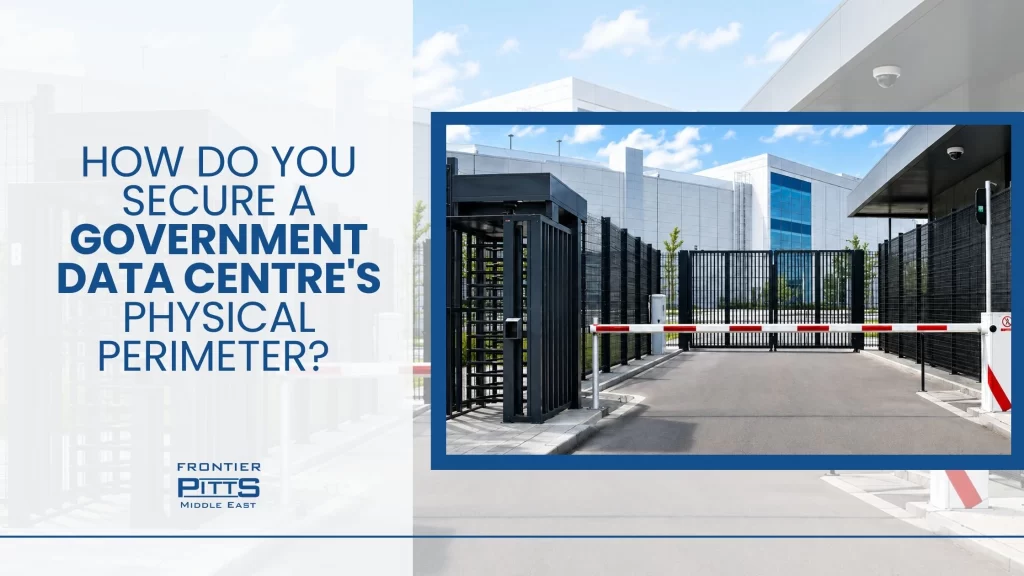
A government-critical data center needs layered, certified physical access control not a single hardened gate. The most effective approach pairs a high-security vehicle gate, a continuous-duty internal barrier, and an anti-tailgating turnstile into one integrated system, commissioned in phases so the live perimeter is never taken offline.
Why a Single Gate Is Never Enough
Ask any security consultant what breaks a perimeter, and the answer is rarely the front gate. It’s the side door nobody hardened, the internal lane nobody audited, or the pedestrian entrance where “just this once” tailgating becomes routine.
We saw this firsthand on a recent project: a government-critical colocation data center in the GCC region, hosting infrastructure for ministries, regulators, and state-adjacent enterprises. The facility runs 24/7/365, with staff, contractors, emergency responders, and government personnel all needing different access rights at different times. A single hardened product wasn’t going to cut it the site needed three coordinated layers.
What we did: designed, supplied, and commissioned an integrated system pairing a fast-acting bi-folding vehicle gate, a 100%-duty-rated internal barrier (FBC6), and a full-height anti-tailgating turnstile (FPT1) all sharing one access control platform and one audit trail.
What “Critical National Infrastructure” Actually Means for Security Design
Data centers serving government tenants aren’t ordinary commercial sites. They process financial transaction records, citizen identity databases, and utilities management systems. A physical breach here isn’t just a hardware loss it can disrupt public services and compromise data sovereignty.
That reality shapes three non-negotiable in the design brief:
- Fail-secure by default. No product can fail open on power loss.
- Zero downtime during installation. The perimeter must stay live and secure throughout construction.
- Unified audit trail. Every access event, across every entry type, needs a timestamped log for compliance reporting.
Mini Example: What to Do If Your Site Can’t Go Offline for Installation
This is one of the most common blockers we hear from facilities teams. The fix isn’t a faster installation, it’s a sequenced one. On this project, each of the three product layers was commissioned separately, with the existing perimeter control kept fully operational at every transition. Nothing was disconnected until its replacement was tested and live.
Mini Example: What to Do If You Have Three Different Threat Profiles at One Perimeter
Don’t force one product to do three jobs. Here, the vehicle gate handled forced-entry and speed of authorized movement, the internal barrier handled high-frequency circulation without mechanical fatigue, and the turnstile handled one-person-at-a-time pedestrian enforcement. Matching the product to the threat, rather than over-specifying a single “do everything” gate, kept both security and daily throughput intact.
Mini Example: What to Do If Your Climate Is the Real Adversary
Gulf heat, dust, and humidity degrade poorly-specified hardware fast. The internal barrier’s octagonal aluminum boom and motor protection were rated specifically for temperature extremes and sand ingress a detail that’s easy to overlook in a spec sheet but shows up in maintenance costs within the first year of operation.
Why Government Data Centers Need a Different Security Standard
The UAE and the wider Middle east are home to some of the fastest-growing digital economies in the world, and government-critical data centers sit at the heart of that growth hosting the infrastructure behind financial systems, citizen services, and utilities management. Facilities like these operate 24/7, serve multiple public-sector tenants, and welcome a constantly rotating mix of staff, contractors, and government personnel through their gates every day.
That combination calls for a security standard built on independently verified performance, not self-declared claims. This is exactly where LPS 1175 comes in.
What Is LPS 1175 Certification?
LPS 1175 is the Loss Prevention Standard for physical attack resistance, administered by the Loss Prevention Certification Board (LPCB). It’s widely regarded as the benchmark for forced-entry resistance in the UK, and it’s increasingly the specification of choice for government agencies and high-security commercial sites across the Gulf.
Rather than relying on a manufacturer’s word, LPS 1175 testing puts a product through a controlled, independently witnessed attack using a defined toolkit — hand tools, power tools, or a combination depending on the rating sought. The result is a security rating (SR) that tells a specifier exactly how long a product can be expected to resist a determined, tool-assisted attempt.
| Security Rating | Typical Attack Duration | Best Suited For |
|---|---|---|
| SR1 | 1 minute | Lower-risk sites, opportunistic entry deterrence |
| SR2 | 3 minutes | Medium-risk commercial and government sites |
| SR3 | 5 minutes | Higher-risk government and critical infrastructure facilities |
| SR4–SR5 | Extended, tool-intensive attack series | Highest-security government and defence applications |
As one of the manufacturers offering LPS 1175-rated gates and turnstiles for the UAE market, we’ve seen specification teams increasingly treat LPS 1175 as a non-negotiable baseline for any government facility handling sensitive data or public infrastructure — much the way EN 12453 has become the baseline for day-to-day operational safety.
Choosing a Security Gates Manufacturer for Government Facilities
Not every security gates manufacturer tests to the same standard, so it’s worth knowing what to look for before a product goes into a specification document:
- Independent certification, not self-declared performance. Ask for the current LPCB certificate number and check it against the LPCB Red Book register.
- Rating matched to risk, not just the highest number available. An SR2 or SR3 rating is often the right specification for a government data centre; SR4–SR5 is typically reserved for defense-grade applications.
- Proven regional experience. A manufacturer with an established track record delivering LPS 1175 and forced-entry-rated systems across the UAE and GCC will understand local climate, civil works, and integration requirements from day one.
- Full-system thinking, not single-product specification. The strongest perimeters treat the gate, barrier, and turnstile as one integrated system with a shared audit trail, rather than three separate purchases.
This is equally true when comparing turnstile manufacturers in the UAE: look for a manufacturer who can show LPS 1175-rated turnstile options for pedestrian access alongside their certified gate range, so every entry point on the perimeter is held to the same verified standard.
The Three-Layer System, Compared
| Layer | Product | Primary Role | Duty Rating | Key Safety Features |
|---|---|---|---|---|
| Outer perimeter | Bi-folding speed gate | Fast-acting primary vehicle access | Continuous-duty automatic operation | Vehicle detector loops, safety photocells, ultrasonic sensors, CCTV/intercom integration |
| Internal vehicle zone | FBC6 automatic barrier | High-frequency internal circulation control | 100% duty rated | Loop detectors, safety photocells, traffic light integration |
| Pedestrian perimeter | FPT1 full-height turnstile | Anti-tailgating pedestrian enforcement | 100% duty rated | Biometric/card integration, one-person-at-a-time physical enforcement, audit logging |
A Pre-Specification Checklist for Multi-Layer CNI Perimeters
Before you finalize a spec for a critical infrastructure site, work through this:
- Have you mapped every entry point by threat type (vehicle, pedestrian, internal circulation) rather than treating the perimeter as one uniform problem?
- Does every product default to a secure/locked state on power loss?
- Can the installed sequence keep your existing perimeter live throughout construction?
- Is every layer feeding one centralized access control and audit system, or will you end up with three disconnected logs?
- Have duty ratings (100% vs standard) been matched to actual usage frequency, not just peak-day estimates?
- Are certifications for each product verified against the manufacturer’s current published spec sheet not assumed from a similar product line?
- Has climate performance (heat, dust, humidity) been specified for your actual site conditions, not generic ratings?
Why Layered Access Control Matters: The Data
Physical access failures carry a measurable cost. IBM’s 2024 Cost of a Data Breach Report puts the global average cost of a data breach at USD 4.88 million, with physical-access vulnerabilities cited as a factor in breach severity and containment time (IBM Security, Cost of a Data Breach Report 2024).
Separately, 2023 industry research on data centre security found that insider threats including tailgating through poorly controlled physical access points — accounted for the majority of breaches by volume. That’s the exact vector a properly enforced, one-person-at-a-time turnstile is built to close.
A Note on Certification Claims
Not every product on a perimeter needs or has the same certification. On this project, LPS 1175 and forced-entry certification requirements were specified for elements of the access control architecture, while duty-rating and continuous-operation standards governed others. We’d rather under-claim than over-claim: if you’re evaluating a similar system, always request the current LPCB certificate number directly from the manufacturer and verify it against the LPCB Red Book register before it goes into a spec document. Certification status can also change between product revisions, so a claim that was accurate two years ago isn’t guaranteed to hold today.
The Result
- One system, not three purchases. Vehicle entry, internal circulation, and pedestrian access now operate under one integrated architecture with a shared audit trail.
- Zero perimeter downtime. The phased installation kept the live site secure throughout, with no gap in coverage.
- Built for daily reality. The 100%-duty-rated barrier supports dozens of movements per shift without mechanical fatigue a detail that matters far more in year two than on handover day.
- Decade-plus design life. British-manufactured equipment with regional maintenance support, specified for Gulf climate conditions.
Next Steps
If you’re specifying physical access control for a critical infrastructure site a data centre, utility, port, or government facility the biggest mistake is treating each entry point as a separate purchase. Start by mapping your site’s actual threat profile across vehicle, pedestrian, and internal access, then build outward from there.
Our team works through this exact process with facilities and security consultants across the UAE, Saudi Arabia, Oman and the wider Middle East. If it would help to talk through your site’s specific constraints, reach out to our engineering team no obligation, just a second set of eyes on the spec.
FAQs
1. What is the best way to secure a data centre’s physical perimeter? The most effective approach layers different products by threat type a certified vehicle gate for the primary entrance, a continuous-duty barrier for internal circulation, and an anti-tailgating turnstile for pedestrians all integrated into one access control system.
2. Can a data centre perimeter be upgraded without taking the facility offline? Yes. It requires sequencing installation in phases, with each new product layer commissioned and tested while the existing perimeter control remains fully operational until handover.
3. What does “100% duty rated” mean for a barrier or turnstile? It means the motor is designed to stay constantly energized for continuous, high-frequency use without mechanical fatigue or performance degradation important for sites with dozens of daily movements.
4. Why does tailgating matter for data centre security? Industry research identifies insider threats, including tailgating through poorly enforced access points, as a leading cause of data centre breaches by volume. Physical one-person-at-a-time enforcement (not just credential checks) closes this gap.
5. What is LPS 1175 certification, and does every gate need it? LPS 1175 is a UK forced-entry resistance standard, independently tested and certified by the LPCB. Not every product on a perimeter requires it the appropriate standard depends on each entry point’s specific threat profile, so always verify current certification status directly with the manufacturer.
6. How is fail-secure different from fail-safe? Fail-secure means a product defaults to a locked/closed state on power loss, prioritising security. Fail-safe defaults to open, prioritising emergency egress. Critical infrastructure perimeters typically mandate fail-secure behaviour for their primary access points.
7. What climate considerations matter for Gulf-region security hardware? Sustained heat, dust ingress, and humidity can degrade motors and electronics faster than in temperate climates. Equipment should be specifically weatherproofed and motor-protected for these conditions, not just generically “outdoor rated.”
8. How long does a multi-layer perimeter installation typically take? Timelines vary by site complexity, but phased installations that avoid taking the perimeter offline generally take longer than a single simultaneous changeover — the trade-off is continuous security throughout, which is non-negotiable for 24/7 critical facilities.
9. What access control integrations should a modern turnstile support? At minimum, card readers, biometric readers, and PIN entry, with the flexibility to support multi-factor authentication and centralised audit logging alongside existing CCTV and alarm systems.
10. How do I verify a manufacturer’s certification claims? Request the current certificate number and cross-check it against the relevant certification body’s public register (for LPS 1175, that’s the LPCB Red Book). Certification can be revision-specific, so confirm it applies to the exact product variant being specified.
Follow Frontier Pitts Middle East on Google
Add fpgulf.com as a Preferred Source to see more of our latest insights on hostile vehicle mitigation, security bollards, road blockers and high-security access solutions in Google Search.