
Shallow Mount Bollards: The Perimeter Nobody Notices
How the Terra Shallow Jupiter Bollard stops 7.2 tonnes at 80kph on 200mm of foundation, and the one figure that decides where it belongs
Ask most people what protects the plaza outside a stadium and they will point at the guards. They will not point at the line of steel posts they walked between on the way in, because they did not register them. That is the whole point.
Perimeter protection has a reputation problem among the people who commission it. The mental image is concrete blocks and chicanes, something that announces a threat every time somebody walks past. Architects resist it, and asset owners often end up buying less protection than the risk assessment asked for.
That tension is a recognised design discipline, not a marketing problem. The UK National Protective Security Authority, which took on the responsibilities of the Centre for the Protection of National Infrastructure, publishes a Public Realm Design Guide for Hostile Vehicle Mitigation on exactly this question of protecting open space without degrading it.
Shallow mount bollards sit at the useful end of that argument. The Terra Shallow Jupiter Bollard is a 1000mm post that stops a 7.2 tonne vehicle at 80kph on 200mm of foundation. People walk between them at Lusail Stadium and Al-Janoub Stadium without thinking about them. Getting that outcome depends on one figure in the classification, and it is the figure most specifications skip.
Anti ram bollards, HVM bollards, crash rated: one product, three names
A vocabulary problem first, because it causes real confusion in tender documents. Anti ram bollards, HVM bollards and crash rated bollards describe the same category of product. They are not three grades of protection. HVM stands for hostile vehicle mitigation, which is the discipline. Anti ram is the older colloquial term, still common in specifications. Crash rated describes what the product has been through, a physical impact test against a defined vehicle at a defined speed.
None of the three tells you anything useful on its own. A specification asking for anti ram bollards without naming a standard, a vehicle mass and a speed has not specified anything. What makes a bollard a genuine HVM product is the classification behind it, and that is verifiable. The Loss Prevention Certification Board, part of BRE Group, lists certified security products in its Red Book register, and the Protective Security Suppliers Association runs a separate verification scheme. Both let a specifier check a claim rather than accept it.
The product in figures
Test standard: IWA 14
Classification: V Static /7200[N2A]/80/90:8.7
Rated vehicle and speed: 7.2 tonnes at 80kph, 90 degree impact
Penetration: 8.7 metres
Embedment: 200mm, Foundation Type B
Height above ground: 1000mm
Diameter: 273mm
Spacing: 1200mm between upright bollard faces
Core material: S355 structural steel
Finish: Shotblasted, hot zinc sprayed, primed, polyurethane topcoat. Stainless or powder coated sleeves optional
Accreditation: Secured by Design, BRE Global
Two of those figures matter more than the rest, and they pull in opposite directions. The 200mm embedment is what makes this product possible where a deep foundation is not. The 8.7 metres of penetration is what determines whether it belongs there.
The figure that decides placement
Penetration is measured from the pre impact position of the barrier line to the final resting position of the leading edge of the vehicle payload. It is not a measure of failure. The bollard stopped the vehicle. The figure describes how far the vehicle travelled while being stopped.
Shallow mount bollards generally record larger penetration distances than deep foundation equivalents. A shallower foundation gives the post less leverage against the ground, so the system absorbs the same energy through deformation and controlled movement rather than rigid resistance alone. You are trading depth for deflection.
For a specifier that converts into one check. Measure from the proposed barrier line to the nearest thing being protected. If the asset, the queue, the seating, the glazing or the occupied building sits more than 8.7 metres behind the line, this product does what you need. If it sits closer, the vehicle reaches it even though the bollard performed exactly as certified.
Establishing the speed a vehicle could actually reach at that point is its own discipline. The National Protective Security Authority publishes due diligence guidance on vehicle dynamics assessment, which is the structured method for working out approach speeds and angles across a real site rather than assuming them. On a significant scheme that assessment should come before the product selection, not after it.
On a perimeter with real standoff, a stadium concourse edge or a plaza threshold with open ground behind it, 8.7 metres is comfortably absorbed. At a pinch point against a building line, a doorway or a seating terrace, the figure may rule the product out regardless of how convenient the foundation depth is. Note also that this is a static product. Vehicle access points need operable equipment, designed as part of the same line rather than added afterwards.
Why 200mm makes the scheme possible
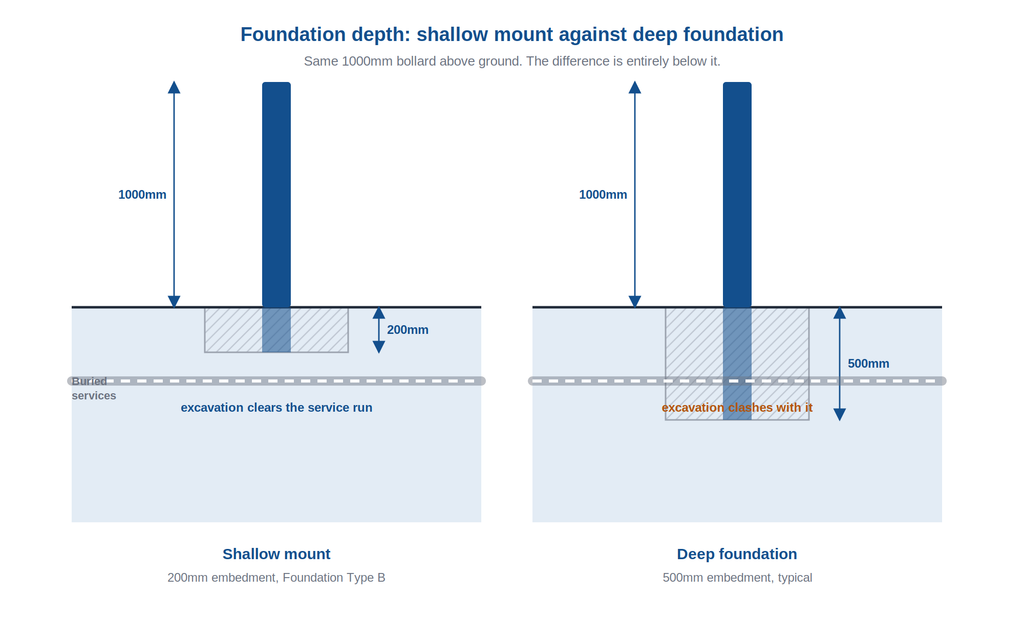
A conventional deep foundation bollard needs an excavation around half a metre deep, plus the working room to form and pour it. On a greenfield site that is a line item. On an existing site it is often the reason the scheme does not happen at all.
City centre plazas, transport interchanges and mature campuses sit on top of power, water, drainage, telecoms and district cooling, and record drawings are often incomplete. A 500mm excavation across a 40 metre frontage becomes a sequence of trial holes, diversions and redesigns. A 200mm embedment stays above most service runs, and where it does not, the clash is shallower and faster to resolve.
The same logic applies to finished surfaces that are hard to reinstate invisibly, to coastal and reclaimed sites where excavating half a metre means dewatering, and to any asset that has to keep operating while the perimeter goes in. In that last case the constraint is not cost, it is the closure window. Less excavation and a shorter cure mean the work can fit into overnight or off season possessions that a deep foundation scheme cannot.
Frontier Pitts Middle East states that this shallow foundation design uses around 25 percent less concrete than a standard installation. On a constrained urban site where concrete logistics dictate the programme, that is a scheduling benefit before it is a cost one.
Bollard spacing, and why people do not notice it
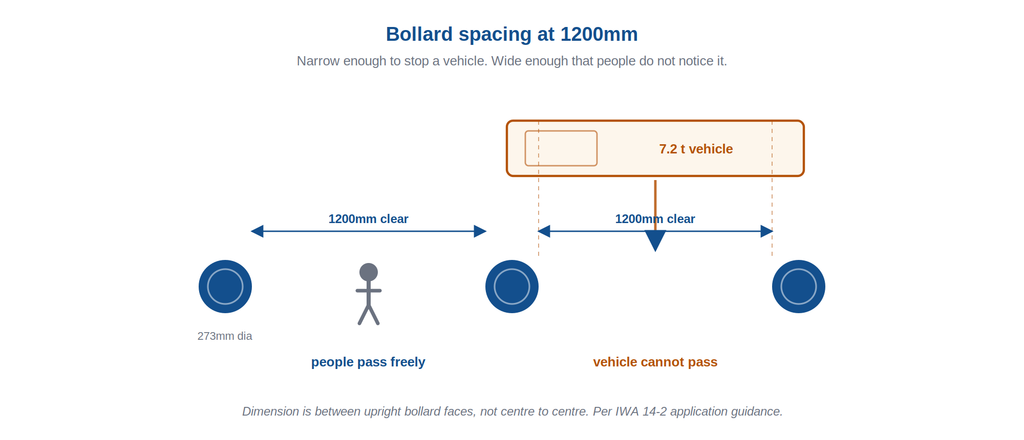
Bollard spacing is specified at 1200mm between upright bollard faces, in line with IWA 14-2 application guidance. It is narrow enough to prevent a vehicle passing between two posts and wide enough to let people through without thinking about it.
A wheelchair, a mobility scooter, a double pushchair, a stretcher and a crowd moving at density all pass through a 1200mm gap. That is the difference between a perimeter and a barrier. A perimeter filters vehicles and ignores people. A barrier filters people, and people notice being filtered.
One bollard spacing decision deserves to be made deliberately rather than by default. At a venue the governing case is not entry but emergency egress, so a line crossing an egress route should be coordinated with the fire strategy and the crowd modelling rather than set out from the security drawing alone.
IWA 14 bollards and the ISO 22343 transition
IWA 14 bollards are products tested and classified under IWA 14-1, with IWA 14-2 providing the application guidance covering spacing and layout. It is the international test regime most commonly seen alongside the British specification across the Gulf.
One point of housekeeping that matters for any document being written now. ISO 22343-1:2023, published by the International Organization for Standardization, has superseded IWA 14-1, with ISO 22343-2 taking on the application guidance. PAS 68, the British publicly available specification developed with BSI, remains in parallel use across the region. Products tested and classified under IWA 14 keep their classification. Certification does not expire because a standard was renumbered.
The practical consequence is for specification writers. If you are drafting in 2026 for a project completing in 2029, reference both regimes and make sure the vendor documentation states which one a given test was run under. Naming only the superseded standard invites a compliance argument at handover that nobody needs.
Do shallow mount bollards offer less protection than deep foundation bollards?
Not in terms of the vehicle they stop. The Terra Shallow Jupiter Bollard is classified to stop 7.2 tonnes at 80kph. The difference is penetration distance. This product records 8.7 metres, where a deep foundation equivalent typically records less.
How deep does a shallow mount bollard foundation need to be?
This product needs 200mm embedment to Foundation Type B. A conventional deep foundation crash rated bollard typically needs 500mm or more.
What is the correct bollard spacing for vehicle protection?
1200mm between upright bollard faces, in line with IWA 14-2 application guidance. That prevents vehicle passage while allowing wheelchairs, pushchairs, stretchers and dense pedestrian flow through.
Are IWA 14 bollards still valid now that ISO 22343-1:2023 exists?
Yes. ISO 22343-1:2023 supersedes IWA 14-1 as the international standard and products classified under IWA 14 retain their classification. For new specifications it is sensible to reference both and to confirm which regime a given test was conducted under.
The measure of a good perimeter
A perimeter has done its job twice over when it stops the vehicle it was designed to stop and, on every other day of its life, nobody using the space gives it a second thought. The foundation depth is what makes that buildable. The 8.7 metres is what makes it correct or incorrect for a given location. Check the second before committing to the first.
Frontier Pitts Middle East supplies, designs, installs and maintains crash rated perimeter systems across the UAE and the wider Gulf. For specification support on a live project, contact sales@frontierpitts.ae.
References and further reading
National Protective Security Authority, Hostile Vehicle Mitigation specialised guidance. The UK government authority for protective security, which took on the responsibilities of the Centre for the Protection of National Infrastructure. Publishes the Public Realm Design Guide for Hostile Vehicle Mitigation and due diligence guidance on vehicle dynamics assessment. npsa.gov.uk
ISO 22343-1:2023, Security and resilience, Vehicle security barriers, Part 1: Performance requirement and test method. The international standard that supersedes IWA 14-1:2013. iso.org
IWA 14-1:2013 and IWA 14-2:2013, Vehicle security barriers. The International Workshop Agreement under which this product is tested and classified, with Part 2 covering application, layout and spacing.
PAS 68, Impact test specifications for vehicle security barriers, developed with BSI. The British specification used in parallel across the Gulf.
Loss Prevention Certification Board, part of BRE Group. Third party certification of security products, listed publicly in the LPCB Red Book. redbooklive.com
Protective Security Suppliers Association. Industry body operating a verification scheme for perimeter security products. pssasecurity.org
Follow Frontier Pitts Middle East on Google
Add fpgulf.com as a Preferred Source to see more of our latest insights on hostile vehicle mitigation, security bollards, road blockers and high-security access solutions in Google Search.