
Automatic Gate Safety Requirements UAE
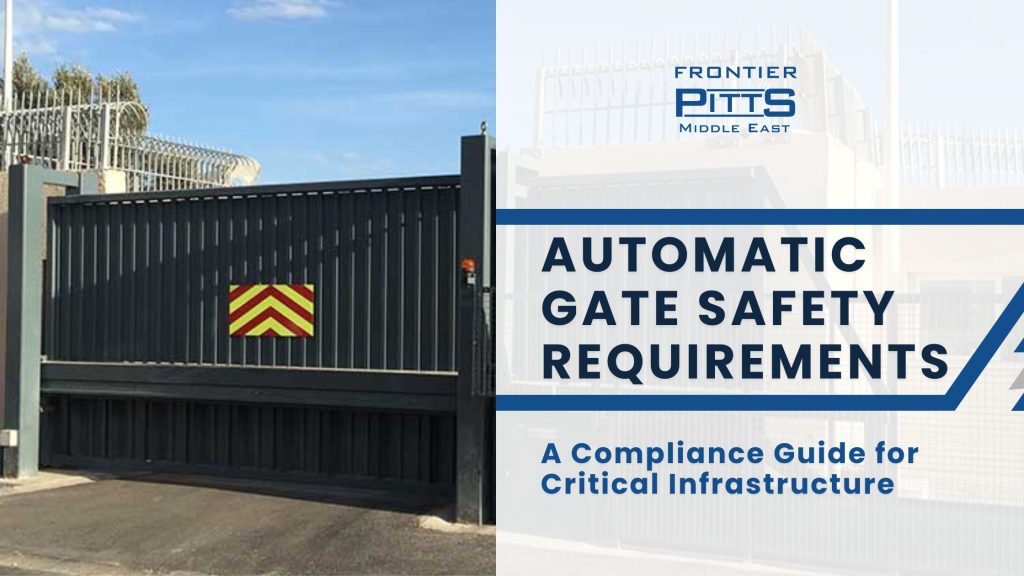
Quick Expert Answer: Automatic gates at high-security UAE facilities must undergo documented risk assessments, force limitation testing per EN 12453 and BS 7906 standards, and integration with hostile vehicle mitigation systems. We engineer solutions with presence detection, emergency fail-safe controls, and where threats demand it crash-rated gates tested to IWA 14 specifications. Proper design prevents operational disruption, liability exposure, and safety incidents at airports, government buildings, and critical infrastructure sites.
We’ve seen it happen too many times.
A sliding gate closes on a delivery truck at a Dubai logistics hub. Operations halt for days. Extensive vehicle damage. The culprit? Not the gate itself but the absence of calibrated force testing and proper detection systems.
At Frontier Pitts Middle East, we work with facility managers and security consultants across Abu Dhabi and Dubai who oversee some of the region’s most sensitive sites. And we’ve learned this: automatic gate safety isn’t just a compliance checkbox. It’s strategic risk management.
When gates protect airports, oil terminals, government complexes, and military installations, failure creates cascading problems injuries, operational downtime, compromised perimeter security, and legal liability.
This guide explains what you need to engineer safety correctly, why international standards matter, and how automatic gates integrate with broader hostile vehicle mitigation strategies.
Why UAE Critical Infrastructure Demands Rigorous Gate Safety
In high-security environments, gates do more than control access. They’re engineered barriers within layered defense systems that include crash-rated road blockers, rising bollards, and hostile vehicle mitigation solutions.
When safety protocols fail, consequences multiply:
- Staff or contractor injuries from crushing hazards
- Damage to emergency vehicles during critical response
- Operational disruption lasting days
- Compromised perimeter security posture
- Liability claims and regulatory scrutiny
Consider what happened at an Abu Dhabi government facility we consulted on: periodic testing revealed motor force drift caused by component wear. Recalibration prevented what could have been a serious entrapment incident. The gate functioned—but not safely.
That distinction matters.
Core Safety Requirements for Automatic Gates in the UAE
1. Industrial Gate Risk Assessment (Non-Negotiable First Step)
Every installation new or upgraded requires a structured hazard analysis documented according to recognized frameworks.
Your assessment must identify:
- Crushing, shearing, and drawing-in hazards
- Pedestrian and vehicle interaction zones
- Emergency access and evacuation routes
- Environmental stressors (extreme heat, sand infiltration, wind loads)
Critical insight for facility upgrades: Visual inspections won’t cut it. We’ve audited gates installed a decade ago under outdated frameworks. Formal hazard reviews with documentation protect you legally and operationally.
2. Force Limitation and Obstruction Testing (EN 12453 & BS 7906 Compliance)
While the UAE doesn’t enforce a single local code, we design our automatic gates to meet EN 12453 (European powered gate safety standard) and BS 7906 (British standard for powered sliding gates).
Force testing ensures:
- Closing pressure stays within safe thresholds for personnel areas
- Obstruction detection triggers immediate stoppage
- Motor torque calibration matches design specifications
- Normal operating speed adjusted per risk assessment requirements
Real-world example: During commissioning at an oil terminal, we discovered manufacturer default settings exceeded safe force limits significantly. Reprogramming prevented potential vehicle damage and injury.
Our security gates and automated systems are designed for continuous duty cycle operation with programmable logic controllers (PLCs) featuring built-in safety functions.
3. Presence Detection Systems (Layered Protection)
Single-point detection fails in complex traffic environments. Reliable systems use multiple technologies:
- Vehicle detector loops embedded in roadway for fail-safe presence confirmation
- Infrared photocells (typically two pairs minimum) for beam interruption detection
- Safety edges on gate leading edges—flexible rubber strips that stop movement when compressed
- Ultrasonic sensors as alternative detection in harsh environments
Facility managers ask us: “Can’t we just add photocells?”
Not for heavy vehicle routes. Loop detection provides fail-safe vehicle presence confirmation that photocells alone cannot deliver. For pedestrian zones, we often specify light curtains for additional coverage.
4. Emergency and Fail-Safe Controls
Our automatic gates behave predictably during power failures, system faults, and emergency evacuations.
Essential safety provisions we engineer:
- Manual disengaging lever arm for emergency override
- UPS backup systems for continued operation during power interruptions
- Emergency stop controls (accessible, clearly marked)
- Redundant safety relays preventing single-point failure
- Wide operating temperature range for desert environments
- Advance drive mechanisms with acceleration and deceleration control
Field example: During a grid fluctuation at a logistics facility, a properly configured fail-secure system kept the perimeter closed while allowing controlled override by security personnel. Uninterrupted security posture—zero panic.
5. Integration with Hostile Vehicle Mitigation Systems
High-security sites layer automatic gates with crash-rated barriers, rising bollards, and road blockers. We manufacture products across the security spectrum—from everyday security gates to crash-rated gates tested to IWA 14 specifications.
Our crash-rated gate portfolio includes:
- Terra G8 Sliding Cantilevered Gate – IWA 14-1 rated for hostile vehicle mitigation, securing wide entrances
- Terra Ultimate 180° Hinged Gate – Crash-rated protection for high-threat environments
- Terra V Gate – Compact crash-rated solution for constrained sites
- Terra Bi-fold Gate – Dual certified IWA 14 and LPS 1175 for combined vehicle and forced entry resistance
Integration requires careful sequencing logic:
- Gate opens only after blocker retracts fully
- Anti-tailgating systems prevent unauthorized follow-through
- PLC interlocks prevent simultaneous conflicting commands
What we’ve seen go wrong: At one Middle East installation, simultaneous movement between a hydraulic blocker and sliding gate created dangerous mechanical stress. Revised PLC sequencing eliminated the risk entirely.
Understanding Gate Security Standards: What They Mean
| Standard | What It Tests | Application |
|---|---|---|
| EN 12453 | Force limitation, obstruction detection, operational safety | All automatic gates (mandatory safety baseline) |
| BS 7906 | Powered sliding gate safety requirements | Sliding and cantilevered gate systems |
| IWA 14-1 | Vehicle impact resistance (crash rating) | High-threat environments requiring hostile vehicle mitigation |
| LPS 1175 | Forced entry resistance (manual attack) | Sites requiring protection against determined intruders |
For ultimate protection, our Terra Bi-fold Gate achieves both IWA 14 crash rating and LPS 1175 forced entry resistance—addressing vehicular and manual threat vectors simultaneously.
Step-by-Step: Conducting Your Industrial Gate Risk Assessment
- Perform comprehensive site survey – Map traffic patterns, pinch points, blind spots
- Identify vehicle and pedestrian flows – Peak times, emergency routes, maintenance access
- Map all hazard zones – Crushing points, shearing edges, drawing-in risks
- Test force limitation values – Measure actual closing force with calibrated equipment
- Verify detection coverage – Test loop response, photocell alignment, sensor sensitivity
- Review emergency procedures – Manual override training, evacuation protocols
- Document all findings – Compliance audit trail, maintenance baseline
- Schedule routine re-testing – Quarterly checks for high-use gates, annual for moderate use
Automatic Gate Safety Compliance Checklist
Use this for internal audits or consultant briefings:
☑ Risk assessment documented with hazard mapping
☑ Force testing performed per EN 12453 / BS 7906
☑ Presence detection installed (loops + photocells minimum)
☑ Safety edges installed on moving gate sections
☑ Emergency stop controls accessible and labeled
☑ Backup power tested under load conditions
☑ Integration with vehicle mitigation systems validated
☑ Manual override mechanisms functional
☑ Maintenance schedule active with logging system
☑ Traffic lights and warning beacons operational
When Standard Gates Aren’t Enough: Choosing Crash-Rated Solutions
| Feature | Security Gates | Crash-Rated Gates (IWA 14) |
|---|---|---|
| Primary Role | Access control, high-frequency traffic | Vehicle stopping power + access control |
| Safety Standards | EN 12453, BS 7906 | EN 12453, BS 7906, IWA 14-1 |
| Crash Rating | None (not impact-tested) | IWA 14-1 certified for hostile vehicle impact |
| Foundation Depth | Standard | Shallow foundation options available |
| Testing Authority | CE marked | MIRA tested, PSSA verified |
| Best For | Corporate campuses, logistics hubs | Government facilities, embassies, military bases, airports |
When to specify crash-rated gates:
- Sites identified in national critical infrastructure inventories
- Facilities with elevated threat assessments
- Government, diplomatic, or military installations
- Airports and seaports requiring airside/waterside protection
- Oil & gas facilities in high-risk regions
View our complete range: Crash-Rated Gates | Security Gates | Bullet Resistant Gates
Common Compliance Mistakes We See in Abu Dhabi and Dubai
- No formal risk assessment – Relying on manufacturer guidelines alone
- Poor photocell placement – Mounting height creates blind spots
- Missing loop detection – Photocells can’t detect stationary vehicles
- Undocumented maintenance – No audit trail for liability defense
- Incorrect gate-blocker sequencing – Creates dangerous timing conflicts
- Non-certified control boards – Lack proper safety relay architecture
- Ignoring environmental factors – Sand infiltration and extreme heat degrade safety systems
One Dubai facility assumed manufacturer defaults were compliant. They weren’t. Force reprogramming reduced closure pressure significantly to meet safety standards.
Sector-Specific Considerations
Airports: Require strict obstruction detection and integration with airside vehicle control systems. Our gates interface with any access control system and support emergency evacuation protocols.
Oil & Gas: May require ATEX-rated explosion-proof components and robust fail-safe behavior in hazardous zones. Our systems accommodate desert environments with wide operating temperature ranges.
Government & Military: Integrate crash-rated gates with HVM barriers and road blockers in layered defense strategies.
Utilities: Must maintain safe function during unstable power conditions—our backup systems and manual overrides are non-negotiable.
Our Manufacturing Standards: British Engineering for Middle East Conditions
Frontier Pitts Middle East delivers British-manufactured security solutions engineered specifically for UAE operating conditions:
- Construction: Fully welded heavy gauge steel with specialized impact beams
- Finish: Shot blasted, hot zinc sprayed (galvanized), primed, and polyurethane topcoat
- Accreditations: MIRA tested, Secured by Design, BRE Global, PSSA Verified
- In-house quality control throughout manufacturing
- Local support with Abu Dhabi headquarters and Dubai service coverage
Essential Accessories for Complete Safety Compliance
Traffic Management:
- LED traffic lights (Red/Green indicators)
- Warning signage (‘STOP’, ‘NO EXIT’, ‘NO ENTRY’)
- Flashing beacons for visual alerts
- Audible alarms/sounders
Detection & Safety:
- Vehicle detector loops (beneath road surface)
- Safety photocells (minimum two pairs)
- Safety edges (leading edge protection)
- Pedestrian guard rails around runback areas
Gate Infill Options:
- Bar infill for visibility
- Anti-climb weldmesh
- Solid sheet infill for privacy
- Square mesh options
- Custom specifications available
Final Thought: Safety is Strategic
Automatic gate safety in the UAE isn’t a facilities issue—it’s risk management that touches operations, liability, and security posture.
When engineered correctly and integrated with crash-rated barriers, automatic gates strengthen both security and safety. When poorly designed, they become vulnerability points.
The difference? Engineering rigor, documentation discipline, and maintenance commitment.
At Frontier Pitts Middle East, we’ve built our reputation on that difference. Whether you’re upgrading legacy systems or designing new critical infrastructure, we engineer safety into your perimeter—not assume it.
Our product range spans:
- Security Gates – Automated access control with full safety compliance
- Crash-Rated Gates – IWA 14 tested hostile vehicle mitigation
- Bullet Resistant Gates – Ballistic protection for ultra-high-threat environments
Ready to audit your current systems or discuss a new project? Contact our Abu Dhabi headquarters or explore our complete gate portfolio: https://fpgulf.com/products-category/gate-manufacturers/