
Bollard Spacing Guidelines in the UAE: Balancing Security and Emergency Access
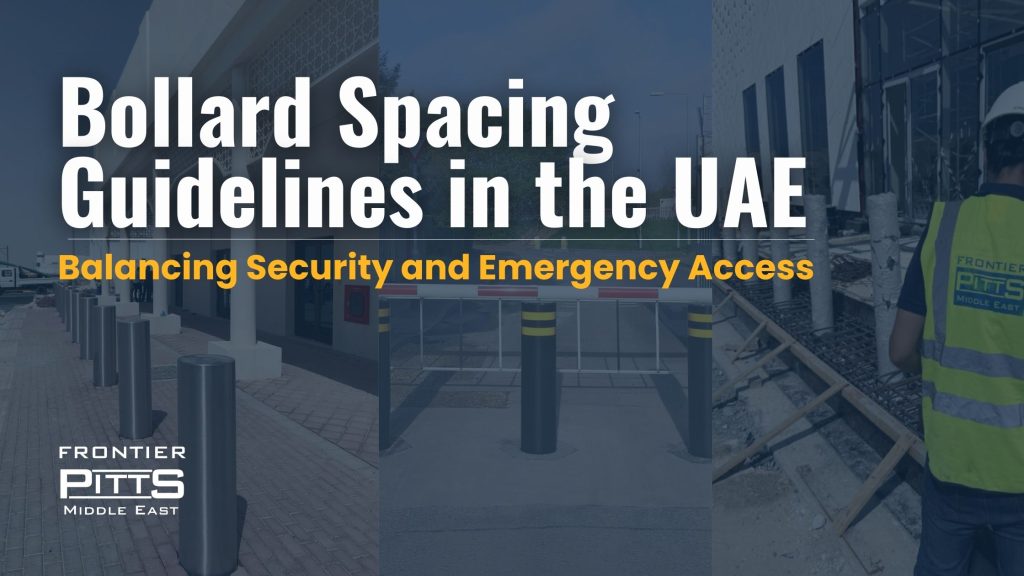
In the UAE, bollards must be spaced 0.9–1.5 metres apart, with spacing determined by site risk level, foundation depth, and the required IWA 14-1:2013 or PAS 68 crash rating. High-security barrier zones around airports and government compounds require ≤0.9 m gaps; public pedestrian areas allow 1.2–1.5 m; emergency vehicle lanes need ≥3.7 m of clear width, typically served by automatic or removable bollards. Shallow bollard systems classified under IWA 14 Foundation Classification B (depth <0.5 m) are the appropriate solution when underground utilities or heritage paving prevents full-depth installation. All UAE bollard installations should align with IWA 14-1:2013, PAS 68, SIRA approval requirements, and relevant UAE municipality accessibility guidelines.
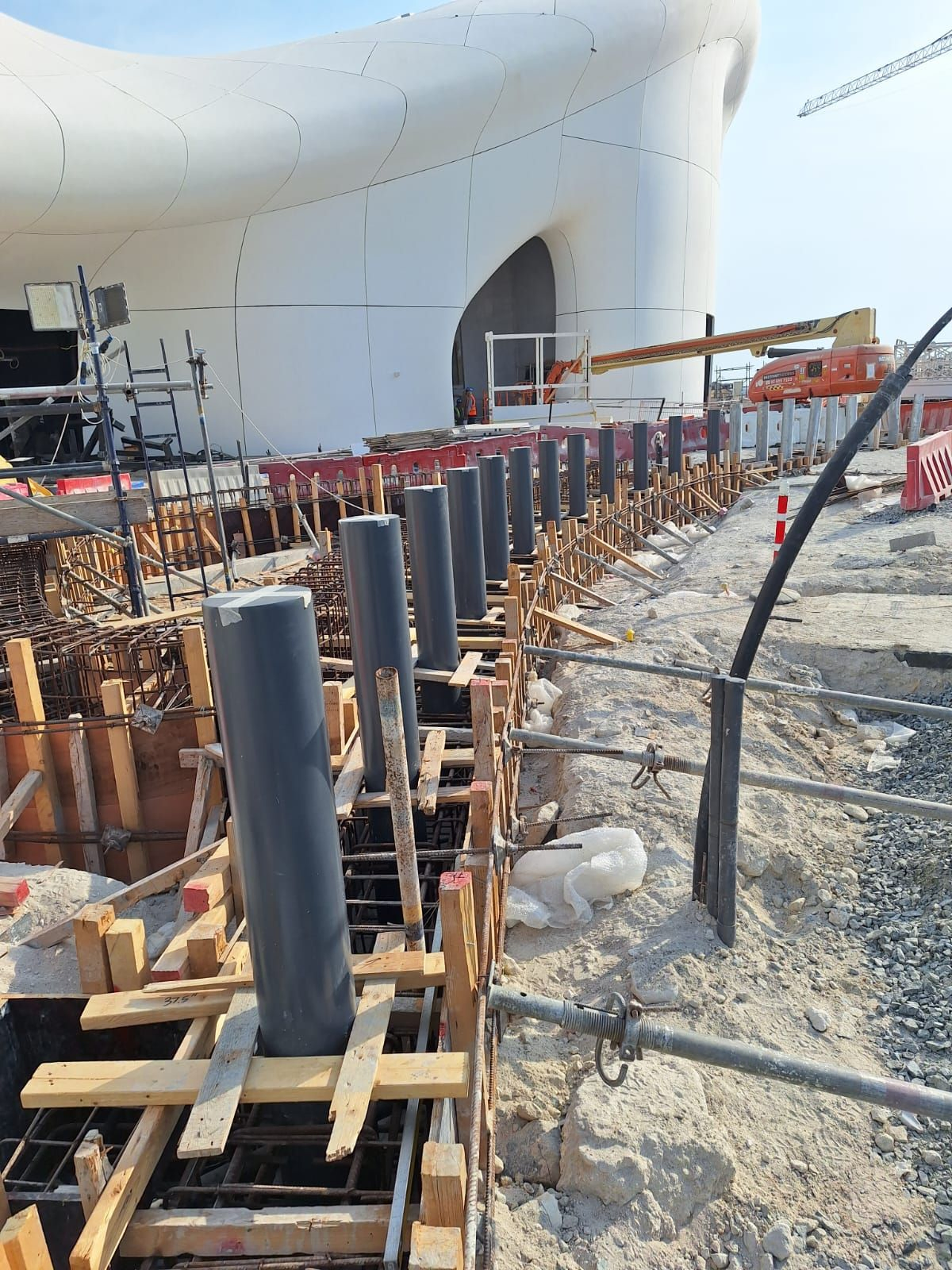
Why Bollard Spacing Is a Certified Engineering Decision
Selecting a gap between bollards is not a site-planning preference it is a certified engineering parameter governed by international impact test standards, UAE municipal codes, and accessibility obligations. Get it wrong in either direction and you face real consequences: frustrated daily users, regulatory non-compliance, or in the worst case a vehicle penetrating a perimeter that looked secure on paper.
For facility managers, civil engineers, and government procurement teams across Abu Dhabi, Dubai, and the wider GCC, the spacing decision sits at the intersection of three disciplines: hostile vehicle mitigation (HVM), universal accessibility, and operational continuity. This guide aligns every recommendation to the certifications and product range that Frontier Pitts Middle East supplies and installs across the region.
Governing Standards & Certifications
| Primary Standard IWA 14-1:2013 Vehicle Security Barriers Performance Requirements & Impact Test Method | UK/Int’l Crash Rating PAS 68 Impact Test Specification for Vehicle Security Barriers | UAE Regulatory SIRA Approval Security Industry Regulatory Agency, Abu Dhabi |
| Quality System ISO 9001 Quality Management manufacturing & installation processes | Attack Resistance LPS 1175 Intruder Resistance (Turnstiles SR2–SR4; applied to pedestrian control) | Accessibility UAE Municipality Codes Universal access aligned to ADA spacing principles |
About IWA 14-1:2013: This International Workshop Agreement specifies the essential impact performance requirement for a Vehicle Security Barrier (VSB) and the test method for rating its performance when subjected to a single impact by a test vehicle. It is the primary certification framework applied to the Frontier Pitts Terra Range including Terra Bollards, Terra Barriers, Terra Road Blockers, and the Terra G8 crash-rated gate across UAE deployments.
IWA 14 Foundation Classifications: What They Mean for Bollard Depth
One of the most consequential and least discussed elements of UAE bollard selection is foundation depth classification. Under IWA 14-1:2013, the foundation system of every vehicle security barrier is categorised as follows:
| A Freestanding No ground fixing. Ballasted or weighted surface deployment only. | Ap Surface-Mounted + Pinned Bolted or pinned to the surface, but not embedded below ground level. | B Shallow Foundation Depth <0.5 m below ground level. Applies to shallow bollard installations in constrained sites. | C Standard Foundation Depth >0.5 m below ground level. The most common classification for rated bollard installations. |
Understanding this classification is critical because foundation type directly affects achievable crash rating. A bollard installed to Classification C can achieve a higher impact rating than the same unit installed to Classification B. Always confirm the required impact rating before specifying a shallow bollard for a high-risk application.
Shallow Bollard Systems in the UAE: When & Why
What Is a Shallow Bollard?
A shallow bollard is a vehicle security barrier installed at a foundation depth of less than 0.5 metres below ground level (IWA 14 Classification B), or surface-mounted and pinned (Classification Ap). It is the correct specification when full-depth excavation is impractical or impossible.
Heritage Sites
Urban Retrofits
PavedPlazas
High-Utility Density Zones
Coastal Walkways
Abu Dhabi & Dubai Streetscapes
When to Specify a Shallow Bollard
- Underground utilities (telecoms, drainage, district cooling) prevent deep excavation
- Rock substrata or compacted aggregate at <500 mm depth
- Existing high-quality paving that must be preserved (granite, marble, heritage stone)
- Temporary or semi-permanent perimeter deployments requiring later removal
- UAE coastal locations where salt-water table complicates deep foundation waterproofing
Always confirm the achievable IWA 14-1:2013 impact rating for your chosen shallow bollard model and foundation depth before finalising specifications. A structural engineer not just an installer must sign off on shallow foundation designs in the UAE.
Think of it like designing a shopping mall entrance you want crowds moving freely, but you don’t want a car rolling straight inside.
Spacing Rules Apply Equally to Shallow Bollards
Foundation depth does not alter the spacing requirement. A shallow bollard installation in a vehicle exclusion zone must still maintain ≤1.2 m spacing (≤0.9 m in high-risk sites) to prevent intrusion. The gap between posts is determined by the threat scenario; the foundation classification is determined by ground conditions. These are independent variables.
Bollard Spacing by Zone Type: UAE Standards
The following recommendations reflect current practice for UAE bollard installations, aligned to IWA 14-1:2013 requirements, UAE municipality guidance, and Frontier Pitts Middle East project experience across Abu Dhabi, Dubai, and the GCC.
1. High-Security Barrier Zones
Government compounds, embassies, military installations, data centres, airports, and critical national infrastructure require the tightest spacing and the highest crash ratings. These sites integrate bollards into a layered high-security barrier system — typically combining IWA 14-rated bollards with crash-rated gates, HVM road blockers, and perimeter fencing. Bollard gaps must be coordinated with adjacent barrier elements to ensure there are no vehicle-passable openings anywhere along the perimeter line.
≤0.9 m between bollard centres. IWA 14-1:2013 or PAS 68 certification mandatory. Pair with Terra Barriers and Terra Road Blockers for a continuous rated perimeter.
2. Standard Vehicle Control & Commercial Perimeters
Shopping centres, office campuses, logistics parks, and car parks where vehicle deterrence is required but access control is also a priority. Automatic bollards or removable bollards are typical here, allowing managed access during operating hours and full closure during off-hours.
≤1.2 m between bollard centres. IWA 14 or PAS 68 rated. Automatic bollards recommended for operational flexibility.
3. Pedestrian Zones & Public Realm
Public plazas, waterfront promenades, souks, and pedestrian streets where the primary purpose is separating foot traffic from vehicle zones. Spacing is wider to allow free movement without creating congestion or accessibility barriers.
1.2–1.5 m between bollard centres. Static or decorative bollards acceptable. Minimum 0.9 m clear gap for wheelchair and mobility aid access.
4. Emergency Vehicle Access Lanes
Every perimeter plan must account for fire brigade, ambulance, and civil defence vehicle access. This is a UAE Civil Defence requirement, not merely a best practice. A “security-first” layout that blocks emergency responders creates a different category of life-safety risk.
≥3.7 m (12 ft) clear lane width. Use automatic or removable bollards at emergency access points, programmed to retract on authorised emergency signal or key override.
5. Logistics & Warehouse Loading Docks
UAE logistics and free zone operators must balance vehicle throughput with perimeter security. Wide truck bays need to remain fully operational while adjacent pedestrian walkways maintain appropriate bollard spacing.
3.5–4 m clear width for truck bays. 1.2–1.5 m spacing for adjacent pedestrian walkways. Removable bollards recommended where bay configuration changes seasonally.
UAE Bollard Spacing: Master Reference Table
| Zone / Application | Spacing | Bollard Type | Standard | Foundation Class |
|---|---|---|---|---|
| High-security barriers critical infrastructure | ≤ 0.9 m | Static or Automatic | IWA 14 / PAS 68 | C (preferred) |
| Standard vehicle control commercial perimeter | ≤ 1.2 m | Automatic / Static | IWA 14 / PAS 68 | B or C |
| Pedestrian zone public realm | 1.2 – 1.5 m | Static / Decorative | Municipal code | B, Ap, or C |
| Wheelchair & accessibility compliance | ≥ 0.9 m clear | Any | UAE Accessibility / ADA-aligned | As specified |
| Emergency vehicle access lane | ≥ 3.7 m clear lane | Automatic / Removable | UAE Civil Defence | C (retractable) |
| Warehouse loading dock truck bay | 3.5 – 4 m clear | Removable / Automatic | Operational + IWA 14 | B or C |
| Warehouse loading dock pedestrian walkway | 1.2 – 1.5 m | Static / Removable | IWA 14 / municipal | B or C |
| Shallow bollard constrained foundation (retrofit) | Same as zone above | Any (depth < 0.5 m) | IWA 14 Class B / Ap | B or Ap |
Sources: IWA 14-1:2013; PAS 68; UAE Civil Defence guidelines; Frontier Pitts Middle East project specifications. Last updated May 2025.
Frontier Pitts Middle East: UAE Bollard Product Range
All products below are supplied and installed by Frontier Pitts Middle East LLC (Abu Dhabi) and manufactured to IWA 14-1:2013 and/or PAS 68 certification standards as part of the Frontier Pitts Terra Range.
| Product Type | Best For | Key Advantage | Crash Rating |
|---|---|---|---|
| Static Bollards | Permanent perimeter control; highest security priority | Most cost-effective HVM solution; reliable, zero-maintenance actuation | IWA 14 / PAS 68 |
| Automatic (Hydraulic) Bollards | Controlled access zones; logistics gates; government compounds | Retract on authorisation; emergency retraction capability; seamless integration with access control | IWA 14 / PAS 68 |
| Removable Bollards | Temporary exclusion; seasonal events; flexible dock layouts | No permanent foundation required; repositionable; low capital cost | Site-dependent |
| Bollard Sleeves | Heritage or aesthetic-sensitive sites | Decorative outer sleeve over a rated inner core; aesthetics without compromising crash resistance | As rated core |
| Shallow Bollard Systems | Urban retrofit; utility-dense sites; paved plazas | IWA 14 Class B / Ap compliant; suitable where excavation is constrained | IWA 14 Class B / Ap |
How to Specify the Right UAE Bollard Spacing: 6-Step Process
- Classify site risk level. Critical infrastructure (airports, embassies, utilities) → ≤0.9 m; Commercial → ≤1.2 m; Public realm → 1.2–1.5 m. Risk classification determines your maximum permissible gap.
- Determine the required IWA 14 or PAS 68 crash rating. The threat vehicle type (motorbike, car, 7.5t truck) and approach speed define the minimum certification level. Higher impact ratings may require closer spacing and deeper foundations.
- Survey ground conditions. Identify soil type, water table, and underground utilities. If excavation depth is limited to <0.5 m, specify a shallow bollard under IWA 14 Foundation Classification B.
- Map zone types across the site. Apply appropriate spacing to each zone: vehicle exclusion, pedestrian flow, emergency access, and loading dock areas. Never apply a single spacing value across a mixed-use perimeter.
- Select bollard type per zone. Static for permanent control; automatic for managed access; removable for temporary or flexible configurations. Shallow bollard where depth is constrained.
- Integrate with the wider high-security barrier system. Bollards rarely stand alone. Coordinate spacing and height with adjacent HVM barriers, crash-rated gates, and road blockers to eliminate gaps and achieve a continuous, rated perimeter line.
Engineering & Environmental Considerations for UAE Sites
Soil Conditions
Sandy substrata across much of Abu Dhabi and the wider UAE can reduce the effective load-bearing capacity of bollard foundations. Sites with low soil bearing capacity may require reinforced base plates, wider pile caps, or closer bollard spacing to achieve the same effective barrier performance as installations in denser soil. This is a structural engineering question, not an installation preference.
Underground Utilities & the Case for Shallow Bollards
UAE urban sites, particularly within Abu Dhabi, Dubai, and free zone developments are dense with buried infrastructure: district cooling pipes, telecoms conduits, power cables, and drainage systems. When full-depth excavation risks damaging these assets, a shallow bollard classified under IWA 14 Foundation Classification B or Ap is the correct engineering response. Surface-mounted and resin-anchored systems can achieve meaningful impact resistance while avoiding utility conflict, though the achieved crash rating must be independently verified for the specific anchoring system and ground condition.
Coastal Corrosion
UAE coastal installations — Abu Dhabi Corniche, Dubai Marina, Ras Al Khaimah seafront — face accelerated corrosion from salt air and high humidity. Frontier Pitts Middle East recommends marine-grade stainless steel, hot-dip galvanised, or powder-coated bollard finishes for all coastal sites. This applies equally to shallow bollard anchor hardware, which is particularly vulnerable to moisture ingress at the surface-to-substrate interface.
Integration with High-Security Barrier Systems
Bollard spacing cannot be planned in isolation where the bollard line meets other barrier elements. Every junction between a bollard run and a HVM barrier, crash-rated gate, or road blocker must be modelled and certified as a system — not as independent components. A vehicle can exploit a gap at a gate post even if the bollard spacing itself is compliant. Frontier Pitts Middle East designs and certifies complete perimeter systems, not individual units.
Frequently Asked Questions
What is the standard bollard spacing in the UAE to stop vehicles?
Bollards must be spaced no more than 1.2 metres apart to prevent standard vehicle intrusion. In high-security barrier zones — airports, embassies, government compounds — spacing tightens to ≤0.9 m. All vehicle-rated bollards should be certified to IWA 14-1:2013 or PAS 68. Spacing alone is insufficient without an appropriate crash-rated bollard; both elements must be compliant.
What is a shallow bollard and when should I specify one in the UAE?
A shallow bollard is a vehicle security barrier installed at a foundation depth of less than 0.5 metres below ground (IWA 14-1:2013 Foundation Classification B) or surface-mounted and anchored (Classification Ap). It is the correct specification for UAE sites where underground utilities, rock substrata, heritage paving, or urban retrofit constraints prevent full-depth excavation. The crash rating achievable at shallow depth must be confirmed with a structural engineer before specification.
What certifications does a UAE bollard installation need?
UAE bollard installations for commercial and government sites typically require IWA 14-1:2013 vehicle security barrier certification and/or PAS 68 crash-test compliance. Government, critical infrastructure, and security-sensitive sites in Abu Dhabi additionally require SIRA approval (Security Industry Regulatory Agency). Frontier Pitts Middle East holds IWA 14, PAS 68, SIRA, ISO 9001, and British Chamber of Commerce accreditations.
What is IWA 14-1:2013 Foundation Classification B?
Foundation Classification B under IWA 14-1:2013 applies to vehicle security barriers installed at a depth of less than 0.5 metres below ground level. This is the primary standard applied to shallow bollard systems. Classification C covers installations deeper than 0.5 m, which can generally achieve higher crash ratings. Classifications A and Ap cover freestanding and surface-pinned systems respectively.
How far apart should UAE bollards be for wheelchair access?
A minimum 0.9 metres clear gap between bollards is required to allow wheelchair passage. Spacing of 1.2–1.5 m is recommended for general pedestrian zones to accommodate strollers, luggage trolleys, and mobility aids without restriction. UAE municipality codes increasingly align to universal accessibility principles derived from ADA spacing guidance.
What bollard spacing is required for emergency vehicle access in the UAE?
UAE Civil Defence requirements mandate a minimum 3.7 metres (12 ft) clear lane for emergency vehicle access. This is best achieved using automatic bollards or removable bollards at designated emergency access points, which can be opened rapidly by security personnel or on automated trigger, while the rest of the perimeter remains secured by fixed or static bollards.
How do high-security barriers and bollards work together in the UAE?
Bollards are one element of a layered high-security barrier system. They control vehicle access at pedestrian-scale gaps, while HVM barriers, crash-rated gates, and road blockers manage vehicle-width openings. In a correctly engineered perimeter, all elements are specified, tested, and certified as a coordinated system under IWA 14-1:2013 and/or PAS 68 — not as isolated products. Frontier Pitts Middle East designs and certifies complete integrated perimeter solutions across the UAE and GCC.
Sources & References
- IWA 14-1:2013 — Vehicle security barriers — Part 1: Performance requirements and vehicle impact test method. International Organization for Standardization (ISO), Geneva.
- PAS 68:2013 — Impact test specifications for vehicle security barriers. British Standards Institution (BSI), London.
- LPS 1175 — Requirements and testing procedures for the LPCB approval and listing of intruder resistant building components, strongpoints, security enclosures and free-standing barriers. Loss Prevention Certification Board.
- Frontier Pitts Middle East LLC — Certificate and Regulation. fpgulf.com/services/certificate-and-regulation/ (2025).
- Security Industry Regulatory Agency (SIRA) — UAE Federal & Abu Dhabi security equipment approval framework. Abu Dhabi, UAE.
Ready to Specify the Right UAE Bollard Solution?
Frontier Pitts Middle East designs and installs IWA 14-certified bollards, shallow bollard systems, and complete high-security barrier solutions across the UAE and GCC. Our team will align every recommendation to your site conditions, ground constraints, and UAE regulatory requirements.
Follow Frontier Pitts Middle East on Google
Add fpgulf.com as a Preferred Source to see more of our latest insights on hostile vehicle mitigation, security bollards, road blockers and high-security access solutions in Google Search.