
How to Install High-Security Bollards | UAE Safety Guide
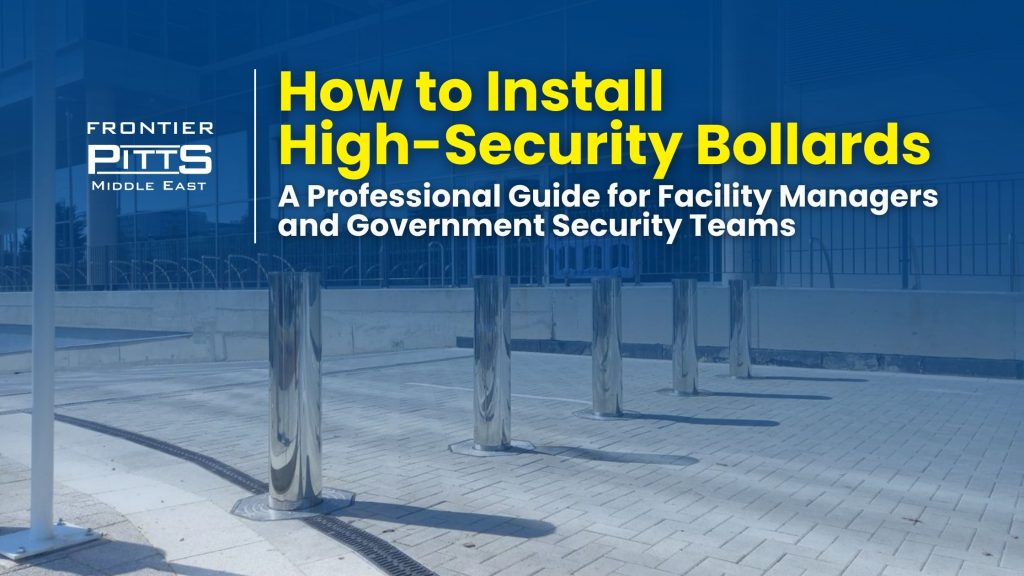
How to Install High-Security Bollards: A Professional Guide for Facility Managers and Government Security Teams
High-security bollards are the most cost-effective frontline solution for hostile vehicle mitigation (HVM) capable of stopping a 7,500 lb vehicle traveling at 30 mph dead in its tracks, protecting critical infrastructure, pedestrian zones, and high-risk public spaces. If you manage a government facility, logistics hub, or any site classified under national security or urban safety protocols, getting the installation right the first time is non-negotiable.
This guide walks through the exact process we follow at Frontier Pitts Middle East, aligned with international security standards and best practices for both static and automatic bollard systems.
Why Bollard Selection Comes Before Installation
Before a single hole is dug, the right bollard type must be matched to your threat profile. At Frontier Pitts Middle East, we supply three core categories:
| Bollard Type | Best For | Key Benefit |
|---|---|---|
| Static Bollards | Permanent perimeter security | Most cost-effective HVM solution |
| Automatic (Retractable) Bollards | Controlled vehicle access points | Security + operational flexibility |
| Removable Bollards | Temporary or event-based access control | Versatility without compromising protection |
All three types are engineered to withstand both low- and high-speed vehicle impacts. Crash-rated bollards from our range are tested to meet rigorous international certification standards, ensuring they perform when it counts most.
A note on standards: Government facilities and public-sector projects should specify bollards certified to PAS 68 and IWA 14-1 rating. These certifications define exactly what vehicle weight and speed a bollard can arrest critical data for any procurement or planning submission.
Step 1: Site Assessment and Security Planning
The most overlooked phase of any bollard installation is the planning stage. A technically perfect installation in the wrong location does nothing.
Start with a formal site assessment that covers:
- Threat modeling: What vehicle type poses the highest risk — a passenger car, an HGV, or both? This determines crash-rating requirements.
- Underground utility survey: Bollard foundations typically require 600–900mm depth. Striking a utility cable or drainage line mid-installation creates costly delays and safety hazards.
- Spacing calculation: For hostile vehicle mitigation purposes, gap spacing between bollards is as important as the bollard rating itself. Industry guidance recommends maximum 1.2m centre-to-centre gaps for full perimeter protection, though this varies by site geometry.
- Access and egress flow: Particularly for automatic bollard systems, map pedestrian and vehicle movement patterns before marking positions.
For government agencies and public sector clients, this phase should also include consultation with your security consultant or a certified HVM specialist to ensure the installation integrates with your wider perimeter security strategy.
Step 2: Excavation
With positions confirmed and marked, excavation begins using a mechanical auger or post-hole digger.
- Depth: 600–900mm for most static and automatic bollards. Manufacturer specifications take precedence — always.
- Diameter: Typically 100–150mm wider than the bollard foundation tube to allow clean concrete placement.
- Consistency: Irregular hole depth is a leading cause of bollard misalignment. Check each hole with a depth rod before proceeding.
If your site has hard standing (concrete, tarmac, block paving), saw-cutting before excavation produces a clean finish and reduces reinstatement costs.
Step 3: Bollard Positioning and Concrete Pour
This is where structural integrity is won or lost.
Place each bollard into its excavated hole and verify alignment with a spirit level — both on the vertical axis and in relation to adjacent bollards. For a perimeter installation, a string line between anchor points keeps the run true.
Concrete specification matters. Use a minimum C25/30 mix for static bollards. Pour in layers if depth exceeds 600mm, tamping each layer to eliminate voids. Air pockets around the foundation tube are the most common cause of bollard movement under impact.
Allow a full 48-hour cure before any load-bearing or operational testing. In high-temperature climates like the UAE, consider shading the pour and keeping it moist to prevent rapid surface drying that can compromise cure strength.
Step 4: Electrical Integration (Automatic Bollards)
Automatic bollards require careful M&E coordination. This phase should involve a qualified electrical engineer familiar with access control systems.
Key tasks include:
- Routing control cabling in armoured conduit below finished ground level
- Connecting to the site’s access control or security management system
- Integrating loop detectors or safety sensors (mandatory for public-facing installations)
- Programming rise/fall cycle times and fail-safe positions
At Frontier Pitts Middle East, our automatic bollards are designed for integration with industry-standard access control platforms, and our installation and commissioning service covers the full M&E scope. For government facilities, bollard control systems are typically required to integrate with wider site security operations — this should be specified in advance.
Step 5: Testing and Commissioning
No bollard installation is complete without formal commissioning. For high-security sites, this is a compliance requirement, not a courtesy check.
Commissioning should include:
- Static load verification: Confirm each bollard is fully cured and shows no movement under manual lateral force.
- Operational cycle testing (automatic bollards): Minimum 50 full rise/fall cycles before sign-off, checking for hydraulic pressure consistency and sensor response times.
- Emergency override test: Every automatic bollard system must have a tested manual override for power failure scenarios.
- Documentation: Produce an as-built record including bollard positions, foundation depths, electrical routing, and control system configuration. This is essential for future maintenance and compliance audits.
Step 6: Maintenance Programme
A certified, crash-rated bollard that hasn’t been maintained is a liability, not an asset. Establish a structured maintenance programme from day one.
Recommended maintenance schedule:
- Monthly: Visual inspection for surface damage, debris clearance around bollard bases, and sensor function check (automatic bollards)
- Quarterly: Hydraulic fluid level check and operational cycle test (automatic bollards), foundation integrity inspection
- Annual: Full engineering inspection, certification review, and load testing if required by site security policy
Frontier Pitts Middle East provides dedicated maintenance contracts for the full range of bollards we supply and install across the Middle East region.
Frequently Asked Questions
What is the difference between PAS 68 and IWA 14-1 certified bollards? PAS 68 is the British Standard for vehicle security barriers, defining impact test conditions by vehicle type, speed, and penetration distance. IWA 14-1 is the international equivalent developed by ISO. Both are widely accepted by government procurement bodies. Frontier Pitts Middle East supplies bollards certified to these standards — ask us for certification documentation specific to the product you’re specifying.
How far apart should security bollards be installed for hostile vehicle mitigation? For full HVM protection, gaps between bollard centres should not exceed 1.2 metres. Larger gaps allow smaller vehicles to pass between bollards. Spacing requirements should be confirmed through a formal threat and vulnerability assessment.
Can automatic bollards be integrated with existing access control systems? Yes. Our automatic bollards support integration with standard access control platforms via wired and wireless interfaces. Integration complexity depends on your existing system — our technical team can advise during the specification stage.
How long does a bollard installation take? A standard static bollard installation of 10–15 units on a prepared site typically takes 1–2 days, plus 48 hours concrete cure time. Automatic bollard installations with M&E integration are typically 3–5 days depending on site conditions and system complexity.
Working with Frontier Pitts Middle East
We are the Middle East distribution and installation partner for Frontier Pitts — a leading British manufacturer of security gates, barriers, road blockers, bollards, and pedestrian control systems. Our bollard range covers automatic bollards and static, removable, and sleeved bollards, all designed to meet the demanding requirements of government, critical infrastructure, and high-security commercial clients.
We support the full project lifecycle—from specification and supply to installation, commissioning, and ongoing maintenance. If you’re planning a perimeter security upgrade or a new facility that requires certified hostile vehicle mitigation (HVM) solutions, contact our team at fpgulf.com or call +971 2621 2272.
Frontier Pitts Middle East — Office 1301, Building C88, Commercial Tower A, 15 Baghdad St, Abu Dhabi, UAE