
Security Barrier Compliance in UAE & Middle East
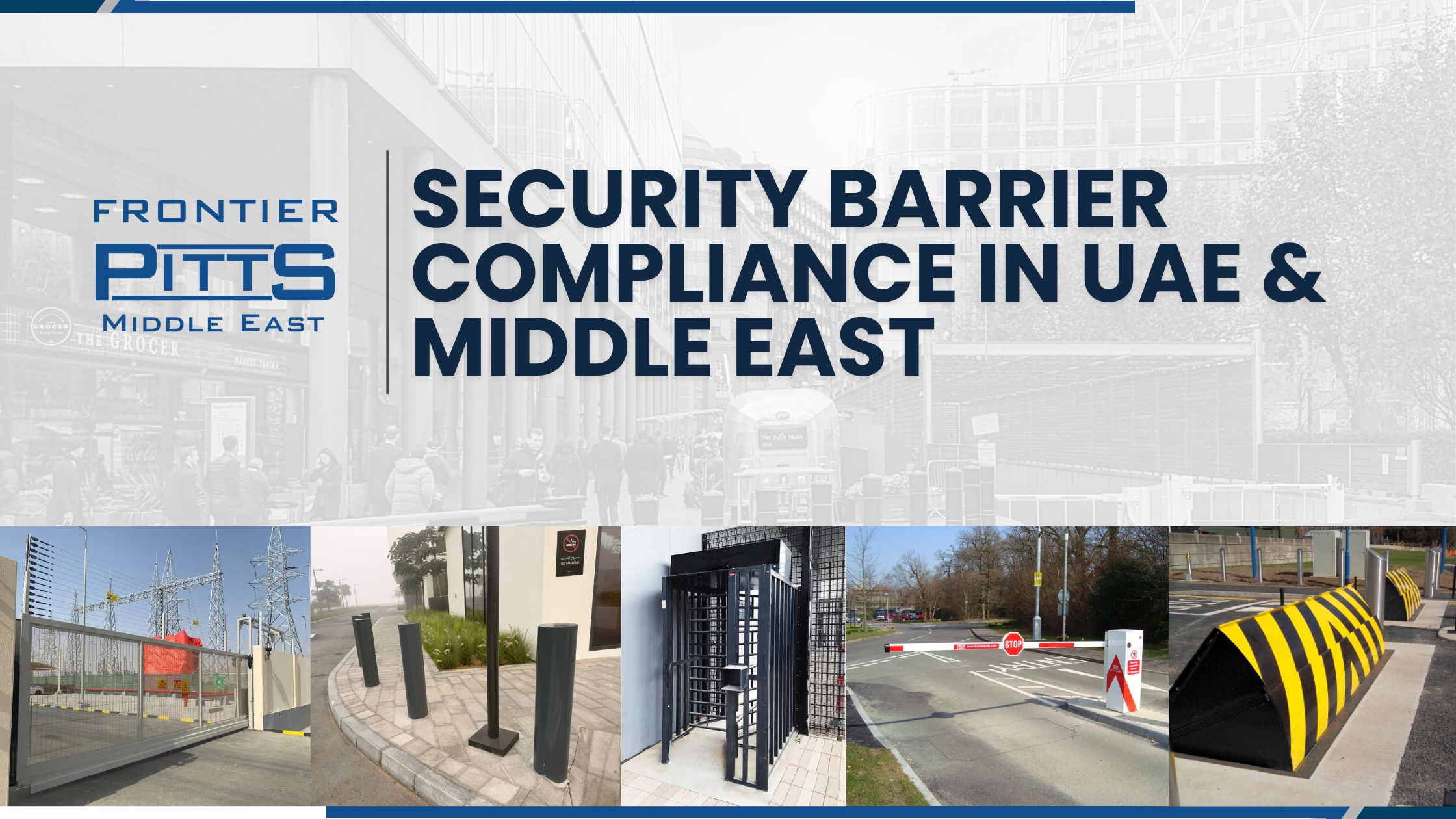
What Security Barrier Compliance Actually Means for Infrastructure Projects in the UAE and Middle East
Most security failures at critical infrastructure sites are not the result of a total lack of protection. They are the result of the wrong protection – barriers that were never tested to international standards, installed by suppliers who couldn’t produce a single certification document on request.
At Frontier Pitts Middle East, we have spent decades working alongside government agencies, airport authorities, oil and gas operators, and urban planners across the UAE and the wider Gulf region. The single most preventable risk we encounter, time and again, is non-compliant barrier specification. This guide exists to change that.
What Does Security Barrier Compliance Actually Mean?
Security barrier compliance means that a physical barrier system – whether a bollard, road blocker, crash-rated gate, or HVM barrier – has been independently tested and verified to stop a defined vehicle threat under controlled conditions, and operates safely for the people around it.
In practical terms, compliance answers three questions:
- Can this barrier physically stop a vehicle at a specified speed and weight?
- Does the system operate without causing injury to authorised users?
- Does it meet the standards that government approvers, insurers, and regulators will accept?
If your supplier cannot answer all three with documented evidence, the system should be treated as non-compliant – regardless of how it looks or what is claimed in a brochure.
The Standards That Matter (And What They Actually Test)
There is no single universal standard for security barriers. Most credible infrastructure projects require compliance across multiple frameworks. Here is what each standard covers and why it matters:
PAS 68 – Hostile Vehicle Mitigation (Impact Testing) PAS 68 is a UK-derived standard that subjects barriers to real vehicle crash testing. It quantifies stopping power based on vehicle weight, speed, and penetration distance. Our Terra Bollards, Terra Road Blockers, and HVM Barriers are tested to PAS 68, making them appropriate for high-threat environments including government buildings, military sites, and public spaces.
IWA 14-1 – International Crash Rating for Vehicle Barriers Developed by the International Workshop Agreement, IWA 14-1 provides a globally consistent performance framework for crash-rated vehicle barriers. Our Terra G8 Crash Rated Gate and Terra Road Blockers carry IWA 14-1 certification — the specification most commonly required for UAE government and airport procurement. If you are specifying for a site that requires international recognition, IWA 14-1 is non-negotiable.
LPS 1175 – Forced Entry and Intruder Resistance Where IWA 14-1 and PAS 68 address vehicle threats, LPS 1175 addresses deliberate forced-entry attack. Our Platinum Turnstile B3 is LPS 1175 Security Rated 2 & 3, and our Terra Diamond Turnstile achieves LPS 1175 Security Rated 3 & 4 — approved for government use. For perimeter access control that must resist both vehicle and pedestrian threats, LPS 1175-rated turnstiles are the benchmark.
| Standard | What It Tests | Typical Application |
|---|---|---|
| PAS 68 | Vehicle impact (UK) | Government, military, public space |
| IWA 14-1 | Crash rating (international) | Airports, urban security, UAE procurement |
| LPS 1175 | Forced entry resistance | Turnstiles, pedestrian gates, perimeter control |
Why Compliance Cannot Be Treated as Optional in the Middle East
The threat landscape for critical infrastructure in the Gulf is not theoretical. Airports, oil and gas facilities, government ministries, and high-footfall urban spaces all face documented vehicle-borne security risks. A vehicle travelling at moderate speed generates force that untested barriers simply cannot absorb.
Beyond physical risk, non-compliant barriers create three compounding problems for facility managers and government procurement teams:
Regulatory rejection. UAE government and municipal approvals increasingly require documented certification at tender stage. An uncertified system does not just fail — it delays the entire project.
Insurance liability. Incidents involving non-compliant barriers expose operators to significant liability. Certification documentation is the primary line of defence in any post-incident review.
Operational failure. Barriers that haven’t been crash-tested to a published standard may hold up under normal use and fail precisely when they are needed most.
The rule we apply consistently: if a supplier cannot produce certification documents, treat the product as non-compliant from the outset.
How to Specify Compliant Security Barriers: A Practical Framework
Getting compliance right is a process, not a product decision. Here is how we approach it with clients from initial brief through to commissioning:
Step 1 — Define the Threat What vehicle type, weight, and approach speed poses the credible threat at this site? A logistics distribution hub has a different profile to a public plaza or a government ministerial building. The answer to this question determines which certification level is required.
Step 2 — Conduct a Site-Specific Risk Assessment Perimeter layout, stand-off distance, entry point geometry, and adjacent pedestrian flows all affect what barrier configuration will actually work. This is not a desk exercise — it requires site analysis.
Step 3 — Select Certified Products Specify barriers from our IWA 14-1 and PAS 68 certified Terra Range, including Terra Bollards, Terra Road Blockers, HVM Barriers, and Crash Rated Gates. For pedestrian access control, specify LPS 1175 rated turnstiles. Every product in our range comes with full certification documentation.
Step 4 — Plan Integration with Wider Security Systems A certified barrier sitting in isolation is a missed opportunity. Properly specified HVM systems integrate with access control, CCTV, and security gate management. This is where physical security becomes a coherent system rather than a collection of separate products.
Step 5 — Work with an Approved Supplier Frontier Pitts Middle East is listed on the UK government approved suppliers register and holds SIRA approval, ISO certification, and British Chambers of Commerce accreditation. For Middle East projects, our Abu Dhabi office provides full local project support from specification through installation, commissioning, and ongoing maintenance.
The Products Built for Middle East Compliance Requirements
Our Terra Range was designed specifically to meet the dual demands of IWA 14-1 international standards and the operational realities of Gulf infrastructure:
- HVM Barriers — bi-directional, impact tested to PAS 68 and IWA 14-1
- HVM Blockers (Terra Road Blockers) — surface-mounted, certified for high-threat access points
- Crash Rated Gates (Terra G8) — IWA 14-1 tested sliding cantilevered gate
- Automatic and Static Bollards — including hydraulic rising bollards for controlled access
- LPS 1175 Turnstiles — Diamond (SR3 & SR4) and Platinum B3 (SR2 & SR3) for government-approved pedestrian access control
- Security Car Park Barriers — for commercial and government facility access management
The Question Facility Managers Should Be Asking Every Supplier
The single most important question is not “what is the price?” It is: “Can you provide the original certification test documents for this specific product?”
If the answer involves hesitation, redirection, or a promise to follow up later — that is your answer.
Compliant barrier systems are not more expensive to operate. They are less expensive in every scenario that actually matters: regulatory approval, insurance, incident response, and long-term liability.
Frequently Asked Questions
What is PAS 68 and is it required in the UAE? PAS 68 is a UK standard that verifies a barrier can stop a defined vehicle at a tested speed and weight. While not legally mandated across the UAE, it is widely accepted by government and high-security site approvers as evidence of credible impact protection.
What is IWA 14-1 and why does it matter for Middle East projects? IWA 14-1 is an international crash-rating standard that provides a globally recognised performance benchmark for vehicle barriers. It is the standard most commonly specified in UAE government, airport, and major infrastructure procurement.
What is LPS 1175 and when is it required? LPS 1175 tests barriers and gates against forced, deliberate entry attacks. It is required for government-approved pedestrian access control and perimeter security where both vehicle and intruder threats must be addressed.
Can one standard cover all compliance needs for a site? No. Most credible infrastructure sites require multiple standards simultaneously — IWA 14-1 or PAS 68 for vehicle threats, and LPS 1175 for forced entry. Specifying only one standard leaves documented gaps in your security posture.
What certifications does Frontier Pitts Middle East hold? Our products and operations hold IWA 14-1 and PAS 68 certification across the Terra Range, LPS 1175 ratings for turnstiles, SIRA approval, ISO certification, British Chambers of Commerce accreditation, and UK government approved supplier status.
Frontier Pitts Middle East | Office 1301, Building C88, Commercial Tower A, 15 Baghdad St, Abu Dhabi, UAE sales@frontierpitts.ae | +971 26212272 | fpgulf.com
Frontier Pitts is the leading British manufacturer of HVM security systems, crash-rated gates, bollards, road blockers, and LPS 1175 turnstiles, with over 50 years of manufacturing experience and an established presence across the UAE and Middle East.
Follow Frontier Pitts Middle East on Google
Add fpgulf.com as a Preferred Source to see more of our latest insights on hostile vehicle mitigation, security bollards, road blockers and high-security access solutions in Google Search.