
High Security Turnstile Solutions: The Long-Term Benefits of Secure Entrances
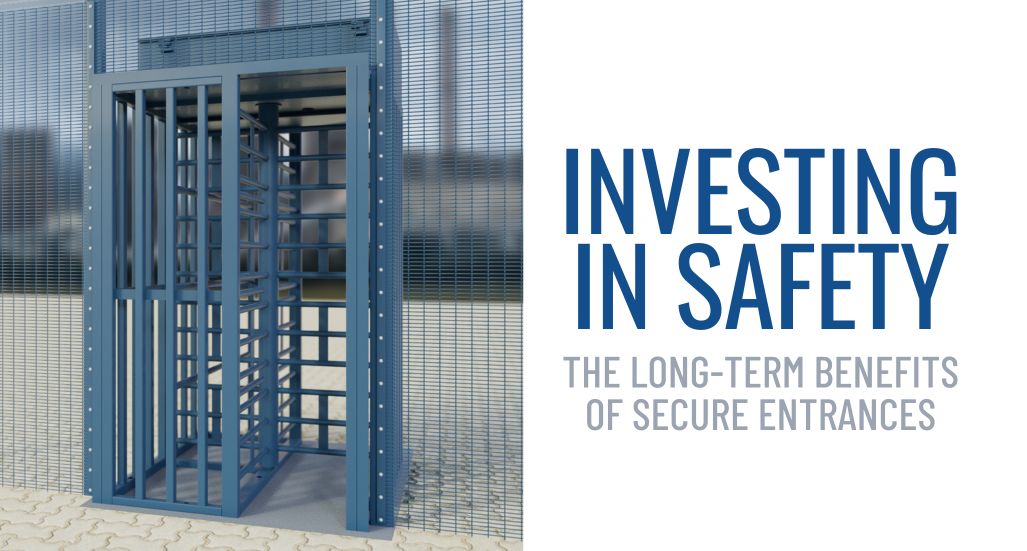 by Frontier Pitts Middle East Photo
Secure entrances, including certified turnstiles, access control systems, and crash-rated bollards- are the primary physical layer of urban security. For government facilities and critical infrastructure, high security turnstile LPS 1175-certified solutions provide independently verified, attack-resistant protection that deters unauthorized access, manages pedestrian flow, and remains operational during power failure.
What Are Secure Entrances and Why Do They Matter in Urban Planning?
Secure entrances are engineered access points that control the movement of people and vehicles into protected spaces. They combine physical barriers, electronic access control, and certified hardware to create a layered security perimeter. In urban planning contexts, they serve a dual function: deterring threats before they materialize, and managing the flow of authorized users without disruption.
At Frontier Pitts Middle East, we’ve observed across hundreds of deployments from UAE government facilities to port infrastructure and data centers that the entrance is where security posture is either established or compromised. Getting this decision right at the specification stage determines the integrity of everything that follows.
The 3 Certified Turnstile Solutions Urban Planners and Facility Managers Should Know
Not all turnstiles are equal. For government procurement and critical infrastructure, independent certification is non-negotiable. Here is how the primary options compare:
| Product | Certification | Security Rating | Attack Resistance | Best For |
|---|---|---|---|---|
| LPS 1175 Terra Diamond Turnstile | LPS 1175: Issue 6.1 (Cert. 1059a/01 & 1059a/02) | SR3 & SR4 | 10-min attack, 30-min test duration | Nuclear, utilities, government critical sites |
| LPS 1175 Platinum Turnstile B3 | LPS 1175 | SR B3, Red Book Listed | Power locking bolt, fail-secure | Data centers, ports, high-security government buildings |
| FPT1 Full Height Turnstile | Bespoke manufacturing | 100% duty rating | Continuous heavy use | Perimeter gates, industrial sites, grid stations |
All three are CPNI-approved for government use, fail-secure by design (protection holds during power failure), and compatible with any access control platform from RFID card readers to biometric scanners.
How Do LPS 1175-Certified Turnstiles Work? (Step-by-Step)
Understanding what LPS 1175 certification actually means helps procurement teams and security managers make defensible specification decisions.
Step 1 — Independent Testing Body The Loss Prevention Certification Board (LPCB) administers LPS 1175 testing. Results are independently verified, not self-reported. Products are listed in the publicly accessible Red Book.
Step 2 — Tool Category Assignment Each security rating corresponds to a defined tool set. SR3 (Category C) tools include axes, cold chisels, crowbars, gas torches, and 400mm bolt cutters. SR4 (Category D) tools escalate to sledgehammers, cordless jigsaws, scissor jacks, and plate shears.
Step 3 — Timed Attack Testing The product must resist physical attack for a defined working time within a maximum test duration. SR3 requires 5 minutes working time within a 20-minute test window. SR4 requires 10 minutes working time within a 30-minute test window.
Step 4 — Real-World Implication A 10-minute attack resistance isn’t just a number. It is the operational window that gives on-site security personnel time to detect, respond to, and neutralize a breach attempt a standard defined in UK government and CPNI security frameworks.
Step 5 — CPNI Government Approval Products that pass LPS 1175 testing at relevant ratings may additionally be submitted for CPNI (Centre for the Protection of National Infrastructure) approval for UK government use. The Terra Diamond Turnstile holds this approval and is listed in the CPNI Catalogues of Security Equipment.
Frequently Asked Questions: Secure Entrances for Government and Facility Managers
Q: What is the difference between LPS 1175 SR3 and SR4 for turnstiles? SR3 requires the product to resist a 5-minute working attack (20-minute test) using Category C hand tools. SR4 escalates to a 10-minute working attack (30-minute test) using Category D power tools including jigsaws and sledgehammers. The Terra Diamond Turnstile from Frontier Pitts Middle East is the only turnstile on the market currently certified to both SR3 and SR4.
Q: What does “fail-secure” mean in access control? A fail-secure turnstile remains locked — denying access — in the event of a power failure. This is the standard required for high-security and government environments. It is the opposite of fail-safe (or fail-open), where the unit defaults to unlocked during a power loss. All Frontier Pitts turnstiles are fail-secure.
Q: Can turnstiles integrate with existing access control systems? Yes. All three turnstile models in the Frontier Pitts Middle East range are designed to interface with any existing access control infrastructure — including RFID, biometric, PIN, and multi-factor authentication systems — without requiring platform replacement.
Q: What are the civil and electrical requirements for installing a full-height turnstile? The FPT1 Full Height Turnstile requires a foundation of 1500mm x 1300mm x 300mm with integrated power and control wiring ducts. It operates on a 230V 50Hz 2-amp single-phase supply. The LPS 1175 Platinum Turnstile B3 has a compact footprint of 1600mm x 1600mm x 300mm on the same electrical specification.
Q: Are certified turnstiles required for UAE government procurement? While UAE procurement standards vary by authority and project classification, facilities handling critical infrastructure, sensitive data, or public safety functions are increasingly specifying LPS 1175-certified and CPNI-approved products as a condition of contract. Independent certification provides the audit trail that government procurement requires.
Q: How long does a certified turnstile last, and what maintenance is required? A heavy-duty turnstile specified and installed correctly has a service life measured in decades rather than years. The FPT1, for instance, carries a 100% duty rating — engineered for continuous, high-frequency use. Frontier Pitts Middle East provides installation and commissioning, ongoing maintenance services, and documented warranty terms to support the full asset lifecycle.
Access Control Integration: Why Hardware Alone Is Not Enough
A certified turnstile without a properly configured access control system is a physical barrier with an exploitable gap. The two must work as a unified system.
Access control platforms manage who can pass, when, and under what conditions. Integrated with turnstile hardware, they log every entry and exit event, flag anomalies in real time, enforce tiered access across a facility, and enable instant remote lockdown in emergency scenarios. For government agencies operating facilities across multiple sites, centralized access management is not a convenience — it is an operational requirement.
Frontier Pitts Middle East designs all entrance solutions with integration as a baseline assumption, not an afterthought. Whether the existing infrastructure uses biometric scanners, RFID cards, or PIN systems, our turnstile range connects without requiring a platform overhaul.
Crash-Rated Bollards: The Vehicle Perimeter Layer
Pedestrian access control addresses one threat vector. Vehicle-based threats require a separate, equally rigorous approach.
Frontier Pitts Middle East’s bollard range includes IWA 14 and PAS 68-rated automatic and static options — independently tested against defined vehicle impact scenarios. PAS 68, developed by the British Standards Institution, specifies vehicle impact test conditions by vehicle weight and speed. IWA 14 is the international equivalent, providing comparable certification for global procurement contexts.
Critically, certified bollards can be designed to disappear into the urban environment. Planter-style housings, architectural cladding, and integrated street furniture finishes mean that the security layer and the public realm experience are not mutually exclusive — they are complementary.
Why Certification and Independent Verification Matter for Procurement
For public sector procurement teams, the question of specification defensibility arises at every major security investment. Selecting a Red Book Listed, LPS 1175-certified product is a position that can withstand audit, legal scrutiny, and post-incident review. Selecting an uncertified alternative on cost grounds creates liability that no budget saving justifies.
Key certifications to look for in any secure entrance specification include: LPS 1175 (LPCB, UK), CPNI approval (UK government infrastructure), PAS 68 / IWA 14 (vehicle impact, bollards and barriers), and ISO 9001 quality management compliance.
For more on certification standards and regulatory compliance relevant to your project, visit Frontier Pitts Middle East’s Certificate and Regulation page.
Actionable Next Steps for Facility Managers and Government Procurement Teams
1. Audit your current perimeter. Identify which access points lack certified hardware and where access control integration is incomplete or absent.
2. Match your threat profile to the correct certification level. Not every entrance requires SR4. But critical infrastructure, utilities, and government buildings holding sensitive data or personnel should be specified to the highest defensible standard.
3. Request independent certification documentation. Any supplier should be able to provide LPCB Red Book listing references, CPNI approval documentation, and test certificates on request. For the Terra Diamond Turnstile, certificate numbers 1059a/01 and 1059a/02 are publicly verifiable.
4. Plan for the full lifecycle. Specify installation, commissioning, maintenance schedules, and warranty terms at procurement stage — not after. Short-term savings on service contracts routinely become long-term liability.
5. Speak to a specialist. Frontier Pitts Middle East provides factory-direct pricing, one-on-one consultation, and end-to-end project delivery across the UAE and wider Gulf region.
Explore our full turnstile range → Download product catalogues → Contact our team →
Sources and Further Reading:
- Loss Prevention Certification Board (LPCB) Red Book — redbooklive.com
- Centre for the Protection of National Infrastructure (CPNI) — cpni.gov.uk
- BSI PAS 68: Impact Test Specifications for Vehicle Security Barriers — bsigroup.com
- IWA 14-1: Vehicle Security Barriers, ISO International Standard — iso.org
- Frontier Pitts Middle East Product Documentation — fpgulf.com
Frontier Pitts Middle East is a leading British manufacturer and supplier of certified perimeter security solutions across Abu Dhabi, Dubai, and the wider Gulf region — including LPS 1175-certified turnstiles, PAS 68/IWA 14 bollards, HVM barriers, crash-rated gates, and integrated access control systems. Office 1301, Building C88, Commercial Tower A, 15 Baghdad St, Abu Dhabi, UAE. Tel: +971 26212272. Email: sales@frontierpitts.ae
Follow Frontier Pitts Middle East on Google
Add fpgulf.com as a Preferred Source to see more of our latest insights on hostile vehicle mitigation, security bollards, road blockers and high-security access solutions in Google Search.