
Layered Security Approach Explained for Infrastructure
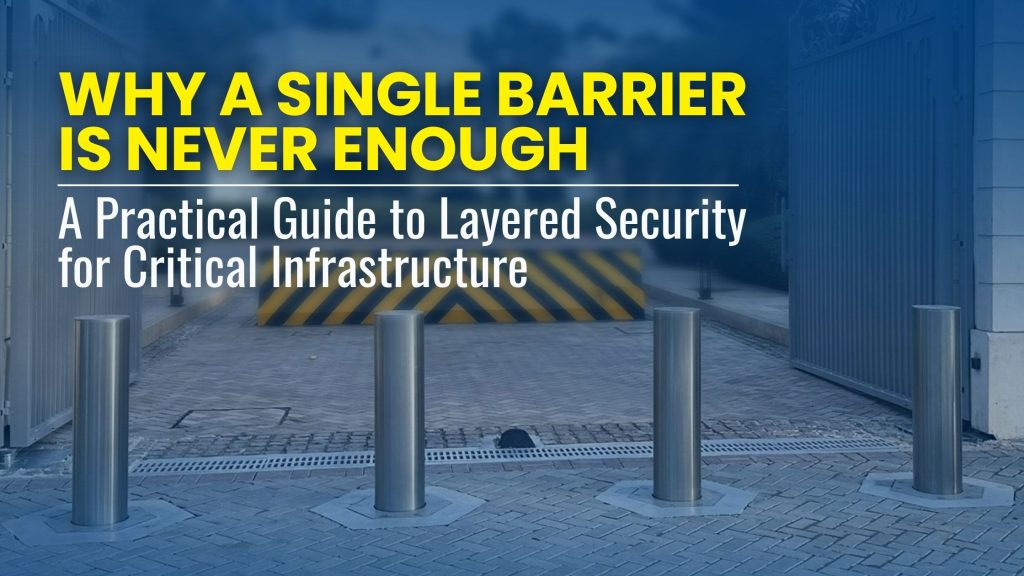
Why a Single Barrier Is Never Enough: A Practical Guide to Layered Security for Critical Infrastructure
By Frontier Pitts Middle East | Physical Security Specialists | Updated March 2026
The single most important thing facility managers and government security planners can do today is stop treating perimeter protection as a one-product problem. Layered security what infrastructure protection professionals call defense-in-depth is not a luxury reserved for military installations. It is the operational standard for every airport, government campus, energy facility, and urban public space that carries strategic, economic, or public safety significance.
At Frontier Pitts Middle East, we have spent over 50 years engineering and manufacturing certified hostile vehicle mitigation (HVM) systems, security gates, bollards, barriers, and turnstiles. What we see repeatedly across the UAE and the broader region is the same vulnerability: facilities that invest in one strong barrier at the entrance and assume the job is done. It rarely is.
What Does a Layered Security Approach Actually Mean?
A layered security approach means deploying coordinated, interdependent security systems across multiple defensive zones, so that if one control fails or is bypassed, the next layer immediately reduces or contains the threat. It is the same logic used in cybersecurity, military planning, and aviation safety, applied to the physical world.
The typical zones for a critical infrastructure site look like this:
Zone 1 — Outer Perimeter: Security fencing, perimeter intrusion detection, CCTV and surveillance lighting. This is your early warning layer — it identifies and deters before a threat reaches the building.
Zone 2 — Vehicle Mitigation: IWA 14-1 and PAS 68 rated barriers, HVM road blockers, automatic bollards, and crash-rated gates. This is your stopping layer — engineered to halt a vehicle of specified mass at specified speed before it reaches a populated area or sensitive structure.
Zone 3 — Controlled Entry Points: Crash-rated gates and security gates at vehicle access points, integrated with access control and monitoring systems.
Zone 4 — Pedestrian Access Control: LPS 1175-rated turnstiles for personnel entry — systems that authenticate, record, and physically control who enters. Our LPS 1175 Terra Diamond Turnstile is rated at Security Level 3 and 4 and is approved for government use.
Zone 5 — Internal Monitoring: Surveillance, alarm systems, and response protocols tied to a central security management platform.
Each zone is only as effective as its integration with the others. Security gates that aren’t linked to surveillance systems create blind spots. Bollards installed at the wrong stand-off distance offer less protection than their certification implies.
The Standards That Matter – and What They Actually Test
One of the most common misconceptions we encounter is treating certification labels as interchangeable. They are not. Here is what the key standards mean in practice for government procurement officers and facility managers specifying systems:
| Standard | What It Tests | Typical Application |
|---|---|---|
| IWA 14-1 | International vehicle impact test — vehicle mass and speed to full stop | HVM barriers, crash-rated gates, road blockers |
| PAS 68 | British vehicle impact standard — penetration distance after impact | Bollards, barriers in public-access areas |
| LPS 1175 | Forcible physical attack resistance — rated in security levels (B1–B8) | Turnstiles, security gates (anti-intruder) |
| ISO 9001 | Quality management system certification | Manufacturing and installation processes |
| SIRA Approved | UAE Security Industry Regulatory Agency compliance | UAE-deployed systems |
Our full Terra HVM range , including the Terra Bollards, Terra Road Blockers, Terra Barriers, and Terra G8 crash-rated sliding gate is tested to both IWA 14-1 and PAS 68 specifications. Our Platinum Turnstile B3 carries LPS 1175 Security Ratings 2 and 3. These are not marketing claims; they are independently verified impact and attack-resistance results.
How to Plan a Layered Security System: A Practical Framework
Security planning has a sequence. Skipping steps is where most vulnerability gaps originate.
Step 1: Threat and Vulnerability Assessment Before specifying any product, define the realistic threat profile for your site. A logistics hub in an industrial zone carries different risk parameters than a government ministry building in a city centre. What are the credible attack vectors? Vehicle-borne? Unauthorised pedestrian access? Insider threat?
Step 2: Map Approach Routes Physically map every route — road, pedestrian pathway, service access — that leads to your facility boundary. Attackers exploit the routes that planners overlook, particularly service entrances and emergency access points.
Step 3: Establish Stand-Off Distance Stand-off distance is the engineered buffer between a potential vehicle threat and your building or occupied space. Crash-rated systems must be positioned to stop a vehicle within this distance. Installing IWA 14-rated bollards too close to a building entrance significantly reduces their protective value, regardless of their certification rating.
Step 4: Specify the Right Systems for Each Zone This is where certification alignment matters. For vehicle mitigation, IWA 14-1 or PAS 68-rated products. For pedestrian control at high-security facilities, LPS 1175-rated turnstiles. For vehicle entry management, crash-rated gates with integrated access control.
Step 5: Integrate, Test, and Audit All layers must communicate. Barriers should be linked to surveillance systems. Turnstile access logs should feed into security management platforms. And the entire system should be subject to regular operational audits — not just at commissioning.
Where Government and Public Sector Planners Often Get It Wrong
Three patterns consistently appear in facilities that experience security failures:
Specifying products, not systems. Purchasing a certified bollard without considering its placement, stand-off distance, or integration with adjacent barriers is a common and costly mistake.
Treating pedestrian access as secondary. Hostile vehicle mitigation attracts the most attention, but insider threats and unauthorised pedestrian access are statistically more frequent. LPS 1175-rated turnstiles combined with biometric or card-based access control address this layer directly.
Procuring without SIRA compliance for UAE deployments. In the UAE, the Security Industry Regulatory Agency sets mandatory compliance requirements for security systems deployed in public and government environments. Frontier Pitts Middle East is SIRA-approved, which simplifies procurement and regulatory sign-off for government clients.
A Practical Checklist for Facility Security Managers
Before signing off on any perimeter security upgrade or new installation, run through these:
✔ Has a formal threat and vulnerability assessment been completed?
✔ Are all vehicle mitigation systems IWA 14-1 or PAS 68 rated for the specified vehicle mass and speed?
✔ Are bollards and barriers positioned at the correct stand-off distance from the protected structure?
✔ Does pedestrian access control include LPS 1175-rated systems at high-risk entry points?
✔ Are security gates integrated with surveillance and access control monitoring?
✔ Is the entire system SIRA-compliant for UAE deployments?
✔ Is a documented maintenance and audit programme in place post-installation?
Why Frontier Pitts Middle East
We are the regional arm of the UK’s leading manufacturer of certified security gates, barriers, bollards, road blockers, and turnstiles — with over five decades of engineering heritage and a manufacturing standard certified to ISO 9001. Our IWA 14-1 and PAS 68 Terra HVM range is specified by government bodies, airports, energy facilities, and military installations across the Middle East.
What distinguishes us is not just product certification — it is the full-project capability: threat consultation, bespoke manufacturing, installation and commissioning, and ongoing maintenance. Security is a process, not a product.
If you are specifying security infrastructure for a new facility or reviewing an existing perimeter for compliance and adequacy, we are available for a technical consultation.
Explore our certified HVM product range → Contact our team in Abu Dhabi →
Frontier Pitts Middle East | Office 1301, Building C88, Commercial Tower A, 15 Baghdad St, Abu Dhabi, UAE | +971 26212272 | sales@frontierpitts.ae
Certifications: IWA 14-1 | PAS 68 | LPS 1175 | ISO 9001 | SIRA Approved | British Chambers of Commerce Member