
UAE HVM Security Checklist for Gates, Bollards & Barriers
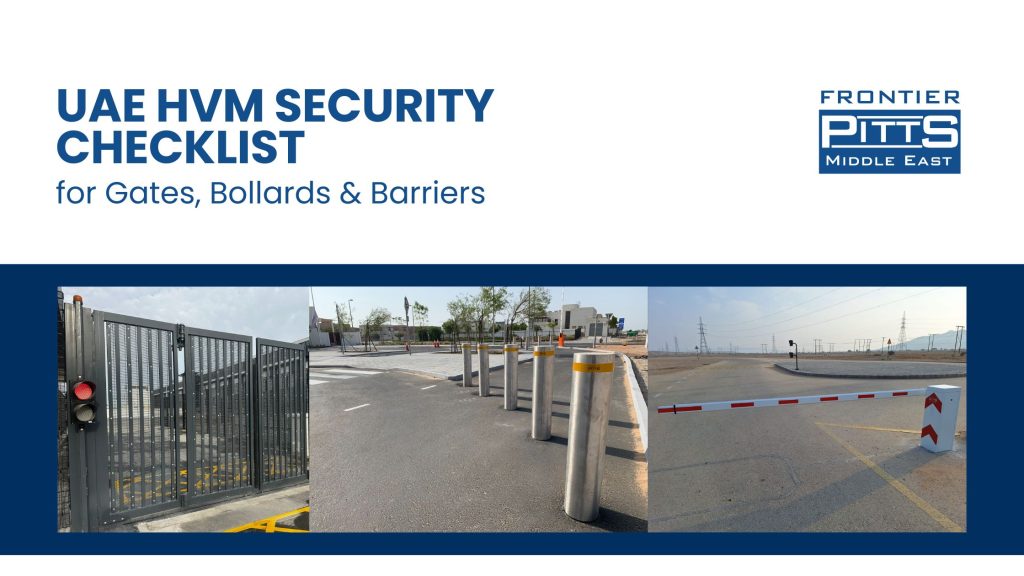
A UAE HVM security checklist helps project teams choose certified gates, bollards, barriers, and road blockers that protect critical sites from unauthorized vehicle access. The right hostile vehicle mitigation system should match the site risk, meet PAS 68, IWA 14, LPS 1175, or ISO 22343 standards, and include proper installation, integration, and maintenance planning.
What Should a UAE HVM Security Checklist Include?
A UAE HVM security checklist should include site risk assessment, product certification review, foundation planning, installer qualification, access control integration, authority compliance, emergency operation testing, and preventive maintenance. These steps help ensure gates, bollards, road blockers, and barriers perform correctly as part of one complete hostile vehicle mitigation system.
This refreshed structure builds from the original checklist content you provided, including certification verification, site preparation, integration, quality control, and maintenance planning.
Why This Matters for UAE and GCC Projects
UAE infrastructure projects are becoming more connected, more data-driven, and more security-focused. The UAE smart cities market generated USD 17.9 million in 2024 and is projected to reach USD 78.1 million by 2030, with expected CAGR of 29.8% from 2025 to 2030. This growth supports rising demand for secure access, intelligent mobility, and integrated perimeter protection.
Globally, ISO 22343-1:2023 now provides performance requirements and a test method for vehicle security barriers used to protect people in public and private locations from vehicle impact. The UK National Protective Security Authority also notes that ISO 22343-1 supersedes PAS 68 and IWA 14-1, while the industry continues transitioning from older standards.
For UAE project teams, this means working with experienced security gate systems manufacturers Middle East, a trusted Middle East barrier supplier, or a qualified Dubai barrier supplier is not only about product supply. It is about choosing tested systems, correct installation methods, and long-term technical support.
Comparison Table: HVM Solutions for UAE Sites
| HVM Solution | Best Use Case | Key Benefit | Common Standard |
|---|---|---|---|
| Crash-rated gates | Secured vehicle entrances | Controls authorized vehicle access | PAS 68, IWA 14, ISO 22343 |
| Bollards | Building fronts, walkways, drop-off zones | Protects pedestrian and asset areas | PAS 68, IWA 14, ISO 22343 |
| Road blockers | High-security checkpoints | Strong vehicle stopping performance | PAS 68, IWA 14, ISO 22343 |
| Rising barriers | Managed vehicle lanes | Supports controlled entry and exit | PAS 68, IWA 14 |
| Full height turnstiles | Pedestrian access points | Controls people movement | LPS 1175 |
| Shallow mount systems | Sites with limited excavation depth | Reduces foundation disruption | PAS 68, IWA 14, ISO 22343 |
What is a hostile vehicle mitigation system?
A hostile vehicle mitigation system is a group of physical security products designed to manage, slow, or stop unauthorized vehicle access. It can include crash-rated gates, bollards, road blockers, barriers, and supporting access control systems.
Why are PAS 68, IWA 14, and ISO 22343 important?
PAS 68, IWA 14, and ISO 22343 are vehicle impact testing standards used to measure how barriers, bollards, gates, and road blockers perform under controlled vehicle impact tests. ISO 22343-1:2023 is the newer international standard for vehicle security barrier performance testing.
What is the role of LPS 1175 in perimeter security?
LPS 1175 is used for physical attack resistance. It is commonly applied to security-rated gates, turnstiles, doors, fencing, and other perimeter products where resistance against manual forced entry is important.
How do I choose between bollards, barriers, and road blockers?
Use bollards for pedestrian-facing areas, barriers for managed traffic lanes, and road blockers for higher-security vehicle checkpoints. The right choice depends on site risk, available space, vehicle movement, foundation depth, and required certification.
Why should UAE projects work with certified suppliers?
Certified suppliers help project teams select tested products, provide documentation, support installation planning, and align systems with authority, consultant, and operational requirements. This is especially important for critical infrastructure, government, oil and gas, logistics, commercial, and public-sector facilities.
Next Steps for UAE HVM Project Teams
Before approving a hostile vehicle mitigation system, project teams should request certification documents, review foundation requirements, confirm access control integration, and check the supplier’s UAE installation support. For complex sites, involve the consultant, contractor, facility manager, and HVM supplier early so the gates, bollards, road blockers, and barriers work as one coordinated perimeter security system.
For support with certified HVM gates, crash-rated bollards, road blockers, and barriers, Frontier Pitts Middle East can help review your site requirements and recommend a suitable system for UAE and GCC infrastructure projects. Visit us at www.fpgulf.com.
Follow Frontier Pitts Middle East on Google
Add fpgulf.com as a Preferred Source to see more of our latest insights on hostile vehicle mitigation, security bollards, road blockers and high-security access solutions in Google Search.