
What Is Hostile Vehicle Mitigation?
Hostile vehicle mitigation (HVM) is the single most critical layer of physical security that most public facilities are still underestimating. A vehicle travelling at 48 km/h carries enough kinetic energy to breach most standard perimeter fences in under a second. The question is no longer whether vehicle-based threats are real — it’s whether your infrastructure is certified to stop them.
At Frontier Pitts Middle East, we’ve spent over 50 years engineering and manufacturing HVM systems deployed at airports, embassies, government buildings, energy facilities, and public venues across the UAE, Saudi Arabia, and Oman. This guide consolidates what security planners, facility managers, and public sector procurement teams need to understand before specifying any perimeter security solution.
What Exactly Is Hostile Vehicle Mitigation?
Hostile vehicle mitigation refers to a coordinated system of certified physical barriers designed to prevent unauthorised vehicles from breaching a protected perimeter — whether through accident, criminal intent, or a deliberate ramming attack. It is not a single product. It is a security strategy.
Effective HVM systems combine crash-rated bollards, HVM barriers, road blockers, crash-rated gates, and pedestrian turnstiles — all tested and certified to internationally recognised standards. In the Middle East, the two most widely referenced standards are PAS 68 and IWA 14-1. Every product in our Terra HVM range has been independently impact-tested to one or both of these specifications.
Why This Matters Right Now for Public Sector Planners
Urban development across the Gulf is accelerating. New metro stations, government districts, expo venues, ports, and energy facilities are being commissioned at a pace that sometimes outstrips security planning. According to the UN Office of Counter-Terrorism, vehicle-ramming attacks have increased significantly as a tactic against crowded public spaces since 2016 — making proactive HVM specification not just best practice, but a duty of care.
Across the UAE and KSA, national infrastructure frameworks increasingly mandate that critical facilities demonstrate compliance with vehicle barrier testing standards before occupancy approvals are granted. Getting the certification right at design stage is far less expensive than retrofitting after a threat assessment failure.
The Standards That Actually Matter: PAS 68 and IWA 14-1
Not all bollards are crash-rated. Not all barriers are equal. Here is what certified testing actually means in practice.
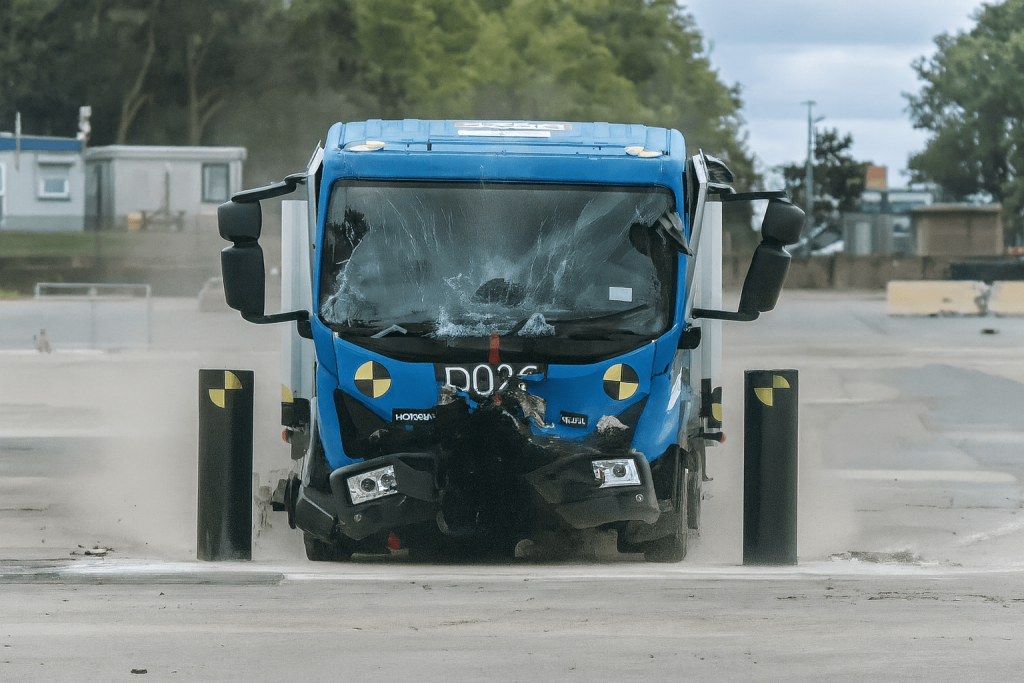
PAS 68 is a British Standards Institution specification that certifies a barrier’s ability to stop a defined vehicle at a defined speed. During testing, a vehicle is driven into the barrier under controlled conditions and the penetration distance of the vehicle past the barrier line is measured. A typical certification rating reads:
V/7500[N2]/48/90 — meaning the barrier stopped a 7,500 kg vehicle travelling at 48 km/h at a 90-degree impact angle.
IWA 14-1 is the international equivalent, developed by the International Organization for Standardization. It assesses vehicle mass, speed, and penetration distance using comparable methodology, and is increasingly the standard referenced in Middle East government tenders.
Our Terra range — including the Terra Bollards, Terra Road Blockers, Terra Barriers, and Terra G8 Crash Rated Gate — has been successfully impact tested to IWA 14-1. The Terra G8 sliding cantilevered gate was specifically tested to the new IWA 14-1 specification, making it one of the most rigorously certified access control solutions available in this region.
The Core HVM Product Categories — and When to Use Each
HVM Barriers
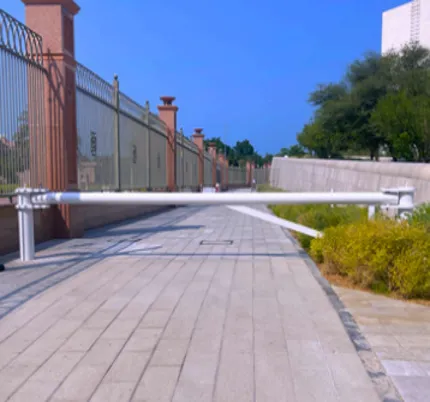
Our manual bi-directional HVM Swing Barrier is designed for environments where vehicle flow needs to be controlled without permanent infrastructure. Impact-tested to IWA 14-1, it is particularly suited to temporary high-security events, embassy perimeters, and checkpoint environments.
Crash-Rated Bollards (Automatic, Static, and Removable)
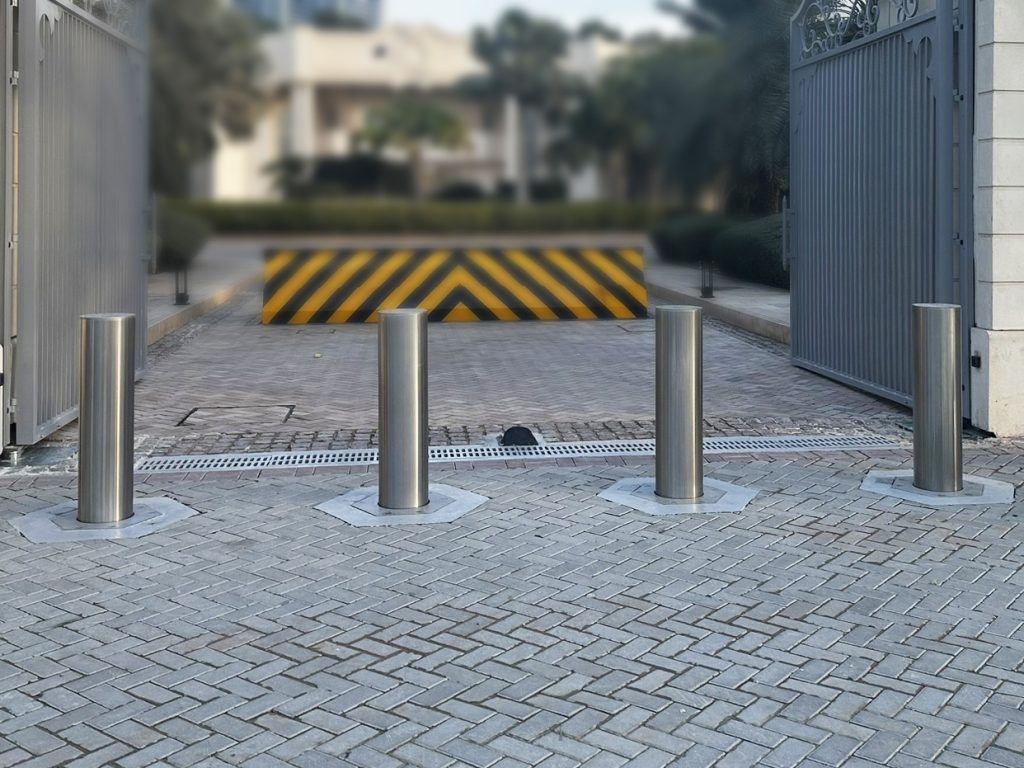
Bollards remain the most versatile HVM tool for urban environments. We supply automatic rising bollards, static bollards, removable bollards, and bollard sleeves — all available in PAS 68 and IWA 14-1 certified configurations. For pedestrian zones, government plazas, and stadium approaches, automatic bollards allow genuine access management without sacrificing aesthetics or emergency vehicle throughput.
HVM Road Blockers
The Terra HVM Blocker is a surface-mounted or in-ground rising road blocker designed for high-security chokepoints — military base entrances, secure logistics hubs, and embassy vehicle lanes. Impact tested to international specification, it is capable of stopping multi-tonne vehicles instantly and is the system of choice when penetration distance must be near zero.

Crash-Rated Gates and Security Gates
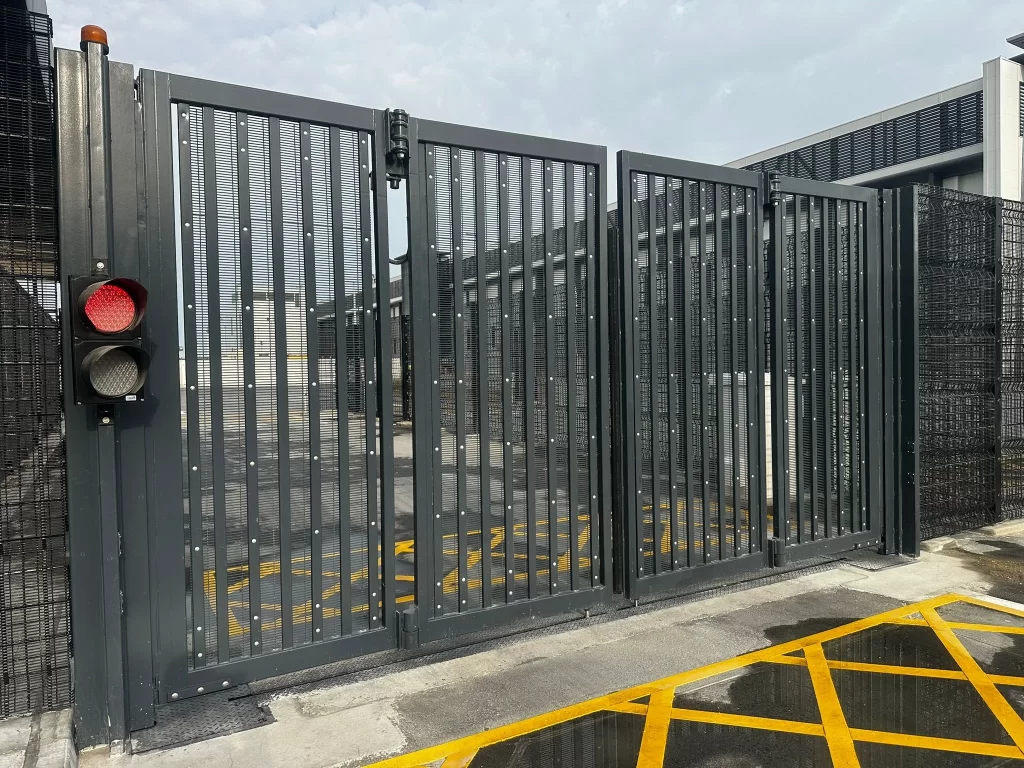
Vehicle entry points are the most commonly exploited vulnerability in any perimeter. Our Terra G8 — a crash-rated sliding cantilevered gate — provides IWA 14-1 certified protection at main access points. For environments requiring bullet resistance alongside vehicle control, our bullet-resistant gate range adds an additional layer of protection.
Security gates are typically integrated with licence plate recognition, CCTV, and manned checkpoint systems to create a layered entry management process.
LPS 1175 Certified Turnstiles
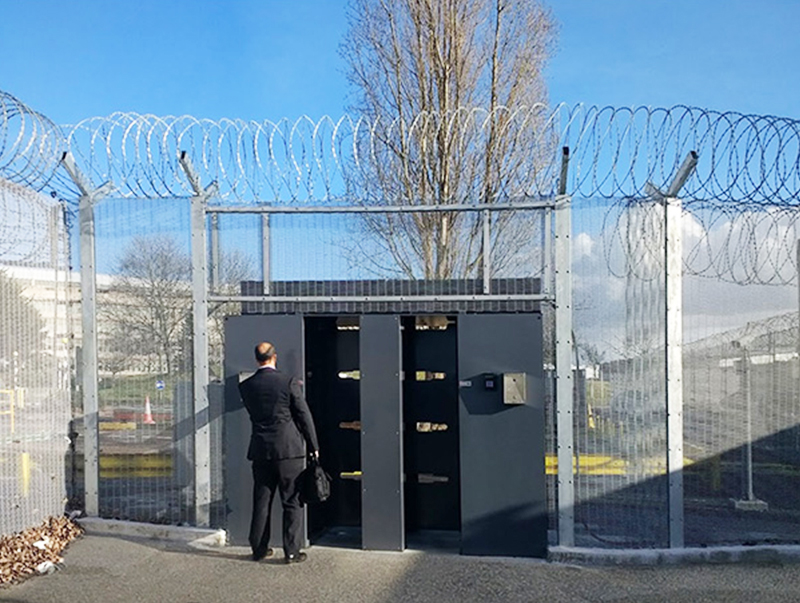
HVM is not only about vehicles. Pedestrian access control is the final layer. Our turnstile range includes the LPS 1175 Diamond Turnstile (security rated 3 & 4, approved for government use) and the LPS 1175 Platinum Turnstile B3 (security rated 2 & 3). The FPT1 Full Height Turnstile completes the range for high-throughput applications such as transportation hubs and stadiums.
LPS 1175 is a Loss Prevention Standard that certifies resistance to physical attack — a critical credential for any turnstile specified in government or defence environments.
A Practical HVM Planning Framework
| Step | Action | Key Consideration |
|---|---|---|
| 1. Risk Assessment | Define threat vectors and attacker profiles | Vehicle speed, mass, approach distance |
| 2. Site Survey | Map all vehicle approach paths | Standoff distance available |
| 3. Product Selection | Match certified barriers to threat rating | PAS 68 / IWA 14-1 certification required |
| 4. Layered Design | Combine bollards, blockers, gates, and turnstiles | No single product provides complete protection |
| 5. Integration | Connect to access control and CCTV systems | Licence plate recognition, checkpoint design |
| 6. Maintenance Plan | Schedule inspection and testing | Hydraulic systems require quarterly checks |
Common Specification Errors That Create Real Vulnerabilities
The most frequent mistake we see in tender documents is specifying “crash-rated bollards” without referencing a test standard. A bollard can claim impact resistance without any third-party certification. Always require the full IWA 14-1 or PAS 68 test certificate, including the penetration distance result and vehicle parameters used in testing.
The second most common error is designing for vehicle control without planning emergency access. Every HVM system must include a protocol for ambulance, fire, and police entry — typically via automatic bollard lowering linked to a monitored control system.
Why Frontier Pitts Middle East
We are the regional arm of the UK’s leading certified HVM manufacturer, operating from Abu Dhabi with full installation, commissioning, mechanical and electrical engineering, maintenance, and warranty services delivered in-region. We are listed on the government approved suppliers list, hold SIRA approval, ISO certification, and British Chambers of Commerce accreditation.
Every system we supply is manufactured to client-specific requirements — not off-the-shelf approximations. Because in critical infrastructure security, specification precision is not a preference. It is the difference between a barrier that holds and one that doesn’t.
For project enquiries, technical specifications, or to request our certified product catalogue, contact Frontier Pitts Middle East at fpgulf.com or call +971 2 621 2272.
Follow Frontier Pitts Middle East on Google
Add fpgulf.com as a Preferred Source to see more of our latest insights on hostile vehicle mitigation, security bollards, road blockers and high-security access solutions in Google Search.