
What Are Access Control Turnstiles and How Do They Prevent Tailgating?
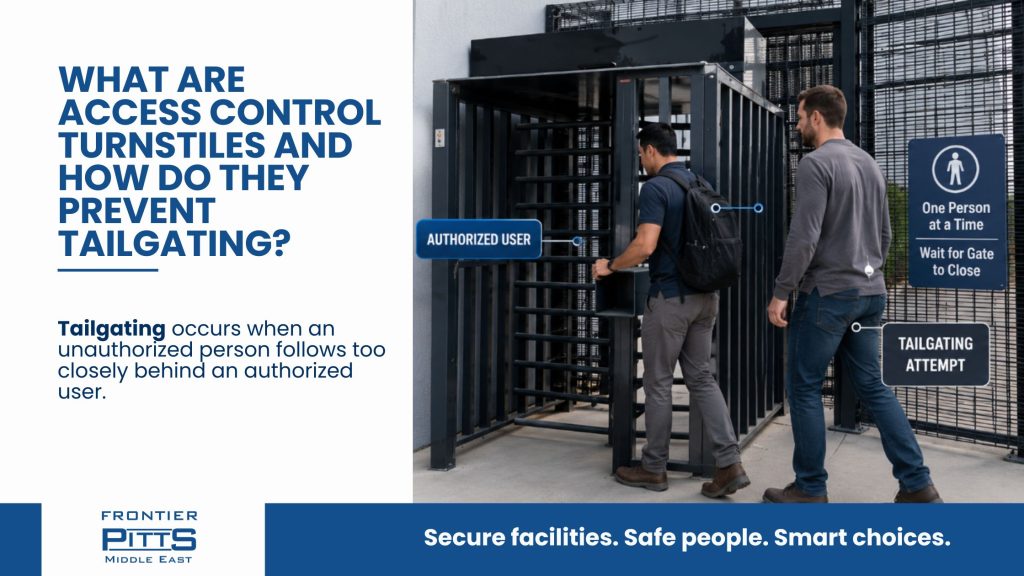
Access control turnstiles are physical barriers installed at entry points that allow only one authenticated person to pass per credential presentation. They prevent tailgating, the act of an unauthorised person following someone through a secured entrance, by mechanically resetting after each passage, integrating with biometric and card-based authentication, and triggering instant alerts on multi-person detection. They are the frontline standard for perimeter security across the UAE, GCC, and internationally.
Access control turnstiles are among the most reliable investments a facility can make. Across government campuses, energy facilities, data centres, and corporate headquarters throughout the UAE and GCC, they deliver something that digital systems alone cannot: a physical enforcement point that ensures every person who enters is who they say they are.
This guide walks you through everything from how turnstiles work and which standards matter, to how they fit into a complete perimeter security strategy written for security specifiers, facility managers, and decision-makers across the region.
| 1 in 5 physical breaches involve tailgating (ASSA ABLOY, 2024) | SR3 & SR4 LPS 1175 ratings — only turnstiles on market at this level | 10 min attack resistance — LPS 1175 SR4 test duration | GCC+ deployed in UAE, KSA, Oman, Qatar and beyond |
1. What Are Access Control Turnstiles?
An access control turnstile is a physical barrier installed at a pedestrian entry point that permits only one authorised person to pass per credential presentation. Once someone badges in whether by RFID card, PIN, fingerprint, or facial recognition the turnstile rotates or retracts to allow entry, then immediately resets. The mechanism itself enforces the rule.
This is the key distinction: unlike a standard door with a card reader, which opens freely for anyone nearby, a turnstile physically closes after each individual passes. Authorisation and access become the same event.
Common deployment locations across the GCC include:
- Government ministries and federal facilities
- Oil, gas, and utilities infrastructure
- Data centres and financial institutions
- Airports, seaports, and logistics hubs
- Hospital campuses and educational institutions
- Corporate office lobbies and industrial sites
| Frequently Asked What is the difference between a turnstile and a standard access gate? A standard gate or door opens fully on authentication meaning anyone nearby can follow through. A turnstile resets after each individual passage. One credential, one entry. The physical mechanism makes the enforcement absolute. |
2. Types of Access Control Turnstiles and Which Certifications Matter
Selecting the right turnstile begins with understanding both the security level you need and the certifications that back it up. Frontier Pitts Middle East offers three proven models, each designed for specific threat profiles and operational requirements.
| Turnstile Type | Key Certification & Features | Ideal Deployment |
| LPS 1175 Terra Diamond Turnstile | LPS 1175 Issue 6.1 — SR3 & SR4 | CPNI Approved | Red Book Listed | Nuclear, critical national infrastructure, government high-security zones |
| LPS 1175 Platinum Turnstile B3 | LPS 1175 Issue 8 — Security Rating B3 | CPNI Approved | Red Book Listed | Energy facilities, data centres, embassies, secure campuses |
| FPT1 Full Height Turnstile | 100% duty rated | Bespoke manufacture | 120° rotor option | Perimeter pedestrian control at gates, industrial sites, ports |
LPS 1175 Explained — The Standard That Defines High-Security Barriers
LPS 1175 is the Loss Prevention Standard issued by the Loss Prevention Certification Board (LPCB). It defines the requirements and testing procedures for physical security products including turnstiles against simulated intruder attacks using real tools.
Products rated to LPS 1175 are listed in the LPCB Red Book, the definitive reference for specifiers working on secure government and critical infrastructure projects. For GCC facilities aligned with UK or international security frameworks, Red Book listing is frequently a project requirement.
| Security Rating | Tool Category | Max Working Time | Max Test Duration |
| SR3 | C — Axe, bolt cutters, cordless drill, crowbar | 5 minutes | 20 minutes |
| SR4 | D — Sledgehammer, jigsaw, scissor jack, plate shears | 10 minutes | 30 minutes |
| KEY FACT — INDUSTRY FIRST Frontier Pitts is the first and only manufacturer in the world to achieve LPS 1175 Issue 6 certification for a full-height turnstile. The Terra Diamond Turnstile holds Security Ratings 3 and 4 — certified to withstand a sustained 10-minute tool attack under test conditions. No other turnstile on the market carries this rating. |
Product Spotlight: LPS 1175 Terra Diamond Turnstile
The Terra Diamond is the highest-rated access control turnstile available worldwide — certified to LPS 1175 Issue 6.1 at both SR3 and SR4, and CPNI approved for UK government use. It is installed at nuclear facilities, defence sites, and critical utilities both internationally and across the GCC.
| LPS 1175 Terra Diamond Turnstile LPS 1175 Issue 6.1: SR3 (Cert. 1059a/01) & SR4 (Cert. 1059a/02) | CPNI Approved | LPCB Red Book Listed |
| Design Features: Heavy-duty, high-security full-height construction — infilled rotor arms prevent climbing and pass-throughAnti-return solenoid lock and power locking bolt for complete lockdown capabilityFail-secure: turnstile remains secure during power failureTurnstile seeks next lock position — users cannot become trappedFull CPNI approved fenceline integration availableProven at nuclear and utility sites nationally and internationally View Product Details → |
Product Spotlight: LPS 1175 Platinum Turnstile B3
The Platinum Turnstile B3 is the world’s first LPS 1175-certified turnstile featuring a 120° rotor design (3-section walkway), setting a new benchmark in high-security access control. It is Red Book Listed and CPNI approved — an outstanding specification for energy, data, and government facilities.
| LPS 1175 Platinum Turnstile B3 LPS 1175 Issue 8 — Security Rating B3 | CPNI Approved | LPCB Red Book Listed |
| Design Features: First LPS 1175-rated turnstile with a 120° rotor (3-section walkway) innovative and industry-leadingHeavy-duty fully welded steel cage with high-security mesh backingPower locking bolt and anti-return solenoid for maximum securityFail-secure design: security maintained during power failureManual release handle for emergency / maintenance accessFull CPNI approved fenceline integration — ideal for critical infrastructureDimensions: L 1600mm × W 1600mm × D 300mm | Power: 230V 50Hz single phaseRotor options: 90° (4-section) or 120° (3-section walkway)Projects include: Pure Data Centre (UAE), Shakbout Rehabilitation (UAE), OETC Sohar Port and Oman power grid stations View Product Details → |
Product Spotlight: FPT1 Full Height Turnstile
The FPT1 is Frontier Pitts’s proven full-height perimeter turnstile, designed for deployment alongside security sliding gates or security hinged gates to provide combined pedestrian and vehicular control at facility boundaries. Bespoke manufacturing is available for site-specific requirements.
| FPT1 Full Height Turnstile 100% Duty Rating | Bespoke Manufacturing Available |
| Design Features: Designed for 100% duty rating continuous and frequent use at busy perimeter checkpoints120° rotor option available for improved throughput and flow managementSingle rotor configuration suitable for perimeter fenceline deploymentInterfaceable with any access control system (RFID, biometric, PIN)Optional: signs, special colour, lights, cowled switch, trombone rotorFoundation: L 1500mm × W 1300mm × D 300mm | Power: 230V 50Hz single phaseProjects include: OETC grid stations across Oman, UAE industrial sites, port facilities View Product Details → |
3. What Is Tailgating and Why Leading Organisations Take It Seriously
Tailgating (also called piggybacking) occurs when an unauthorised person follows an authorised individual through a secured entry point without presenting their own credentials. It is one of the most frequent physical security events recorded at corporate and government facilities worldwide.
According to ASSA ABLOY’s 2024 Access Control Report, approximately 1 in 5 reported physical security incidents involves tailgating. Notably, it often occurs without any harmful intent a held door, a waved colleague, a lingering visitor. Yet from a compliance perspective, the outcome is the same: an unverified person inside a controlled area with no access record.
Why Organisations in the GCC Prioritise Tailgating Prevention
The UAE and broader GCC region have seen significant investment in physical security infrastructure over the past decade, driven by smart city programmes, expanding critical infrastructure, and alignment with international security standards. Facilities regulated under government frameworks — including energy, transport, and financial services — require demonstrable controls over every entry point.
Access control turnstiles provide exactly that: a verified, logged record of every person who enters, and a physical mechanism that makes tailgating structurally impossible rather than just policy-dependent.
| Frequently Asked Is tailgating a compliance issue even when it is unintentional? Yes. Regulatory frameworks governing critical infrastructure, financial services, and government facilities treat unauthorised access as a compliance event regardless of intent. Turnstiles provide the physical and audit controls needed to demonstrate consistent compliance. |
4. How Access Control Turnstiles Prevent Tailgating. Step by Step
Modern access control turnstiles layer several complementary mechanisms to make tailgating structurally impossible. Here is how each layer works:
Step 1: One-Person-Per-Authentication Mechanics
The foundation. After each valid credential is accepted RFID card, PIN, fingerprint, facial recognition — the turnstile permits exactly one passage and then physically resets. This is hardware-enforced: it cannot be bypassed by social interaction or politeness.
Step 2: Anti-Passback Technology
Anti-passback prevents the same credential from authorising two consecutive entries. If someone badges in and passes their card back through or over the barrier to a colleague, the system declines the second attempt. The credential is logically ‘inside’ until a matching exit event is recorded.
Step 3: Infrared and Optical Tailgate Detection
Sensor arrays built into the turnstile lane detect the presence of more than one body during a single passage. When multi-occupancy is detected, the barrier locks, an audible alarm sounds, and the event is time-stamped in the access log. CCTV integration can trigger an automatic image capture at the same moment.
Step 4: Biometric Integration for Credential Assurance
At highest-security sites including those where LPS 1175-rated barriers are specified — turnstiles integrate with fingerprint readers, iris scanners, or facial recognition cameras to confirm that the person presenting a credential is its rightful holder. This eliminates card sharing and shoulder-surfing entirely.
Step 5: Fail-Secure Operation
Both the LPS 1175 Terra Diamond and the LPS 1175 Platinum Turnstile B3 are fail-secure by design. In the event of a power failure, the turnstile remains locked maintaining security integrity rather than defaulting to an open state. This is a critical design requirement for high-security sites and is often mandated in project specifications.
Step 6: Full Audit Trail and Real-Time Monitoring
Every entry event — successful or otherwise — is logged with a timestamp, credential identifier, and lane reference. Security operations teams receive real-time alerts on tailgating attempts. The complete audit trail supports compliance reporting, incident investigation, and ongoing access reviews.
| Frequently Asked Can Frontier Pitts turnstiles integrate with CCTV, biometrics, and access management platforms? Yes. All three Frontier Pitts turnstile models support open-protocol integration with CCTV, video analytics, facial recognition, fingerprint readers, and third-party access control software. Tailgate detection events can trigger simultaneous camera capture, control room alerts, and door or gate lockdowns. |
5. Turnstiles Within a Complete Perimeter Security Strategy
Turnstiles are the most effective pedestrian access control tool available — and they perform at their best as part of a layered perimeter security architecture. Effective physical security is built in concentric rings, each designed to detect, delay, and manage access before it reaches critical assets.
The Layered Security Model
- Outer perimeter: Anti-climb fencing, CCTV, perimeter intrusion detection systems, lighting
- Vehicle access control: HVM barriers, road blockers, crash-rated gates, automatic boom barriers — tested to PAS 68 and IWA 14
- Pedestrian entry points: LPS 1175-rated access control turnstiles, security airlocks, manned reception
- Internal zone control: Door-level access, biometrics, internal turnstiles for sensitive areas
Frontier Pitts Middle East provides all four layers from a single, factory-direct British manufacturer. This means complete system integration, consistent certification documentation, and a single point of accountability for your entire security envelope.
GCC Infrastructure and Perimeter Security Investment
Investment in perimeter security solutions across the GCC has grown substantially, with UAE Vision 2031, Saudi Vision 2030, and Qatar National Vision 2030 each driving major infrastructure programmes in energy, transport, and smart cities. Security specifications for these programmes routinely include international standards — LPS 1175, PAS 68, IWA 14 — making certified, Red Book-listed products the expected baseline.
| Frequently Asked What is the difference between perimeter security and access control? Perimeter security establishes and protects the outer boundary of a facility through physical barriers, detection systems, and surveillance. Access control manages who is permitted through defined entry points. Turnstiles are the intersection: they sit at entry points and physically enforce the permissions defined by your access control policy. |
6. Hostile Vehicle Mitigation and How It Works Alongside Turnstiles
A hostile vehicle mitigation (HVM) system is a certified physical barrier solution designed to stop a vehicle from breaching a facility perimeter — whether through a gate, a car park entrance, or an open roadway. HVM systems include crash-rated road blockers, automatic bollards, swing barriers, and sliding or hinged security gates, all tested and certified to international impact standards.
Frontier Pitts Middle East supplies a complete HVM range, each product tested to PAS 68 or IWA 14 — the internationally recognised standards for vehicle-borne attack resistance:
- PAS 68-rated barriers, road blockers, and bollards — tested to UK standards for hostile vehicle impact
- IWA 14-rated automatic bollards and swing barriers — international standard adopted across the GCC
- Crash-rated sliding and hinged security gates — for vehicle entry control at main campus access points
How HVM and Turnstiles Work Together
HVM addresses the vehicular threat at the outer perimeter. Turnstiles manage the pedestrian threat at building entry points. Together, they form a complete security envelope covering both attack vectors — the two areas most commonly specified together on critical infrastructure projects.
- HVM layer: Stops vehicle-borne threats at the perimeter boundary before they reach the facility
- Turnstile layer: Ensures every pedestrian entering the building is authorised, verified, and logged
- Integration: Both systems can feed into a unified security management platform for centralised monitoring
| SPECIFICATION GUIDANCE For sites requiring both HVM and turnstile solutions — such as energy facilities, port authorities, and government campuses — Frontier Pitts Middle East can supply and install a fully integrated, certified solution from a single manufacturer. This simplifies procurement, certification documentation, and long-term maintenance accountability. |
| Frequently Asked Do we need both a hostile vehicle mitigation system and access control turnstiles? For facilities on government, energy, or critical infrastructure frameworks — yes. HVM and turnstiles address different threat vectors. A complete security specification combines both: HVM at the perimeter for vehicle threats, turnstiles at building entry for pedestrian access control. Frontier Pitts can supply both from a single certified manufacturer. |
7. Turnstile Selection Checklist for GCC Facilities
Use this checklist when evaluating and specifying access control turnstiles for your site:
- Define the security level required does the specification require LPS 1175 certification? If so, which Security Rating (B3, SR3, or SR4)?
- Confirm whether CPNI approval and LPCB Red Book listing are project requirements
- Establish peak throughput requirements people per hour to determine single or twin-rotor configuration
- Identify the credential types to be used: RFID, biometric, facial recognition, PIN, or multi-factor
- Confirm integration requirements with existing access control software and CCTV platforms
- Review outdoor installation requirements: IP-rated enclosures and stainless-steel finishes for UAE/GCC climate
- Consider accessibility requirements: does the site need a wide-lane option alongside standard turnstile lanes?
- Confirm fail-secure vs. fail-safe requirements based on your life safety and security policy
- Determine whether HVM coverage is also required at vehicle access points — and whether a single-supplier approach is preferred
- Confirm local support and maintenance availability — Frontier Pitts Middle East is based in Abu Dhabi
8. Frequently Asked Questions
Q1. What does LPS 1175 certification mean for an access control turnstile?
LPS 1175 is the Loss Prevention Standard issued by the LPCB, which certifies physical security products against simulated intruder attacks using real tools. Ratings run from SR1 to SR8 (or B1 to B8 in Issue 8). The Frontier Pitts Terra Diamond Turnstile holds SR3 and SR4 under Issue 6.1 — meaning it successfully resisted a 10-minute tool attack with Category D tools including sledgehammers, jigsaws, and plate shears. It is the only turnstile in the world with this certification.
Q2. What is the difference between LPS 1175 SR3/SR4 and LPS 1175 B3?
SR3 and SR4 refer to Security Ratings under LPS 1175 Issue 6.1 (the legacy rating system), while B3 refers to the equivalent rating under LPS 1175 Issue 8 (the current standard). The Frontier Pitts Platinum Turnstile B3 is certified under the current Issue 8 framework, while the Terra Diamond holds both SR3 and SR4 under Issue 6.1. Both are Red Book Listed and CPNI approved.
Q3. Are Frontier Pitts turnstiles suitable for outdoor installation in the UAE?
Yes. The FPT1, Terra Diamond, and Platinum Turnstile B3 are all designed for perimeter and outdoor use, with specifications suitable for the GCC climate including high temperatures, dust, and humidity. For outdoor installation, stainless-steel finishes and IP-rated enclosures are recommended and available — confirm with the Frontier Pitts Middle East team for site-specific guidance.
Q4. What happens to the turnstile during a power failure?
Both the LPS 1175 Terra Diamond and LPS 1175 Platinum Turnstile B3 are fail-secure by design. During a power failure, the turnstile remains locked, maintaining security integrity. This is a core feature of LPS 1175-certified products and is typically mandatory in government and critical infrastructure specifications.
Q5. Can one turnstile manage both entry and exit?
Yes. Bi-directional configurations are available for sites where space is a consideration and separate in/out lanes are not practical. For higher-security environments or compliance-sensitive sites, dedicated entry and exit lanes are often preferred to maintain a clean audit trail.
Q6. What industries use access control turnstiles in the GCC?
Frontier Pitts turnstiles are deployed across government and federal facilities, oil and gas infrastructure (including OETC grid stations in Oman), data centres, ports and logistics hubs, hospital campuses, and corporate office environments throughout the UAE, Saudi Arabia, Oman, Qatar, and Bahrain.
Q7. Can turnstiles integrate with visitor management systems?
Yes. Modern access control turnstiles integrate with visitor management platforms to issue temporary credentials, automatically expire access at set times, and maintain a complete visitor movement record. This is particularly valuable for high-footfall facilities that need to balance openness with audit accountability.
Q8. What is the expected service life of a commercial-grade turnstile?
With regular preventive maintenance, commercial-grade turnstiles typically deliver 10 to 15 years of reliable operation. High-cycle models — such as the FPT1 with its 100% duty rating — are designed for continuous and frequent use at busy perimeter checkpoints. Frontier Pitts Middle East provides maintenance, spare parts, and warranty support from its Abu Dhabi office.
Q9. How do turnstiles support compliance and audit requirements?
Every passage through an access control turnstile is time-stamped and logged against a specific credential. This creates a complete, tamper-resistant record of facility access — supporting compliance reporting for government frameworks, ISO standards, and sector-specific regulations. Real-time alerts on tailgating attempts are also logged, providing evidence of active access management.
Q10. What is the difference between an optical speed gate and a full-height turnstile?
An optical speed gate uses retractable barriers and infrared sensors — it is fast, sleek, and suited to high-throughput environments such as corporate lobbies. A full-height turnstile uses a physical cage that completely encloses the passage, making it structurally impossible to climb over or reach around. Many high-security sites deploy optical speed gates in public-facing areas and full-height or LPS 1175-rated turnstiles at restricted inner access points.
| Sources & References 1. Loss Prevention Certification Board (LPCB): LPS 1175 Red Book Listings: lpcb.org 2. ASSA ABLOY Access Control Report 2024: Physical Security Incident Data 3. Centre for the Protection of National Infrastructure (CPNI): Catalogues of Security Equipment: cpni.gov.uk 4. Frontier Pitts Middle East: Product Catalogues and Certification Certificates: fpgulf.com 5. British Standards Institution (BSI): PAS 68:2013 and IWA 14-1:2013 Vehicle Security Barrier Standards 6. UAE Ministry of Interior: Critical Infrastructure Security Framework (referenced in project specifications) |
| Speak with a Specialist Frontier Pitts Middle East provides factory-direct, British-manufactured turnstile solutions, LPS 1175 certified, CPNI approved, and proven across critical infrastructure sites throughout the UAE, Saudi Arabia, Oman, and the wider GCC. 📞 +971 26212272 ✉ sales@frontierpitts.ae Office 1301, Building C88, Commercial Tower A, 15 Baghdad St, Abu Dhabi, UAE Explore All Turnstile Products → fpgulf.com/products-category/turnstiles |
Follow Frontier Pitts Middle East on Google
Add fpgulf.com as a Preferred Source to see more of our latest insights on hostile vehicle mitigation, security bollards, road blockers and high-security access solutions in Google Search.