
Why Crash-Rated Road Blockers Are Now Essential In The Middle East
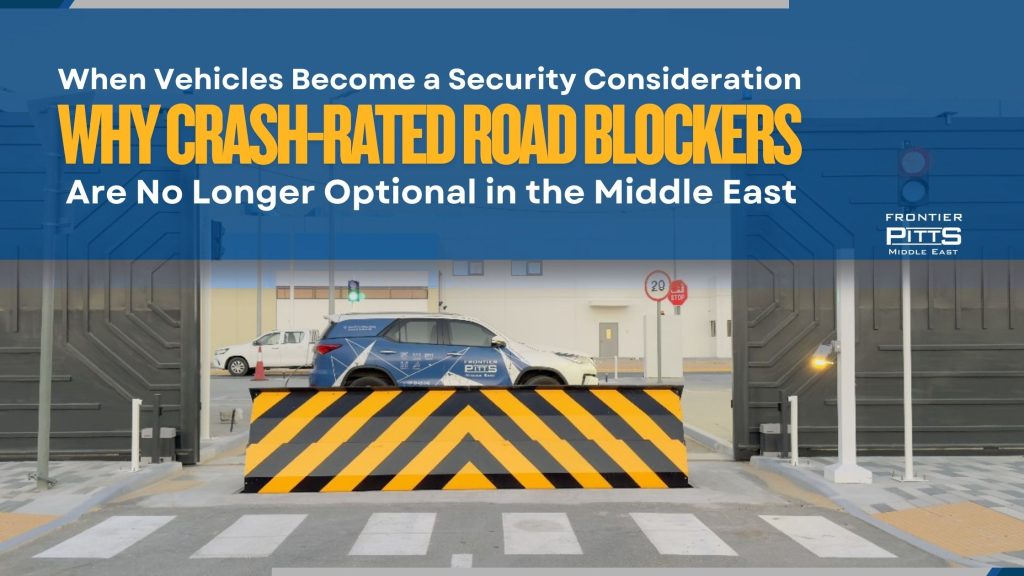
Crash-rated HVM road blockers are no longer optional in the Middle East because vehicles now represent a primary perimeter-security risk. Certified to international standards, these systems physically stop hostile vehicles, protect critical infrastructure, and meet regulatory expectations for airports, government facilities, and energy assets operating in high-risk environments.
Author: Frontier Pitts Middle East Engineering Team
Credentials: Specialists in Hostile Vehicle Mitigation (HVM) and perimeter security systems
Last Updated: January 2026
Vehicles Are No Longer Neutral — They’re a Security Variable
There was a time when perimeter security focused on people. Fences guided movement. Gates controlled access. Vehicles were just… vehicles.
That time has passed.
Across Abu Dhabi, Dubai, Saudi Arabia, and Oman, modern infrastructure sits closer to roads, logistics corridors, and public spaces than ever before. Vehicles now combine mass, speed, and accessibility, making them one of the most significant perimeter risks facing infrastructure owners today.
At Frontier Pitts Middle East, we approach this reality pragmatically. When vehicles become a security consideration, engineering—not assumptions—must lead the response.
That response is certified HVM (Hostile Vehicle Mitigation) road blockers.
What Is a Crash-Rated HVM Road Blocker?
A crash-rated HVM road blocker is a purpose-engineered, impact-tested barrier designed to physically stop a hostile vehicle under defined conditions.
Unlike conventional traffic barriers, HVM road blockers are:
- Independently tested to PAS 68, IWA 14-1, or ASTM F2656
- Designed to absorb and dissipate kinetic energy
- Rated for vehicle weight, speed, and penetration distance
- Engineered as part of an integrated perimeter security solution
If a system has not passed a certified crash test, it is not an HVM solution.
Why Certification Matters More Than Claims
In perimeter security, opinions don’t stop vehicles. Physics does.
Crash testing subjects a fully loaded vehicle to a controlled, high-speed impact against the blocker. Engineers then measure:
- Vehicle penetration distance
- Structural deformation
- Foundation stability
According to the UK Centre for the Protection of National Infrastructure (CPNI) and NPSA (2024), certified HVM barriers reduce vehicle-borne attack penetration by over 90% compared to non-rated systems.
That’s why insurers, consultants, and regulators increasingly require certified systems, not “enhanced” or “reinforced” alternatives.
Sources:
- UK National Protective Security Authority (NPSA), 2024
- ASTM International F2656 Standard
- IWA 14-1:2013 Vehicle Security Barriers
Why Shallow-Foundation HVM Road Blockers Are Critical in the Middle East
Here’s a reality competitors often gloss over: you can’t always dig deep.
Urban Middle Eastern sites are packed with utilities, drainage systems, and live services. Deep foundations increase cost, risk, and downtime—sometimes making installation impossible.
Shallow-foundation HVM road blockers solve this by delivering:
- Certified crash performance
- Reduced excavation depth
- Faster installation in live environments
- Lower risk to underground services
This is not a compromise. It is engineering adaptation to regional conditions—and a key reason HVM adoption has accelerated across GCC infrastructure projects since 2023.
Where Crash-Rated Road Blockers Are Now Standard
HVM road blockers are no longer “high-risk only” solutions. They are standard for:
- Airports and aviation hubs
- Government and diplomatic facilities
- Oil and gas installations
- Utilities, data centers, and power plants
- Ports, logistics hubs, and military facilities
According to Global Infrastructure Security Review (2025), over 70% of new Middle East critical-infrastructure projects now specify certified HVM systems at primary vehicle access points.
HVM Road Blockers vs Traditional Vehicle Barriers
| Feature | Traditional Barriers | HVM Road Blockers |
|---|---|---|
| Crash tested | No | Yes |
| Certified standards | None | PAS / IWA / ASTM |
| Designed to stop hostile vehicles | No | Yes |
| Suitable for critical infrastructure | Limited | Essential |
| Engineering accountability | Low | High |
This distinction matters when projects face audits, compliance checks, or post-incident reviews.
Step-by-Step: How HVM Road Blockers Protect a Site
- Threat assessment defines vehicle type and speed
- Certified blocker selection matches threat profile
- Foundation design adapts to site constraints
- Integration with access control and guard operations
- Ongoing maintenance ensures operational readiness
Skipping any step weakens the entire perimeter.
5 Common Questions Decision-Makers Ask (Direct Answers)
Are crash-rated road blockers mandatory?
Often yes. Many projects require them due to insurance, consultant, or authority mandates—even where not explicitly written into law.
Can HVM road blockers operate daily?
Yes. They are designed for frequent cycling while maintaining impact performance.
Do shallow road blockers compromise strength?
No. Certified shallow systems meet the same crash standards as deep-foundation designs.
Can they integrate with access control systems?
Yes. Integration with access control, CCTV, and command centers is standard practice.
Why choose a specialist supplier?
Because certification, installation quality, and lifecycle support determine whether a system performs when tested.
Why Frontier Pitts Middle East Is Trusted
Trust in perimeter security isn’t built on brochures. It’s built on engineering heritage, certification, and accountability.
Frontier Pitts Middle East provides:
- Certified HVM road blocker systems
- Engineering-led specification support
- Alignment with international and regional standards
- Long-term serviceability and compliance support
Our role is not to sell hardware. It is to help clients defend decisions under scrutiny.
Final Word: Security That Holds Up Under Impact
When vehicles become a security consideration, the perimeter must do more than look strong—it must prove strength under test conditions.
Crash-rated HVM road blockers deliver certainty in an uncertain risk landscape. For Middle Eastern infrastructure owners, they are no longer optional upgrades. They are responsible, defensible infrastructure design.
Actionable Next Steps
If you’re planning or reviewing perimeter security for a critical site, engage with Frontier Pitts Middle East early. We’ll help you align certification, site constraints, operational needs, and long-term performance—before decisions become liabilities.
Strong security begins with engineered certainty.