
Why Vehicle Presence Detection is Crucial for High-Security Gates
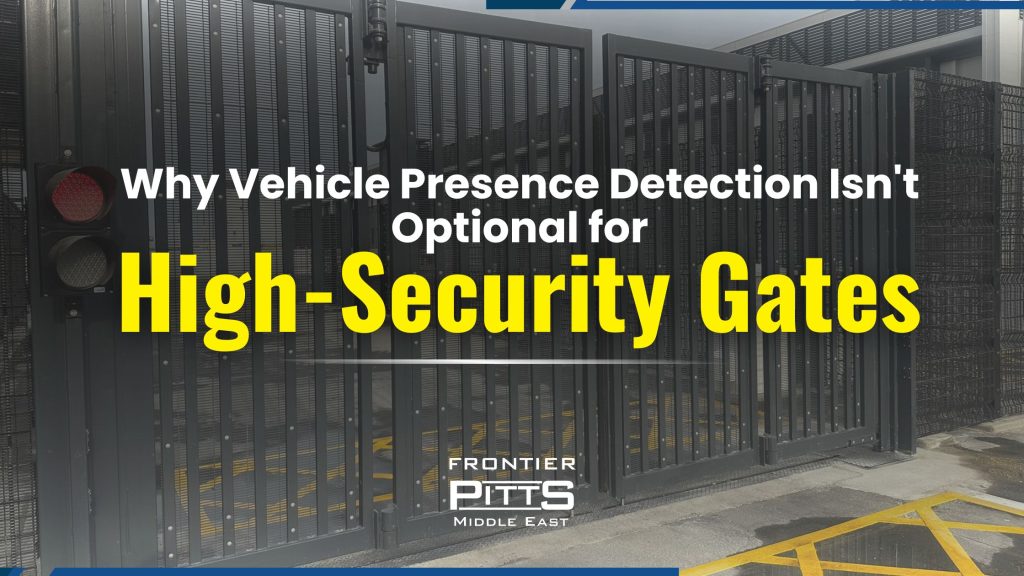
Vehicle Presence Detection Isn’t Optional for High-Security Gates
Direct Answer: Vehicle presence detection systems are essential to prevent automated security gates from closing on vehicles or objects, significantly reducing the risk of injury by up to 95%. They also eliminate costly equipment damage in high-security facilities across the Middle East.
At Frontier Pitts Middle East, when designing perimeter security systems, clients often focus primarily on crash ratings and threat mitigation. However, we understand that a PAS 68-rated gate designed to stop a 7.5-tonne truck travelling at 80 km/h can still cause catastrophic damage if it closes on a vehicle in its path.
This isn’t just a theoretical concern. We’ve seen such incidents occur.
What Vehicle Presence Detection Actually Does
A vehicle presence detection system creates an invisible safety zone around your gate. When anything enters that zone—a vehicle, a person, or even debris—the system either prevents the gate from moving or stops it immediately. Think of it as the difference between a car with airbags and one without. Both will take you from point A to point B, but only one protects you when something goes wrong.
How it works in practice:
- Sensors continuously monitor the gate’s movement zone.
- Detection triggers halt all gate operations instantly.
- The gate remains stopped until the zone clears.
- Movement only resumes after explicit confirmation.
This is in line with EN 12453 standards for powered gate safety, a framework that we integrate into every system we engineer.
Why Middle East Infrastructure Demands This Technology
The region presents unique challenges. For example, at a logistics facility in Dubai, a delivery truck’s trailer extended into the gate zone while the driver completed paperwork. The gate’s timer initiated closing, but without presence detection, the gate would have struck the trailer. Fortunately, radar-based detection was installed, preventing any incident.
The real cost of not having this safety layer includes:
- Equipment damage: £11,000-£38,000 per incident
- Operational downtime: 3-7 days on average
- Regulatory investigation exposure
- Reputational damage for government facilities
- Potential injury liability
In a refinery project in Oman, we specified surface-mounted radar sensors for safety detection, and two years later, there have been zero incidents.
The Technology Behind Presence Detection
We offer several detection technologies to meet the unique needs of each environment:
- Inductive Loop Detection: Best for controlled access points such as airports and military facilities. Offers 99.8% detection accuracy under optimal conditions but requires excavation.
- Radar-Based Sensors: Surface-mounted systems that are ideal for areas like refineries or industrial sites, with a detection range of 30-50 metres. These require minimal civil work.
- Infrared Safety Beams: Create a virtual barrier, used as secondary safety layers. Suitable for pedestrian zones but affected by dust or sunlight.
- Advanced LIDAR Systems: Laser scanning technology for precision monitoring, used for critical infrastructure, and distinguishing between vehicle types and sizes.
How This Integrates With Crash-Rated Systems
A crash-rated gate and its safety systems must work together seamlessly. We engineer gates certified to PAS 68 and IWA 14-1 standards for hostile vehicle mitigation, while also ensuring they’re equipped with:
- PLC-controlled safety logic, which overrides gate commands when presence is detected.
- Hydraulic system communication, ensuring smooth stops without mechanical stress.
- Emergency stop circuits independent of primary controls.
- Redundant detection layers for mission-critical facilities.
Common Mistakes We See (And How to Avoid Them)
Mistake 1: Using Residential-Grade Equipment
We specify industrial-grade sensors with MTBF (Mean Time Between Failures) ratings exceeding 100,000 cycles. Residential-grade sensors aren’t designed for the high frequency of use in commercial gates.
Mistake 2: Inadequate Detection Coverage
Vehicles such as car carriers or articulated trucks may extend beyond standard detection zones. We calibrate systems based on actual traffic analysis rather than generic specifications.
Mistake 3: Treating Safety as an Add-On
Presence detection should be designed alongside the gate system from day one to ensure seamless integration and full coverage.
Mistake 4: Ignoring Environmental Factors
Environmental conditions such as high temperatures, dust storms, and humidity in the Middle East require specific sensor ratings, such as IP67 or IP68 ratings and operational temperature ranges.
A Practical Checklist for Your Next Project
Before commissioning any automated security gate, ensure:
- Detection coverage extends beyond the longest expected vehicle.
- Integration testing confirms all safety scenarios work correctly.
- Environmental protection matches your site conditions (heat, dust, moisture).
- Redundant safety measures are in place for high-consequence facilities.
- Inspection procedures are documented and scheduled.
- Operator training covers both normal and emergency scenarios.
- Bypass procedures require documented authorization.
Why Government Facilities Can’t Ignore This
For public sector clients airports, government buildings, critical infrastructure—presence detection isn’t just a best practice; it’s a regulatory requirement. With presence detection, you can answer the following questions confidently:
- Was the system designed to current safety standards?
- Were appropriate detection systems specified?
- Was integration testing verified?
- Were operators properly trained?
These decisions should be documented during procurement, not after an incident.
Ready to Enhance Your Facility’s Security?
Ensure your gates are equipped with the latest in Vehicle Presence Detection technology. Protect your infrastructure, prevent costly damage, and meet critical safety standards.
Contact us today to discuss custom solutions that fit your unique needs. Don’t wait for an incident—invest in safety now.