
Combining HVM Barriers & Turnstiles GCC Security Guide
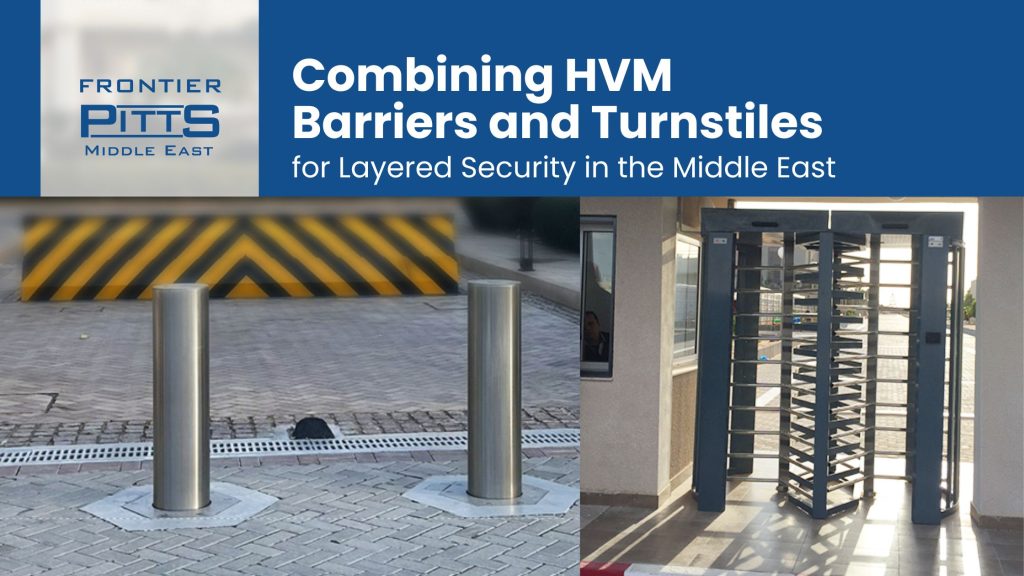
Layered security combines hostile vehicle mitigation (HVM) barriers and full height turnstiles to control both vehicle and pedestrian access in high-risk environments. HVM systems stop vehicle threats at the perimeter, while turnstiles regulate human entry. Together, they form a multi-layer defense widely used across UAE, Saudi Arabia, and GCC critical infrastructure.
Why Layered Security Is Now Essential in GCC Infrastructure
At Frontier Pitts Middle East, we have seen a clear shift: infrastructure owners are moving from single-point protection to integrated perimeter security solutions. The reason is simple – modern threats are multi-dimensional.
According to the International Organization for Standardization, critical infrastructure protection now requires multi-layered risk mitigation, especially in high-traffic public environments.
In the GCC and Saudi Arabia, facilities such as airports, oil terminals, and logistics hubs face:
- Vehicle-borne threats
- Unauthorized pedestrian access
- High-density movement at entry points
A single system cannot address all three effectively.
How HVM Barriers and Turnstiles Work Together
We design layered systems with a simple principle:
separate, control, and protect.
1. Outer Layer: Vehicle Protection
HVM systems including bollards, road blockers, and gates are deployed to stop hostile vehicles.
These systems are tested under standards such as:
- PAS 68 (UK crash testing standard)
- IWA 14 (global impact certification)
2. Inner Layer: Pedestrian Control
Once vehicle threats are managed, full height turnstiles ensure only authorized individuals can enter.
They:
- Prevent tailgating
- Enforce single-person entry
- Integrate with biometric and ID systems
Real-World Application (What We See on Site)
In a recent logistics facility project in Saudi Arabia, we observed a common issue:
vehicles were secured, but pedestrian access was loosely controlled.
After implementing:
- Certified HVM barriers at entry roads
- Full height turnstiles at staff access points
The facility achieved:
- Improved access tracking
- Reduced unauthorized entry
- Faster throughput during peak hours
Step-by-Step: Designing a Layered Security System
For infrastructure owners and consultants, here is a practical framework we use:
Step 1: Identify Risk Zones
Define outer (vehicle) and inner (pedestrian) layers.
Step 2: Install Certified Security Barriers
Deploy hostile vehicle mitigation barriers at all vehicle access points.
Step 3: Implement Turnstile Access
Install full height turnstiles at controlled entry points.
Step 4: Integrate Systems
Connect barriers and turnstiles to:
- CCTV
- Access control platforms
- Central monitoring systems
Step 5: Optimize Movement Flow
Separate pedestrian and vehicle traffic to avoid bottlenecks.
Comparison: HVM Barriers vs Turnstiles
| Feature | HVM Barriers | Full Height Turnstiles |
|---|---|---|
| Primary Role | Stop vehicles | Control people |
| Threat Type | Vehicle-based | Unauthorized access |
| Placement | Outer perimeter | Inner zones |
| Standards | PAS 68 / IWA 14 | LPS 1175 |
| Typical Use | Roads, entrances | Staff and secure entry |
Key Insight:
Facilities that integrate both systems experience significantly higher control efficiency than those relying on a single layer.
Supporting Data and Industry Insight
- The ASIS International highlights that layered security reduces risk exposure by up to 60% in high-security facilities.
- A report from National Institute of Standards and Technology emphasizes the importance of defense-in-depth strategies for infrastructure resilience.
- Middle East smart city initiatives increasingly mandate integrated systems combining vehicle mitigation and access control.
Common Mistakes We See (And How to Avoid Them)
1. Relying on a Single System
A barrier alone cannot manage pedestrian access.
2. Ignoring Certification Standards
Using non-tested systems exposes facilities to compliance risks.
3. Poor Integration
Disconnected systems slow response time and reduce effectiveness.
4. Overlooking Flow Design
Security must not compromise operational efficiency.
Choosing the Right Middle East Barrier Supplier
Not all providers offer true integration.
When evaluating perimeter security solutions UAE companies, we recommend:
- Verify PAS 68 or IWA 14 certification
- Assess integration capability (not just product supply)
- Ensure regional experience in UAE and Saudi Arabia
- Confirm long-term maintenance support
At Frontier Pitts Middle East, we focus on system design – not just installation.
Recommended HVM Solution for Urban Environments
In dense urban projects, shallow mount systems are often preferred due to limited excavation depth.
We recommend reviewing this solution:
👉 https://fpgulf.com/products/pas-68-shallow-terra-venus-bollards-7-5t-48kph/
These systems are widely used in UAE infrastructure projects where underground utilities are present.
Related Questions
What is a hostile vehicle mitigation system?
A system designed to stop or slow vehicles using certified barriers such as bollards and road blockers.
Why combine HVM barriers and turnstiles?
Because vehicle and pedestrian threats require different control mechanisms.
What standards apply in the Middle East?
PAS 68 and IWA 14 are widely used for vehicle barrier testing.
Are full height turnstiles secure for government facilities?
Yes, they provide controlled, single-person entry and integrate with advanced access systems.
What industries benefit most from layered security?
Airports, oil & gas, logistics hubs, and government facilities.
Final Thoughts: Building Resilient Infrastructure
Layered security is no longer optional-it is essential.
By combining:
- Hostile vehicle mitigation systems
- Full height turnstiles
- Integrated monitoring
Infrastructure owners can achieve:
- Higher protection levels
- Better operational flow
- Long-term resilience
Next Steps
If you are planning a new project or upgrading an existing facility:
- Review your current perimeter setup
- Identify gaps between vehicle and pedestrian security
- Work with a specialist to design a layered solution
At Frontier Pitts Middle East, we support infrastructure owners, consultants, and government agencies across the GCC in delivering future-ready perimeter security systems. Visit us www.fpgulf.com.
Follow Frontier Pitts Middle East on Google
Add fpgulf.com as a Preferred Source to see more of our latest insights on hostile vehicle mitigation, security bollards, road blockers and high-security access solutions in Google Search.