
Five HVM Specification Checks That Should Be Completed Before Selecting a Vehicle Security Barrier
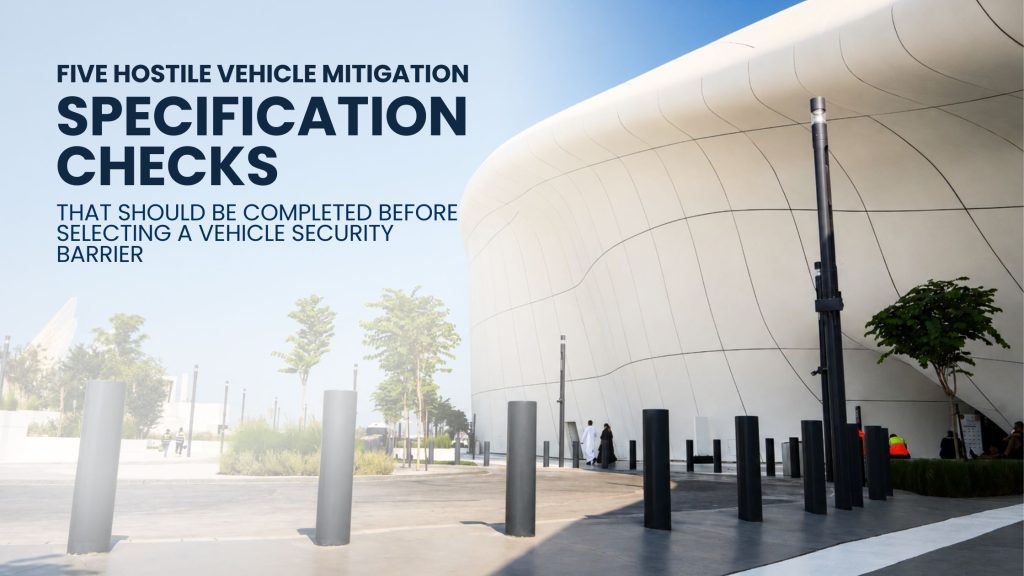
HVM specifications should match a documented vehicle threat, including vehicle mass, speed, angle and required impact performance. Project teams must also verify the tested foundation, site suitability, operational safety, maintenance and technical support. ISO 22343-1:2023 covers impact testing, while ISO 22343-2:2023 covers selection, installation and use.
Before selecting a Vehicle Security Barrier, project teams should confirm five areas: the site-specific vehicle threat, the complete impact-test rating, compatibility with the tested installation, operational and safety requirements, and long-term maintenance support. A product described only as “crash-rated” or “high security” does not provide enough information for a responsible Hostile Vehicle Mitigation specification.
What Is Hostile Vehicle Mitigation?
Hostile Vehicle Mitigation, or HVM, is the risk-based use of security planning, traffic management, operating procedures and physical measures to reduce threats from vehicles used as weapons, delivery systems or tools for forced entry. A Vehicle Security Barrier is one physical component of an HVM scheme, not a complete security strategy by itself.
Vehicle security barriers may include:
- Static, removable or automatic bollards
- Rising road blockers and wedge barriers
- Crash-rated sliding, hinged or bi-folding gates
- Beam barriers and rising-arm barriers
- Temporary vehicle security barriers
- Integrated traffic-calming and access-control measures
The correct product depends on the assessed threat, the road layout, the protected asset, daily traffic movements and the physical conditions at the proposed installation point.
Why Correct HVM Specification Matters
Airports, government buildings, logistics centres, military facilities, utilities and oil and gas sites may face several types of vehicle-related risk. These can include deliberate vehicle-ramming attacks, unauthorised entry, vehicles carrying attackers or weapons, and vehicle-borne improvised explosive devices.
The UK National Protective Security Authority explains that HVM should be informed by the threat, potential consequences, site vulnerability and the operational needs of the organisation being protected. HVM therefore begins with risk assessment and security planning rather than with a product catalogue.
Poor specification can result in:
- A barrier tested against the wrong vehicle type or speed
- Excessive penetration into the protected area
- Conflict with underground utilities
- Unsafe interaction with vehicles or pedestrians
- Traffic congestion at an operational entrance
- Expensive redesign during construction
- A system that cannot be maintained locally
- A certified product being installed differently from its tested configuration
The purpose of an HVM specification is not to select the strongest product available. The purpose is to select a product whose verified performance, configuration and operation match the identified risk.
How a Hostile Vehicle Mitigation System Is Developed
A structured hostile vehicle mitigation system normally follows this sequence:
- Identify the assets, people and operations requiring protection.
- Assess possible vehicle threats and attack routes.
- Estimate the credible vehicle type, mass, speed and impact angle.
- Define the required vehicle penetration and debris limits.
- Prepare the operational requirements for the site.
- Compare independently tested Vehicle Security Barrier options.
- Confirm foundations, utilities, access control and safety integration.
- Install the system in accordance with the approved design.
- Test, commission, operate and maintain the completed system.
ISO 22343-2:2023 provides guidance for selecting, installing and using vehicle security barriers and for preparing operational requirements. ISO 22343-1:2023 addresses vehicle-impact performance requirements, testing and performance ratings.
Main Benefits of Completing the Five Checks
Completing the checks before procurement can help project teams:
- Match barrier performance to a credible threat
- Compare quotations on an equal technical basis
- Reduce design changes and construction delays
- Protect the required stand-off distance
- Improve traffic flow and access-control planning
- Identify utility and foundation constraints early
- Establish clear maintenance responsibilities
- Create an auditable technical decision
HVM Specification Checks at a Glance
| Specification check | Main question | Evidence required |
|---|---|---|
| 1. Threat and approach | What vehicle can reach the barrier, and at what speed and angle? | Risk assessment and vehicle dynamics assessment |
| 2. Impact-test rating | What exactly was tested and what penetration occurred? | Full test classification and independent report |
| 3. Installation configuration | Can the tested foundation and arrangement be reproduced? | Drawings, foundation details and site survey |
| 4. Operation and safety | How will the barrier work during normal and emergency conditions? | Operational requirement and control philosophy |
| 5. Lifecycle support | How will performance be maintained over the system’s service life? | Maintenance plan, training, spares and documentation |
The Five HVM Specification Checks
1. Confirm the Threat Vehicle, Speed and Approach Angle
The first check is whether the proposed barrier rating matches the credible vehicle threat.
A vehicle dynamics assessment examines the routes a hostile vehicle could use to approach the protected area. The assessment should consider straight roads, bends, junctions, kerbs, gradients, traffic-calming features, restricted turning areas and other conditions that may affect achievable impact speed.
Important parameters include:
- Vehicle classification
- Vehicle mass
- Maximum credible approach speed
- Expected impact angle
- Direction of attack
- Available acceleration distance
- Possibility of more than one impact
- Intended location of the protected line
Vehicle mass alone is not enough. The size, structure, speed and impact angle of the test vehicle can all affect barrier performance.
Practical example
A barrier tested with a 7,200 kg vehicle at 48 km/h should not automatically be treated as equivalent to a barrier tested with the same vehicle mass at 80 km/h. Speed has a major effect on impact conditions, so the complete classification must be reviewed.
The project specification should state the required test vehicle, test mass, impact speed and impact angle rather than requesting only a “crash-rated barrier.”
2. Verify the Full Impact-Test Classification
The second check is the exact standard and complete performance rating achieved by the Vehicle Security Barrier.
ISO 22343-1:2023 is the current international standard covering vehicle-impact performance requirements, testing and ratings. PAS 68:2013 and IWA 14-1:2013 have been withdrawn, but NPSA guidance states that existing test results may remain valid when the rated barrier has not been changed from its tested configuration.
A proper classification should identify:
- Test standard
- Barrier type
- Vehicle classification and test mass
- Impact speed
- Impact angle
- Vehicle penetration distance
- Major debris distance, where reported
- Tested foundation and barrier arrangement
A rating applies to specific impact-test conditions. It does not prove that the barrier will provide the same performance against every vehicle, speed, angle, site condition or repeated attack.
Is a crash-rated barrier automatically suitable?
No. A crash rating confirms performance under defined test conditions, but suitability depends on whether those conditions match the site’s threat assessment, required penetration limit, foundation, layout and operating needs.
Project teams should request the independent test report or verified certification rather than relying only on a brochure headline.
It is also important not to confuse impact resistance with other forms of security testing. ISO 22343-1 does not assess slow-speed nudging, repeated ramming, blast, ballistic attack, manual tool attack, electrical manipulation or attacks against the control system. Those risks may require additional standards, design measures or testing.
3. Match the Tested Configuration to the Actual Site
The third check is whether the proposed installation reproduces the configuration that achieved the stated rating.
An impact rating is normally connected to a particular foundation, spacing, barrier width, arrangement and installation method. Changes to those elements should be reviewed by competent engineers and formally supported by the manufacturer or responsible test evidence.
Confirm the following:
- Foundation depth, width and reinforcement
- Concrete specification
- Required anchoring system
- Bollard spacing or barrier clear width
- Ground conditions
- Finished road or pavement level
- Drainage requirements
- Underground utilities
- Nearby structures and foundations
- Barrier orientation and impact direction
- Cabinet, hydraulic power unit and control-panel locations
ISO 22343 recognises that geographical conditions and the intended site surface or soil conditions are relevant to barrier performance and application.
For teams evaluating perimeter security solutions in the UAE, early utility surveys are especially important. Shallow-foundation or surface-mounted high-security barriers may be considered where deep excavation is restricted, but the selected system must still provide the required tested performance.
A shallow foundation is an engineering advantage only when the foundation design is compatible with the project’s actual ground conditions and utility layout.
4. Define Operation, Safety and Access-Control Integration
The fourth check is how the barrier will function during normal operation, equipment failure and emergency conditions.
A static bollard may be appropriate for permanent pedestrian protection. An automatic road blocker or rising bollard may be required where authorised vehicles need regular access. A crash-rated gate may be more suitable where the opening must also provide perimeter closure.
The operational requirement should define:
- Number and type of vehicles per day
- Required clear opening
- Opening and closing speed
- Frequency of operation
- Credential and access-control method
- Guardhouse responsibilities
- Traffic-light and signage sequence
- Vehicle detection and safety devices
- Emergency-services access
- Manual override arrangements
- Power-failure response
- Backup power requirements
- Fire-alarm or building-management integration
- Emergency fast-operation requirements
- Pedestrian separation
High-security barriers must protect the site without introducing an unacceptable risk to authorised drivers, security personnel or pedestrians.
The control philosophy should clearly state who can raise or lower the barrier, what happens when a safety device is activated, and how the site will maintain security during a power, communications or equipment failure.
5. Confirm Documentation, Maintenance and Lifecycle Support
The fifth check is whether the hostile vehicle mitigation system can be properly commissioned, maintained and supported throughout its intended service life.
Before award, request:
- Approved technical drawings
- Independent impact-test evidence
- Installation method statement
- Inspection and test plan
- Control and electrical schematics
- Product data sheets
- Recommended maintenance schedule
- Spare-parts list
- Training requirements
- Warranty terms
- Local technical-support arrangements
- Commissioning and acceptance procedures
- As-built documentation
Environmental and operational conditions should also be recorded. In the UAE and wider GCC, the specification may need to address high temperatures, dust, sand, drainage, corrosion exposure, cleaning practices and the location of sensitive hydraulic or electrical equipment.
Maintenance access must be included in the design. A technically suitable barrier can become unreliable when inspection covers are inaccessible, drainage cannot be cleaned or replacement components cannot be obtained within an acceptable period.
Real-World Application Example
Consider a secure logistics entrance serving a major airport.
The entrance receives delivery vans and heavy goods vehicles throughout the day. A straight approach road allows vehicles to build speed, while underground utilities restrict excavation near the gatehouse.
The correct process would be to assess the credible vehicle and approach speed, establish the acceptable penetration distance, and compare tested road blockers, bollards or crash-rated gates. The design team would then check whether the tested foundation can be installed around the utilities and whether the system can process authorised traffic without causing queues.
The final decision would consider impact performance, road geometry, foundation feasibility, operating frequency, safety devices, backup operation and maintenance access—not simply the highest available crash rating.
Common HVM Specification Mistakes
Avoid these frequent errors:
- Specifying only “PAS 68,” “IWA 14” or “crash-rated”
- Comparing products tested at different speeds as though they are equal
- Ignoring vehicle penetration and debris distance
- Changing the tested spacing or foundation without technical verification
- Selecting an automatic barrier without checking duty cycle
- Treating an access-control barrier as an impact-rated barrier
- Assuming one product protects every approach route
- Forgetting emergency and power-failure operation
- Procuring equipment before completing utility surveys
- Failing to include maintenance, training and spare parts
Simple Vehicle Security Barrier Checklist
Before approving a Vehicle Security Barrier, confirm:
- A documented HVM risk assessment has been completed.
- The credible vehicle type, mass, speed and angle are defined.
- The full independent impact-test classification is available.
- Penetration and debris distances meet the protected-zone requirement.
- The supplied configuration matches the tested configuration.
- Foundations and utilities have been reviewed.
- Traffic, pedestrian and emergency operations are documented.
- Safety and access-control interfaces are defined.
- Maintenance access, training and spare parts are included.
- Final drawings and technical submissions will be independently reviewed.
Frequently Asked Questions
1. What information should be included in an HVM barrier specification?
An HVM specification should define the threat vehicle, vehicle mass, impact speed, impact angle, acceptable penetration, barrier configuration, foundation, operating requirements and maintenance obligations. The specification should also require independent impact-test evidence.
2. What is the current international standard for vehicle security barriers?
ISO 22343-1:2023 is the current international vehicle-impact testing and performance-rating standard. ISO 22343-2:2023 provides guidance for selection, installation, use and preparation of operational requirements.
3. Are PAS 68 and IWA 14-1 ratings still relevant?
Yes, existing test results may still provide valid evidence when the supplied barrier remains consistent with the tested configuration. However, both PAS 68:2013 and IWA 14-1:2013 are withdrawn standards and ISO 22343-1:2023 is their current successor.
4. What does vehicle penetration distance mean?
Vehicle penetration distance indicates how far a defined part of the test vehicle travels beyond the barrier during the impact test. The measurement method differs between some standards, so values should not be compared without checking the applicable test method.
5. Should the strongest available barrier always be selected?
No. The selected barrier should match the credible threat and operational requirement. Overspecification may increase excavation, cost, traffic disruption and maintenance without providing a proportionate security benefit.
6. Can a standard access-control barrier provide hostile vehicle mitigation?
Not unless the specific barrier has verified vehicle-impact performance for the required conditions. A parking barrier may control compliant traffic but should not be assumed to stop a deliberately driven hostile vehicle.
7. When should a shallow-foundation HVM barrier be considered?
A shallow-foundation barrier may be considered where underground utilities, basements, drainage or existing structures restrict excavation. The foundation must still match the tested or technically approved configuration and suit the actual ground conditions.
8. Who should approve the final HVM specification?
The final specification should be reviewed by the project’s security consultant, responsible engineer, asset owner and relevant approving authorities. Product selection should be supported by the manufacturer’s technical information and independent test evidence.
Conclusion
Effective Hostile Vehicle Mitigation depends on more than choosing a product described as strong, certified or crash-rated. Project teams must connect the threat assessment, vehicle dynamics, impact-test classification, foundation design, daily operation and maintenance strategy.
The most suitable Vehicle Security Barrier is the barrier that provides verified performance under conditions relevant to the site and can be safely installed, operated and maintained as part of the wider security plan.
Speak With an HVM Specialist
Frontier Pitts Middle East provides bollards, road blockers, security gates, barriers and other perimeter-security product categories for public and private infrastructure projects.
To discuss Hostile Vehicle Mitigation requirements, project constraints or high-security barriers for an upcoming development, visit www.fpgulf.com.
Follow Frontier Pitts Middle East on Google
Add fpgulf.com as a Preferred Source to see more of our latest insights on hostile vehicle mitigation, security bollards, road blockers and high-security access solutions in Google Search.