
Boom Barrier vs Crash Rated Barrier: Which Does Your Entrance Need?
In short: a boom barrier controls traffic and is not crash tested, while a crash rated barrier is tested to ISO 22343-1, PAS 68 or IWA 14-1 to stop a vehicle of a stated weight at a stated speed.
Every vehicle entrance has a barrier arm, and from the road most of them look alike. A white boom with red bands rises, a car drives through, the boom drops. Behind that similar look sit two very different products: the standard boom barrier, built to manage traffic, and the crash rated barrier, built to stop a vehicle at a tested weight and speed.
Choosing between them is one of the first decisions in any access control specification. This guide explains what each type does, how to tell them apart, and how to decide which one each entrance on your site needs.
What a boom barrier does
A boom barrier, also called an automatic barrier or a rising arm barrier, controls the flow of vehicles. It opens for authorised traffic, closes behind it, and keeps vehicles in order at car parks, staff entrances, loading yards and toll points.
What matters in a boom barrier is how well it handles traffic:
- Speed of operation, so queues do not build at peak times
- Duty rating, meaning how many cycles a day the motor is designed for
- Boom length, to suit the width of the lane
- Reliability, because a barrier that sticks open or shut stops the site working
The Automatic Barrier Model FBC6 is a good example. It uses a rapid-action torque motor with a 100% duty rating, designed for continuous and frequent use. The motor is instantly reversible, and its variable geometry linkage slows the boom at each end of travel and speeds it up in the middle, giving fast operation with low power use. Boom lengths of 4000mm, 5000mm and 6000mm are available, with an override keyswitch to lock the barrier up or down independently of the control system.
A boom barrier is not designed to stop a vehicle that is driven at it. The aluminium boom is a signal to stop, not a physical block.
How a boom barrier works
A boom barrier has three parts: the cabinet, the boom and the controls. The cabinet holds the motor and the drive linkage that raise and lower the boom, often with counterbalance springs so the motor does less work. The boom is a lightweight arm, usually aluminium, sized to the width of the lane.
The controls decide when the boom moves. A barrier can open from a card reader, a ticket machine, an intercom, a remote control or number plate recognition. Ground loops or photocells detect a vehicle under the boom and stop it closing until the lane is clear. An override lets the operator lock the barrier up or down, for example during maintenance or a power cut.
Types of boom barrier
Boom barriers differ mainly in the shape of the boom:
- Straight boom, the standard arm used on most car park and site entrances
- Folding or articulated boom, which bends as it rises, for lanes with low headroom such as basement car parks
- Boom with a skirt, which adds a hanging mesh or rail below the arm to stop pedestrians walking under it
- Long boom, for wide roads and service entrances, often with a support post at the far end
All of these are traffic control products. None of them is crash rated unless the manufacturer can show a test standard and rating.
What a crash rated barrier does
A crash rated barrier, also called an HVM barrier or a security barrier, does the same daily job of opening and closing for traffic. The difference is that it has passed a full-scale vehicle impact test under a recognised standard:
- ISO 22343-1:2023, the current international standard for vehicle security barrier impact testing. It supersedes both PAS 68 and IWA 14-1.
- PAS 68, the British specification, and IWA 14-1, the international workshop agreement. Barriers tested to these earlier standards remain acceptable, and most crash rated barriers in use today carry one of these ratings.
The test result gives a rating that states the vehicle weight and impact speed the barrier stopped. Our guide to PAS 68 and IWA 14-1 crash testing explains how to read a rating in full.
Frontier Pitts Middle East supplies crash rated barriers for different levels of protection and different site conditions:
| Barrier | Tested rating | Operation | Width |
|---|---|---|---|
| PAS 68 Compact Terra Barrier | PAS 68, 3.5t at 48kph | Hydraulic, automatic | Up to 6000mm |
| Terra CEDAR Barrier | PAS 68, 7.5t at 48kph and 3.5t at 80kph | Manual, counterbalanced | Boom up to 4500mm |
| PAS 68 Terra Ultimate Barrier | PAS 68, 7.5t at 80kph | Hydraulic, automatic | Tested at 4500mm |
The Compact Terra Barrier is worth noting for sites where appearance matters. It is a crash rated drop arm barrier with the clean look of a standard car park barrier, so a protected entrance does not have to look like a fortified one.
How to tell them apart
On site, a boom barrier and a crash rated barrier can look similar. The differences are in the testing, the structure and the paperwork.
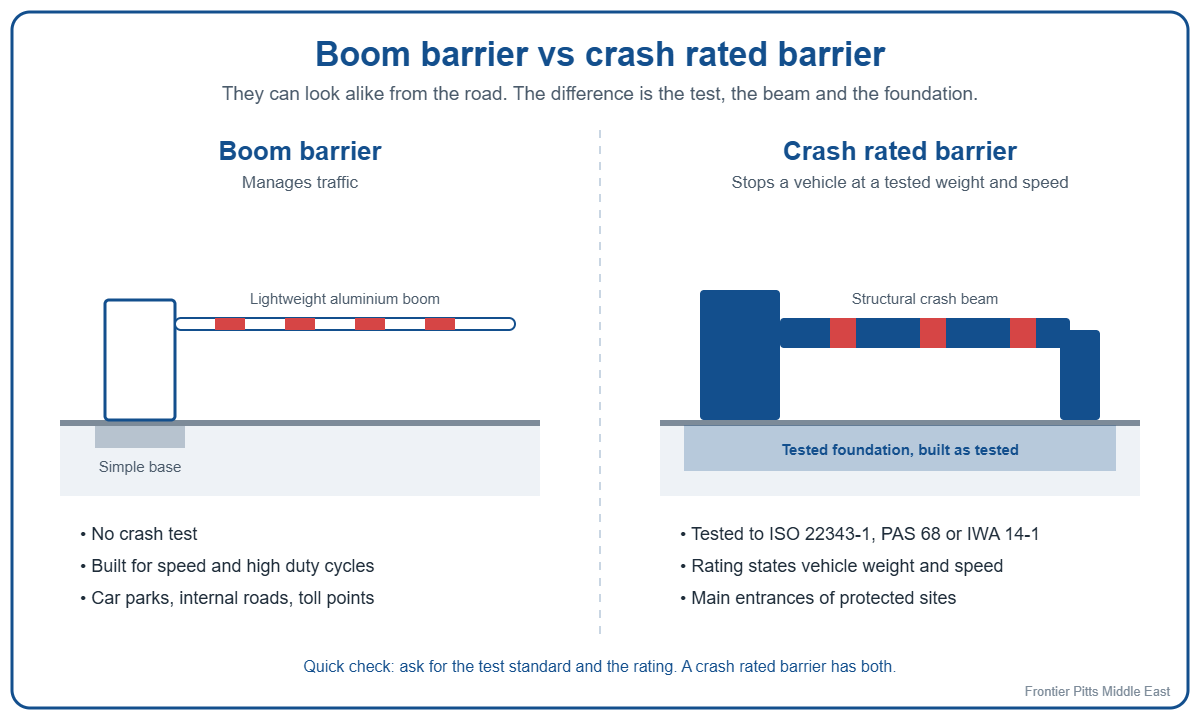
| Boom barrier | Crash rated barrier | |
|---|---|---|
| Purpose | Manage traffic flow | Stop a vehicle at a tested weight and speed |
| Crash test | None | Tested to PAS 68, IWA 14 or ISO 22343 |
| Boom | Lightweight, usually aluminium | Structural crash beam |
| Foundation | Simple base for the cabinet | Tested foundation that must be built as tested |
| Operation | Fast, high duty cycles | Automatic or manual, depending on the model |
| Documentation | Product data sheet | Test standard, rating and installation record |
The quickest check is to ask for the test standard and the rating. A crash rated barrier will have both. If neither is available, the product is a boom barrier.
Which does your entrance need?
Start with what the entrance has to do, not with the product.
Choose a boom barrier when the aim is to control normal traffic: visitor and staff car parks, internal roads, loading bays and toll or pay points. On these lanes, speed, duty rating and reliability matter most.
Choose a crash rated barrier when the site has been assessed as needing protection from a vehicle driven deliberately, or when the project specification calls for a crash rating. Government buildings, utilities, data centres, logistics hubs and critical infrastructure usually fall into this group. In the Gulf, many of these projects also have client or authority requirements for tested products, so check the specification early.
Choose the rating by the approach. A crash rating is matched to the vehicle and speed that could realistically reach the entrance. A long straight approach allows more speed than a tight corner, so the right rating depends on the road layout, not on picking the highest number. The project’s security consultant or risk assessment should set the requirement. ISO 22343-2:2023, which replaced PAS 69, gives guidance on selecting, installing and using vehicle security barriers, and the UK National Protective Security Authority (NPSA) publishes guidance on hostile vehicle mitigation.
Use both when the site has layers. A common layout puts a crash rated barrier at the main perimeter entrance and boom barriers on the internal car parks and service roads behind it. Some sites also pair a boom barrier for daily traffic with a crash rated barrier set back from it, so the security line is only closed when needed.
Power, location and daily use
Two practical questions narrow the choice further.
Is there power at the entrance? Remote sites, utilities and temporary site entrances often have no mains supply. The Terra CEDAR Barrier is a manual, counterbalanced HVM barrier designed for exactly this case, with no power needed to raise or lower it.
How often will it open? A gate that opens a few times a day suits a manual barrier. A busy car park or logistics entrance needs an automatic barrier with a duty rating that matches the traffic. Ask for the cycle rating, not just the opening time.
For wide openings, such as emergency or service routes that open only occasionally, a manual swing barrier can cover more width than a drop arm. The IWA 14 Terra 180° Swing Barrier covers openings up to 10,000mm.
Questions to ask before you buy
Whether you are buying a boom barrier or a crash rated barrier, these questions keep the specification clear:
- Is it crash tested? If yes, to which standard, and what is the full rating: vehicle weight and speed?
- What foundation was it tested with? The installed foundation has to match the tested one, so check the depth against buried services on your site.
- What is the duty rating? Match it to the number of vehicles the lane handles at peak times.
- What happens if power fails? Ask about manual override, battery backup or a manual model.
- What documentation comes at handover? For crash rated barriers, that should include the test standard, the rating and an installation record.
Clear answers to these five questions make it easy to compare products and to show the client exactly what has been installed.
Frequently asked questions
What is the difference between a boom barrier and a crash rated barrier?
A boom barrier manages traffic and is not designed to stop a vehicle driven at it. A crash rated barrier has been impact tested to stop a vehicle of a stated weight at a stated speed, under a standard such as PAS 68, IWA 14 or ISO 22343.
How does a boom barrier work?
A motor in the cabinet raises and lowers a lightweight boom. The barrier opens from an access control device such as a card reader, ticket machine or number plate camera, and ground loops or photocells stop it closing while a vehicle is underneath.
Is an automatic boom barrier crash rated?
Not usually. Most automatic boom barriers are traffic control products with no crash test. A barrier is only crash rated if it has been tested to a recognised standard, so ask for the standard and rating.
Can a crash rated barrier be used for daily traffic?
Yes. Automatic crash rated barriers such as the PAS 68 Compact Terra Barrier and the PAS 68 Terra Ultimate Barrier open and close for traffic like a standard barrier, while also carrying a tested rating.
Which barrier works without power?
A manual barrier such as the Terra CEDAR Barrier, which is counterbalanced and PAS 68 tested, is suited to remote entrances with no power supply.
References
- ISO 22343-1:2023, Vehicle security barriers, Part 1: Performance requirement, vehicle impact test method and performance rating. iso.org
- ISO 22343-2:2023, Vehicle security barriers, Part 2: Application. iso.org
- National Protective Security Authority (NPSA), Hostile vehicle mitigation guidance. npsa.gov.uk
- Secured by Design, Standards explained: barriers (PAS 68, IWA 14-1 and ISO 22343).
Related reading: Understanding Crash-Rated Barriers: A Guide, Crash Rated Explained: Standards, Testing, and Real Uses, Five HVM Specification Checks Before Selecting a Vehicle Security Barrier and How Do You Secure a Government Data Center’s Physical Perimeter?
To discuss the right barrier for each entrance on your site, contact sales@frontierpitts.ae or visit fpgulf.com. You can also browse our full range of HVM barriers.
Follow Frontier Pitts Middle East on Google
Add fpgulf.com as a Preferred Source to see more of our latest insights on hostile vehicle mitigation, security bollards, road blockers and high-security access solutions in Google Search.