
High-Security Barriers in the Middle East
Crash rated barriers certified to PAS 68 or IWA 14-1 are the required standard for protecting critical infrastructure in the UAE and GCC. Unlike standard traffic barriers, they are independently tested to stop vehicles of up to 7,500 kg at speeds of 48–80 kph. Certification documentation is mandatory appearance alone is never sufficient.
Why This Guide Exists
At Frontier Pitts Middle East, we work with government agencies, facility managers, and security engineers across the UAE and GCC daily. And one pattern repeats itself more than any other: procurement decisions made on price or appearance, rather than certification and lifecycle fit.
The cost of that mistake isn’t just financial. For airports, government buildings, oil facilities, and public spaces, a barrier that fails under vehicle attack has consequences that cannot be recovered.
This guide is written to give procurement teams and infrastructure owners a clear, accurate framework — so that what gets installed actually performs when it matters.
What Is an HVM Barrier? (Clear Definition for Specifications and Tenders)
A Hostile Vehicle Mitigation (HVM) barrier is a physical security system that has been independently tested and certified to stop a deliberate vehicle attack at a defined weight and speed. The key phrase is independently tested — not manufacturer-claimed, not visually assessed, but verified under a recognised standard with a published certificate.
In the Middle East context, the two standards that matter are:
PAS 68 — Published by BSI (British Standards Institution), this is the most widely specified standard across UAE and GCC government projects. It defines exact test conditions: vehicle mass, impact speed, angle, and permitted penetration distance.
IWA 14-1 — The International Workshop Agreement published by ISO, commonly applied on public space, transport, and internationally linked infrastructure projects. It is accepted alongside PAS 68 across the region.
Both standards require full-scale physical crash testing by an accredited laboratory. A barrier without a certificate from such a test is not an HVM system — regardless of how it is marketed.
“A concrete road divider or unrated steel post may look substantial. Under a 7,500 kg vehicle impact at 48 kph, it will typically move or fragment. The physics does not care about appearances.” — Frontier Pitts Middle East Engineering Team
Frontier Pitts Middle East’s Certified HVM Barrier Range
Our barrier products are certified to PAS 68 and IWA 14-1 standards. The current range includes:
PAS 68 Compact Terra Barrier Certified to PAS 68 — 3,500 kg vehicle at 48 kph. A compact, drop-arm solution suited for access points where space is constrained and a shallow foundation is required.
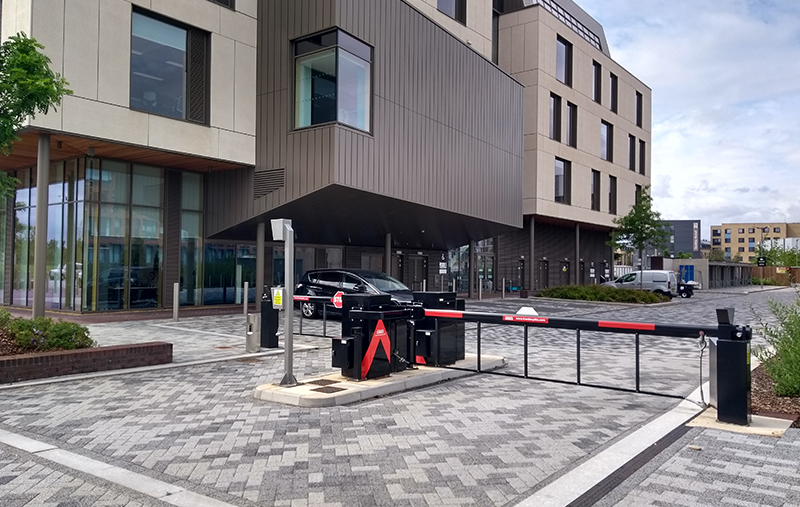
PAS 68 Terra Ultimate Barrier Our highest-rated fixed barrier under PAS 68 — engineered for perimeter protection at high-risk infrastructure including oil facilities, airports, and government campuses.
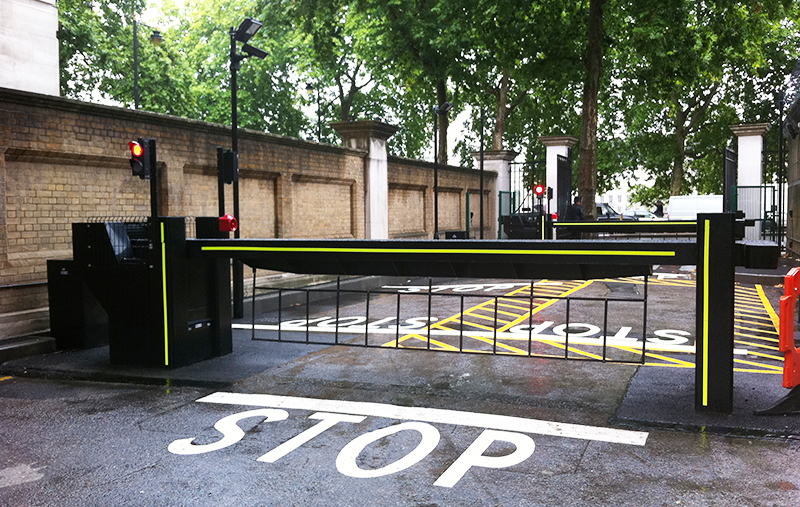
Terra 180° Swing Barrier — IWA 14, 7,200 kg @ 48 kph A manual swing barrier certified to IWA 14-1. Used where a physical vehicle arrest point must also permit controlled pedestrian or maintenance access.
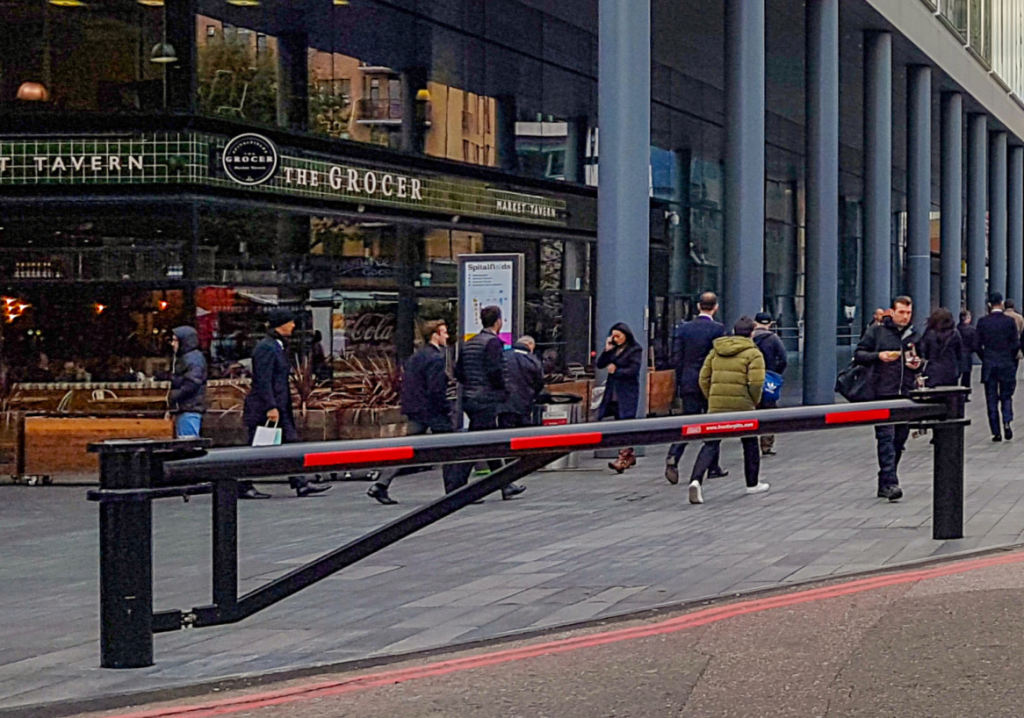
Terra Ultimate 180° Swing Barrier — IWA 14, 7,200 kg @ 80 kph Certified to IWA 14-1 at 80 kph — one of the highest-rated swing barrier solutions available in the region. Designed for maximum-threat entry points.
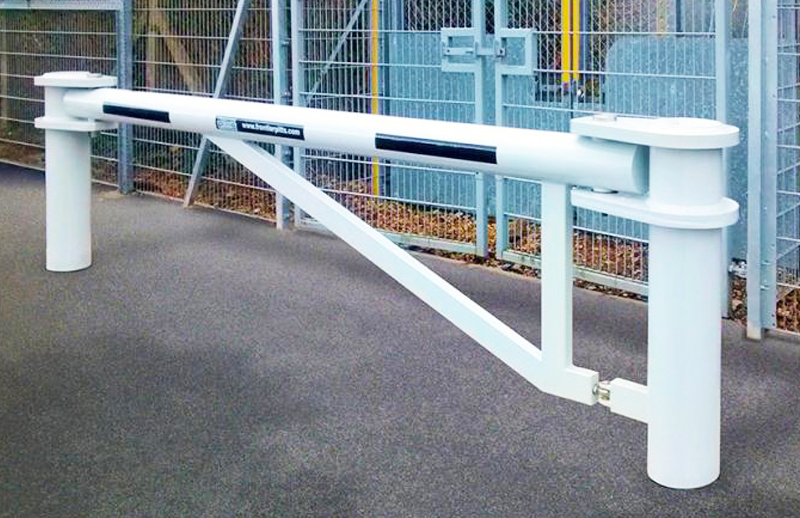
Terra CEDAR Barrier An aesthetically considered barrier solution for environments where security must integrate with architectural design — government plazas, embassies, and civic infrastructure.
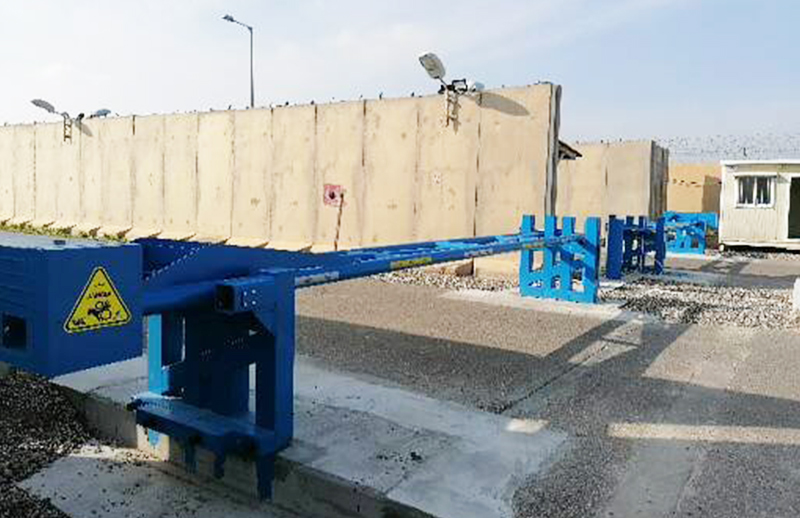
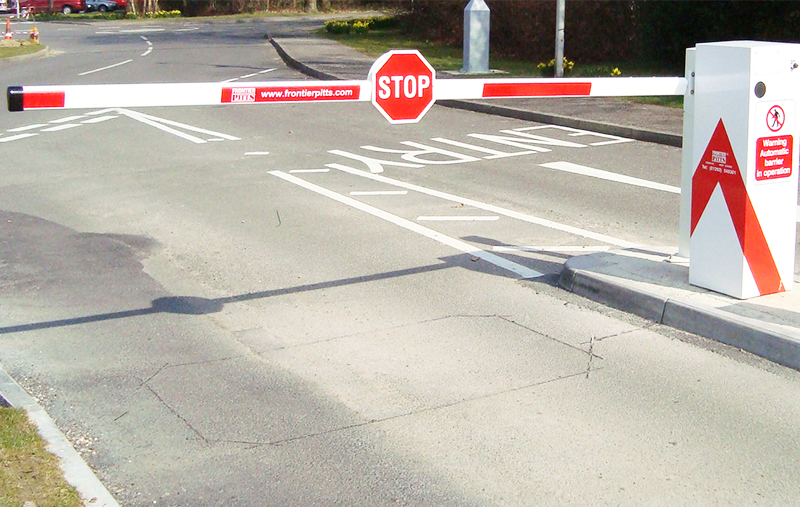
Security Car Park Barriers For controlled vehicle access in car park and facility environments where access management is the primary requirement alongside physical deterrence.
Traffic Barrier vs. Crash Rated HVM Barrier: The Difference That Matters
| Feature | Standard Traffic Barrier | Certified HVM Barrier (PAS 68 / IWA 14-1) |
|---|---|---|
| Purpose | Lane separation, traffic flow | Stopping deliberate vehicle attack |
| Independent crash test | No | Yes — full scale, accredited laboratory |
| Certificate provided | No | Yes — mandatory for compliant procurement |
| Foundation design | Basic, standard civil | Engineered to certified installation spec |
| Suitable for critical infrastructure | No | Yes |
| Suitable for airports / government / oil facilities | No | Yes |
This distinction is where most procurement errors begin. If a tender is written as “crash rated barrier” without specifying the standard and notation, non-certified products can be submitted that technically meet the wording but provide no genuine protection.
Step-by-Step: How to Procure HVM Barriers Without Costly Mistakes
Step 1 — Define Your Threat Level Before Writing a Specification
What is the maximum vehicle weight that could approach your perimeter? What is the realistic impact speed? Is the access point public-facing or controlled? Your answers define the minimum certified performance your barrier must meet — not budget, not aesthetics.
Step 2 — Write the Specification in Full Standard Notation
“Crash rated barrier” is a description, not a specification. Write it precisely:
“PAS 68 V/7500(N2)/48/90:3.6/0.0” or “IWA 14-1 V/7200(N2)/80/90:0.0”
This prevents ambiguity, protects your procurement process, and ensures all tenderers are quoting to identical performance requirements.
Step 3 — Confirm Local Authority Requirements
Standards specified for Abu Dhabi projects may differ from those on Saudi or Oman contracts. Confirm with the relevant authority before issuing tender documents. A mid-project redesign costs significantly more than a pre-tender clarification call.
Step 4 — Evaluate Your Supplier Against These Criteria
When assessing any UAE barrier supplier or Dubai barrier supplier, ask directly:
- Can you provide the original accredited crash test certificate for this exact product?
- Where is your technical support team physically located?
- Who takes engineering responsibility for the civil foundation design?
- What is your spare parts lead time within the GCC?
Real-world scenario: A major regional airport selected a low-cost supplier with no GCC technical presence. Within eight months, a hydraulic fault developed on a primary entry point road blocker. Replacement parts took 23 days to arrive from overseas. The access point ran on manual override throughout — a significant and documented security gap. The initial procurement saving was wiped out, and the reputational exposure was considerably worse.
Step 5 — Plan the Lifecycle From Day One
HVM barriers are mechanical and hydraulic systems. They require planned power supply, drainage provisions, redundancy for primary access points, and structured maintenance. In the UAE’s climate — extreme heat, coastal salt air, fine sand — these requirements are not theoretical. They are the difference between a barrier that performs reliably for 15 years and one that fails in three.
HVM Procurement Checklist
Before issuing any tender for crash rated barriers, confirm all of the following:
☐ Threat level formally defined (vehicle mass, speed, approach type)
☐ Crash rating written in full standard notation (PAS 68 or IWA 14-1)
☐ Original accredited crash test certificate reviewed — not brochure only
☐ Authority and client standard requirements confirmed in writing
☐ Supplier local GCC technical support capacity verified
☐ Civil foundation design responsibility assigned to a qualified engineer
☐ Power supply, drainage, and redundancy planned at design stage
☐ Maintenance SLA and spare parts availability confirmed
If your shortlisted barrier manufacturer in UAE cannot answer every item on this list clearly, that is your answer.
Shallow Mount Barriers: A Critical Consideration for UAE Projects
One of the most underspecified areas in regional procurement is shallow-mount HVM. Dubai and Abu Dhabi developments frequently sit above podium slabs, metro infrastructure, or dense utility networks — conditions that make standard deep-foundation systems structurally impossible.
A shallow-mount barrier is not a compromise. If it carries PAS 68 or IWA 14-1 certification at the required vehicle mass and speed, it performs identically to a deep-foundation equivalent.
Example: A logistics facility in Dubai required certified perimeter protection but the slab depth was insufficient for any standard foundation system. Frontier Pitts Middle East deployed a PAS 68-certified shallow-mount solution. The project met its security specification and came in on programme — without structural redesign.
If your site has underground constraints, specify shallow-mount capability within the tender rather than discovering the limitation after award.
Why Local Technical Support Is a Risk Management Decision
When facility managers search for a “barrier supplier near me,” it is not convenience they’re looking for — it is operational continuity. A supplier without a GCC-based technical team means:
- Longer response times when faults occur
- Extended downtime on critical access points
- Spare parts sourced from overseas on long lead times
- No on-site commissioning expertise familiar with regional conditions
Frontier Pitts Middle East operates from Abu Dhabi, with technical support across the UAE and broader GCC. Our systems are specified with IP-rated enclosures and corrosion-resistant finishes engineered for Gulf climate conditions — not adapted from a European specification.
When to Engage a Specialist (and Why Earlier Is Always Better)
Engage an HVM specialist at concept or early design stage when your project involves:
- Airport perimeter and landside vehicle control
- Government ministry, embassy, or civic building protection
- Oil, gas, or energy facility access management
- Public space or transport hub perimeter security
- Integration of crash rated barriers with access control, ANPR, or RFID systems
Late specialist engagement is the single most common cause of HVM redesign cost. Foundation conditions, utility clashes, and authority standard mismatches are all identifiable and solvable early — and expensive to resolve after construction has begun.
Next Steps
If you are specifying, tendering, or reviewing HVM requirements for a project in the UAE or GCC:
1. Review your current specification — does it name the standard, the vehicle mass, and the impact speed in full notation?
2. Confirm your authority requirement — PAS 68 and IWA 14-1 are the applicable standards for the region.
3. Request certified documentation — from any supplier you are seriously evaluating.
Security Car Park Barriers For controlled vehicle access in car park and facility environments where access management is the primary requirement alongside physical deterrence.
Or contact our technical team directly for a project consultation. 📍 Abu Dhabi, UAE | 📞 +971 26212272 | sales@frontierpitts.ae