
How Shallow Mount Bollards Stop Vehicles | HVM Guide UAE
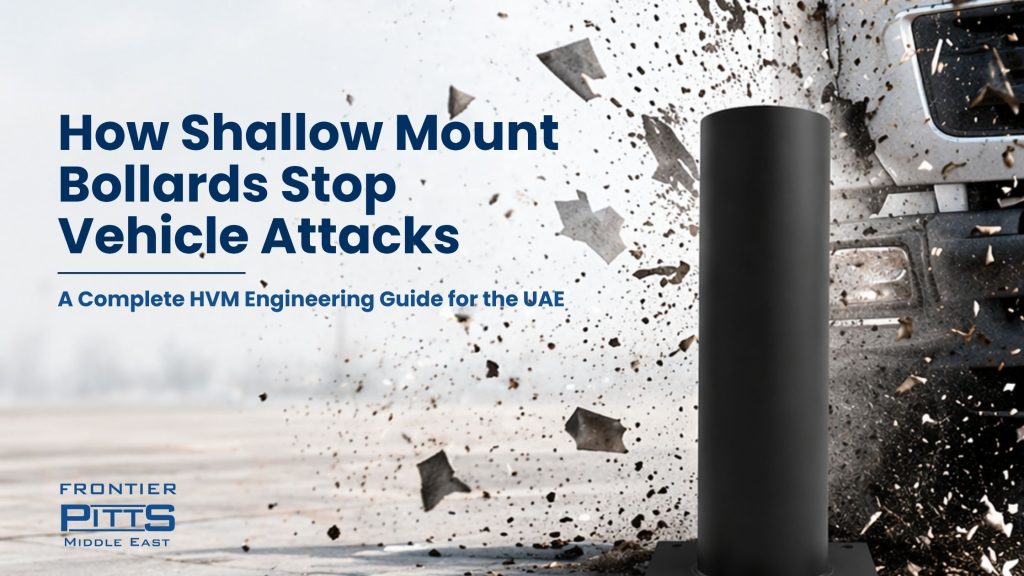
Shallow mount bollards are certified crash barriers that stop threatening vehicles without requiring deep excavation, making them the dominant hostile vehicle mitigation (HVM) solution across the UAE’s infrastructure-dense urban environments.
Shallow mount bollards stop vehicle attacks by absorbing kinetic energy through a high-grade steel core seated in a reinforced concrete base just 200–400mm deep. On impact, force is redistributed laterally into surrounding concrete and soil, decelerating the vehicle within a controlled penetration distance. Certified PAS 68 systems can stop a 7.5-tonne vehicle at 48 km/h with zero lateral penetration.
***7.5tMax test vehicle (PAS 68 rated)
***48km/hCertified impact velocity
***300mmFoundation embedment depth
***0.0mLateral penetration distance
***Featured product – SIRA certified
Terra Shallow Venus Bollard – PAS 68, 7.5t @ 48kph
The benchmark shallow mount bollard for UAE projects, independently crash-tested to PAS 68 specification and approved by Dubai’s Security Industry Regulatory Agency (SIRA). Rated v/7500[N2]/48/90:3.3/0.0 – 3.3m longitudinal, 0.0m lateral penetration.
Embedment: 300mmHeight: 1000mmDiameter: 219mm øSIRA approvedPowder coated standardStainless sleeve option
What Happens During a Vehicle Impact?
The physics of a vehicle-to-bollard collision unfolds in under 200 milliseconds. Understanding the sequence is essential for specifying the correct HVM bollard system for any given threat level or site constraint.
- Initial contact: The vehicle’s kinetic energy transfers instantly into the bollard’s steel core. A 7,500 kg vehicle at 48 km/h carries roughly 3.3 MJ of energy precisely the load the Terra Venus PAS 68 bollard is independently certified to absorb.
- Energy absorption: The engineered steel core begins controlled deformation, converting kinetic energy into heat and material strain rather than allowing through-penetration of the protected perimeter.
- Lateral load distribution: Horizontal forces radiate outward through the 300mm reinforced concrete foundation into surrounding soil, preventing single-point structural failure.
- Rapid vehicle deceleration: Momentum dissipates over a very short distance – the “penetration distance” recorded in crash certification reports. The Terra Venus achieves 0.0m lateral penetration.
- Final containment: The vehicle stops or is deflected within the safe zone. Zero lateral penetration means the threat vehicle does not enter the protected perimeter at any point during or after impact.
Real-world application UAE
Installed project references for the Terra Venus shallow mount bollard include deployments at high-footfall public venues, government facilities, and hotel forecourts across the UAE and GCC, environments where underground utility conflicts make deep-foundation alternatives impractical. In each case, the 300mm embedment depth resolved excavation constraints without compromising crash-rating performance.
Engineering Breakdown: How Shallow Mount Systems Work
Internal structure
A certified shallow mount bollard is not a hollow steel pipe. The Terra Venus is built around a 219mm diameter high-strength steel shaft engineered to deform predictably under rated load conditions redirecting force vectors downward and outward rather than allowing backward travel through the barrier.
Foundation mechanics
Traditional deep-foundation bollards require excavation of 1 metre or more – problematic across Dubai, Abu Dhabi, and Sharjah where underground utilities are densely packed. The Terra Venus shallow bollard solves this with a 300mm embedment depth, anchored with a lateral force-distribution base that compensates for the reduced soil column without sacrificing its PAS 68 performance rating.
Finish and customisation
The Terra Venus ships polyester powder coated as standard, with a full range of aesthetic sleeves available, including stainless steel finishes making it suitable for architectural HVM installations where visual integration with the surrounding environment is a design requirement.
Specifier note: Soil bearing capacity is a critical variable in shallow mount performance. Soft or waterlogged soils common on coastal reclaimed land across the UAE may require ground improvement or a wider concrete spread footing. Always commission a geotechnical assessment before finalising foundation dimensions for any shallow bollard installation.
Shallow Mount vs Deep Foundation: Side-by-Side Comparison
| Criterion | Shallow Mount Bollards | Deep Foundation Bollards |
|---|---|---|
| Foundation depth | 200–400mm Terra Venus: 300mm | 1,000mm+ |
| Installation time | 1–2 days per unit | 3–5 days per unit |
| Utility conflict risk | Low | High |
| Retrofit suitability | Excellent | Poor to moderate |
| Urban suitability (UAE) | Preferred solution | Rarely feasible in CBDs |
| Total installed cost | Lower (less civil work) | Higher |
| Crash rating achievable | PAS 68 / IWA 14 certified | PAS 68 / IWA 14 |
| SIRA compliance (Dubai) | Approved | Varies by product |
Crash Testing Standards Explained
Specifiers across the UAE and GCC regularly encounter three certification frameworks. The Terra Venus bollard is tested to PAS 68, the full-scale British standard rated v/7500[N2]/48/90:3.3/0.0.
| Standard | Origin | Status | What it tests |
|---|---|---|---|
| PAS 68 | UK (BSI) | Being superseded | Full-scale vehicle crash; penetration distance; structural behaviour. Used by Terra Venus certification |
| IWA 14 | International (ISO) | Current – Middle East standard | Harmonised global test; vehicle class, speed, impact angle |
| ISO 22343 | International (ISO) | Emerging – future standard | Replaces PAS 68 and IWA 14; unified performance grading |
How to read the Terra Venus rating: v/7500[N2]/48/90:3.3/0.0 vehicle class V, 7,500 kg, N2 category, impact at 48 km/h, 90° strike angle, 3.3m longitudinal penetration, 0.0m lateral penetration. The zero lateral figure means no breach of the protected zone width. Download the full test data and catalogue here.
UAE Deployment Locations for Shallow Mount HVM Bollards
| Location type | Primary HVM challenge | Why shallow mount wins |
|---|---|---|
| Airports (landside) | High-density pedestrian zones; dense utility runs beneath aprons | 300mm embedment avoids cable strikes; SIRA-certified product accepted by UAE aviation authorities |
| Government buildings | Perimeter security; architectural integration requirements | Stainless steel sleeve option suits formal facades; PAS 68 shallow bollard meets tendering standards |
| Oil & gas facilities | Critical infrastructure; variable soil from reclaimed ground | Geotechnical flexibility; certified crash-rated bollards with documented test reports |
| Shopping malls / retail | Complex underground parking structures below forecourts | Shallow mount bollard supplier with SIRA Dubai compliance |
| Hotels & mixed-use | Aesthetics-first brief; valet drop-off zones | Powder coat or stainless sleeve finish; architectural HVM bollards UAE |
5 Common Installation Mistakes and How to Avoid Them
- Inadequate foundation preparation: Skipping soil compaction or using sub-grade concrete undermines the lateral load distribution mechanism that makes shallow mount bollards effective. Specify minimum C35 concrete and verify compaction before casting.
- Incorrect bollard spacing: Gap distances must be calculated against the widest vehicle in the threat model. Gaps above 1.5m may permit compact vehicle ingress between PAS 68 bollards.
- Selecting uncertified products: Not all “crash-rated” bollards carry third-party witnessed test reports. Always request the full PAS 68 or IWA 14 test report not just a marketing certificate and verify the tested vehicle class and speed match your threat scenario before purchasing from any bollard supplier in UAE.
- Ignoring soil conditions: Soft fill, coastal reclaimed land, or high-water-table sites common across UAE coastal developments significantly affect shallow bollard effectiveness. Commission a ground investigation before design finalisation.
- Overlooking SIRA compliance: Dubai projects require Security Industry Regulatory Agency (SIRA) approval. The Terra Venus shallow mount bollard carries SIRA certification engage on compliance documentation from project inception, not at tender stage.
Frequently Asked Questions
Can shallow mount bollards achieve the same crash rating as deep foundation systems?
Yes. The Terra Venus PAS 68 shallow mount bollard is independently crash-tested at 7.5 tonnes and 48 km/h matching the performance tier of most deep-foundation alternatives while requiring only 300mm of excavation. The engineering compensates for reduced depth through optimised steel core geometry and a wider concrete base spread. Always verify the specific product test report, not the product category claim.
How deep do shallow mount bollards need to be installed?
The Terra Venus shallow foundation bollard requires 300mm embedment depth classified as Foundation Type B under PAS 68 testing. This is a hard specification: deviation from the certified installation depth invalidates the crash rating. The manufacturer provides full installation drawings for download alongside the product catalogue.
Is SIRA approval required for bollards in Dubai?
For security barriers deployed in critical or high-risk environments in Dubai, SIRA certification is typically required by project authorities. The Terra Venus bollard holds current SIRA approval, confirming compliance with Dubai’s regulatory framework for physical security systems. This simplifies the tender approval process on Dubai government, retail, and infrastructure projects.
What finish options are available for shallow mount bollards in the UAE?
The Terra Venus shallow bollard is supplied polyester powder coated as standard, in a range of RAL colours. A full range of aesthetic sleeves is available including stainless steel finishes making it suitable for hotel drop-offs, government building perimeters, and retail environments where visual integration is a design requirement alongside crash performance.
What is the difference between PAS 68 and IWA 14 for bollard specification?
PAS 68 is the UK-origin test standard under which the Terra Venus bollard is certified. IWA 14 is the internationally harmonised equivalent, widely accepted across the Middle East. Both standards test vehicle mass, impact speed, and penetration distance under witnessed conditions. PAS 68 products are accepted on most UAE and GCC projects confirm with your project authority at early-stage specification.
Specifying an HVM bollard system for a UAE or GCC project? The Terra Venus is SIRA-certified, PAS 68 crash-rated, and available with full compliance documentation for government, airport, and critical infrastructure tenders. Click here: View Products specs and download product catalogue.
Follow Frontier Pitts Middle East on Google
Add fpgulf.com as a Preferred Source to see more of our latest insights on hostile vehicle mitigation, security bollards, road blockers and high-security access solutions in Google Search.