
Understanding Crash-Rated Barriers: A Guide
What Are Crash-Rated Barriers?
Crash-rated barriers are vehicle security systems engineered and impact-tested to stop unauthorized or hostile vehicles. They include crash-rated bollards, road blockers and security gates used at airports, government facilities, critical infrastructure and public spaces. Their performance is tested and classified under standards such as PAS 68 and IWA 14-1, based on vehicle weight, impact speed and penetration.
Crash rated barriers are a crucial part of modern security infrastructure. They serve to protect people and property from vehicle intrusions, both accidental and intentional.
Understanding these barriers is essential for security professionals, facility managers, and urban planners. It’s also valuable for anyone interested in enhancing safety in public or private spaces.
This guide delves into the world of crash rated barriers, exploring their types, standards, and applications. By the end, you’ll have a comprehensive understanding of these barriers and how they contribute to a safer, more secure environment.
The Importance of Crash Rated Barriers
Crash rated barriers provide a vital line of defense in today’s security landscape. They are designed to stop vehicles that pose a threat, whether the intent is malicious or accidental.
By preventing unwanted vehicle access, these barriers protect lives and property. Infrastructure such as government buildings, airports, and commercial facilities rely heavily on these barriers. Their presence also acts as a psychological deterrent, reassuring stakeholders of the facility’s commitment to safety and security.
Barriers enhance safety by creating a comprehensive security plan that combines bollards, gates, and road blockers, ensuring the highest level of protection for a given environment.
Types of Crash Rated Barriers
| Barrier Type | Functionality | Best Applications |
|---|---|---|
| Bollards | Vertical posts that control vehicular traffic and protect pedestrians. | Storefronts, pedestrian zones. |
| Gate Barriers | Movable barriers regulating entry and exit points. | Airports, commercial facilities. |
| Road Blockers | Heavy-duty barriers installed at ground level for high-security entry points. | Military bases, government facilities. |
| Security Gates | Provide robust access control, including crash rated options to prevent vehicle intrusions. | High-security facilities, critical infrastructure. |
Bollards
Bollards are versatile safety barriers that effectively protect pedestrian areas and storefronts from vehicular access. Crash rated bollards provide both functional and aesthetic value, making them essential for high-security areas.
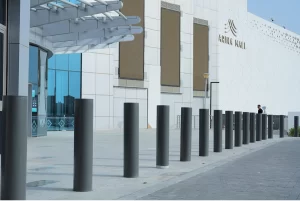
Crash rated bollards help secure pedestrian areas, storefronts, and public spaces without disrupting the site’s architectural design.
| Feature | Crash Rated Bollards | Non-Crash Rated Bollards |
|---|---|---|
| Strength | Designed to withstand impact from specific vehicle speeds and weights. | Primarily used for aesthetic or minimal traffic control purposes. |
| Applications | High-security sites, government facilities, and public spaces. | Pedestrian pathways and decorative urban planning. |
| Compliance | Must meet standards such as IWA 14-1 and PAS 68. | Generally not subjected to crash performance standards. |
Gate Barriers
Gate barriers manage the flow of vehicles at entry and exit points, playing a pivotal role in regulating access to secure areas. Automated gate barriers integrate with advanced systems like RFID or biometric scanners, while manual gate barriers are ideal for low-traffic areas.
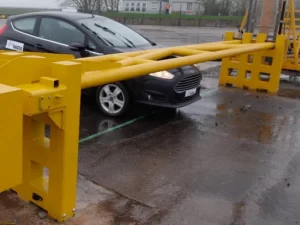
A crash rated gate barrier demonstrates controlled vehicle access and perimeter protection in a security test environment.
| Comparison | Manual Gate Barriers | Automated Gate Barriers |
|---|---|---|
| Operation | Requires human intervention for opening and closing. | Controlled remotely or integrated with electronic access systems. |
| Security Level | Suitable for low-traffic or minimal-security areas. | Ideal for high-security or frequently accessed locations. |
| Convenience | Limited flexibility and slower operation. | Faster operation with higher efficiency. |
Road Blockers
Road blockers are heavy-duty barriers used in locations where maximum security is required. Rising road blockers can be deployed instantly to stop unauthorized vehicles, while fixed road blockers offer permanent high-security solutions.
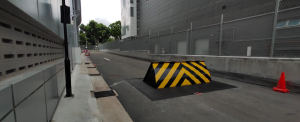
A crash rated road blocker helps control vehicle access and strengthen perimeter protection at high-security facilities.
| Feature | Fixed Road Blockers | Rising Road Blockers |
|---|---|---|
| Operation | Stationary; always visible and active. | Can be raised or lowered as needed. |
| Aesthetic Impact | Highly visible and may affect the site’s appearance. | Concealed when not in use, maintaining the area’s aesthetics. |
| Applications | Permanent high-security perimeters. | Temporary or flexible high-security zones. |
Crash Rated Gates
Crash rated gates provide the ultimate in vehicular access control, combining robust construction with crash-resistant technology. These gates are specifically designed to stop vehicles attempting forced entry, ensuring protection for high-security facilities. The Terra G8 Sliding Cantilevered Gate is a leading example, engineered to meet stringent safety and security standards.
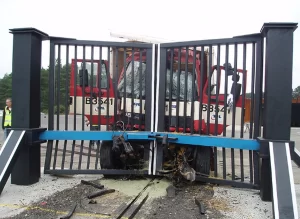
A crash rated gate demonstrates vehicle intrusion resistance and supports secure perimeter protection at high-security sites.
Learn more about Terra G8 Sliding Cantilevered Gate
Standards and Ratings Explained
Crash rated barriers must comply with specific standards like PAS 68 and IWA 14-1. These standards ensure barriers meet rigorous safety and performance criteria.
| Standard | Details | Applications |
|---|---|---|
| IWA 14-1 | International standard covering the impact performance of barriers. | Global infrastructure, especially in urban and high-security areas. |
| PAS 68 | UK standard for testing and classifying vehicle security barriers under impact conditions. | Critical infrastructure, including airports, government facilities, and public spaces. |
Frequently Asked Questions About Crash-Rated Barriers
1. What are crash-rated barriers and how do they work?
Crash-rated barriers are vehicle security systems that have been impact-tested to stop or control vehicles at specified speeds and weights. They include crash-rated bollards, road blockers and security gates designed to protect people, buildings and critical infrastructure from accidental or intentional vehicle intrusion.
2. What is the difference between PAS 68 and IWA 14-1 crash ratings?
PAS 68 and IWA 14-1 are vehicle impact testing standards used to evaluate the performance of security barriers. Test results consider factors such as vehicle type, vehicle weight, impact speed, angle and penetration distance. When comparing products, project teams should review the complete impact-test classification rather than relying only on the words “crash-rated.”
3. What type of crash-rated barrier is best for a high-security site?
The best solution depends on the site’s threat assessment, vehicle access requirements, available space and required security level. Crash-rated bollards are commonly used around pedestrian areas and building perimeters, while road blockers are suited to controlled vehicle entrances and crash-rated gates can secure larger access points.
4. Are crash-rated barriers required for airports, government buildings and critical infrastructure?
Crash-rated barriers are commonly specified where there is a significant risk of unauthorized or hostile vehicle access. Airports, government facilities, military sites, embassies, utilities and other critical infrastructure across the Middle East may require vehicle security measures based on the project’s risk assessment and applicable authority or client security requirements.
5. How do I choose the correct crash rating for a project in the UAE or Saudi Arabia?
Start with a site-specific vehicle threat and risk assessment rather than selecting a barrier based only on the highest available rating. Consider the likely vehicle weight, possible approach speed, available run-up distance, required penetration performance and installation conditions before selecting a PAS 68 or IWA 14-1 tested barrier.
6. Are PAS 68 or IWA 14-1 certified barriers automatically approved for projects in the Middle East?
Not necessarily. PAS 68 and IWA 14-1 demonstrate tested vehicle-impact performance, but individual projects in the UAE, Saudi Arabia and other GCC countries may also have local authority, consultant, client or sector-specific security requirements. Always confirm the required approvals and ensure the proposed installation matches the tested barrier configuration.
7. Can crash-rated barriers be installed where excavation depth is limited?
Yes, certain crash-rated bollards and road blockers are available with shallow foundation designs for locations where underground utilities, drainage systems or structural limitations restrict excavation depth. The required foundation and installation configuration should always follow the tested system specifications to maintain the intended impact performance.
8. Can crash-rated barriers integrate with access control systems?
Yes. Automatic road blockers, crash-rated gates and other vehicle security barriers can be integrated with access control technologies such as RFID readers, card access, intercoms, vehicle identification systems and security control systems. This allows sites to combine physical vehicle protection with controlled entry and operational traffic management.
Conclusion: Comprehensive Security Solutions
Crash rated barriers, including bollards, gate barriers, and road blockers, are essential for safeguarding people and assets. By integrating these barriers with compliance to standards like PAS 68 and IWA 14-1, facilities ensure robust protection against various threats.
For tailored solutions, explore certified products by Frontier Pitts Middle East to meet your security needs.
Follow Frontier Pitts Middle East on Google
Add fpgulf.com as a Preferred Source to see more of our latest insights on hostile vehicle mitigation, security bollards, road blockers and high-security access solutions in Google Search.