
Can Your Site Stop Vehicle Impact Risks? HVM Bollards
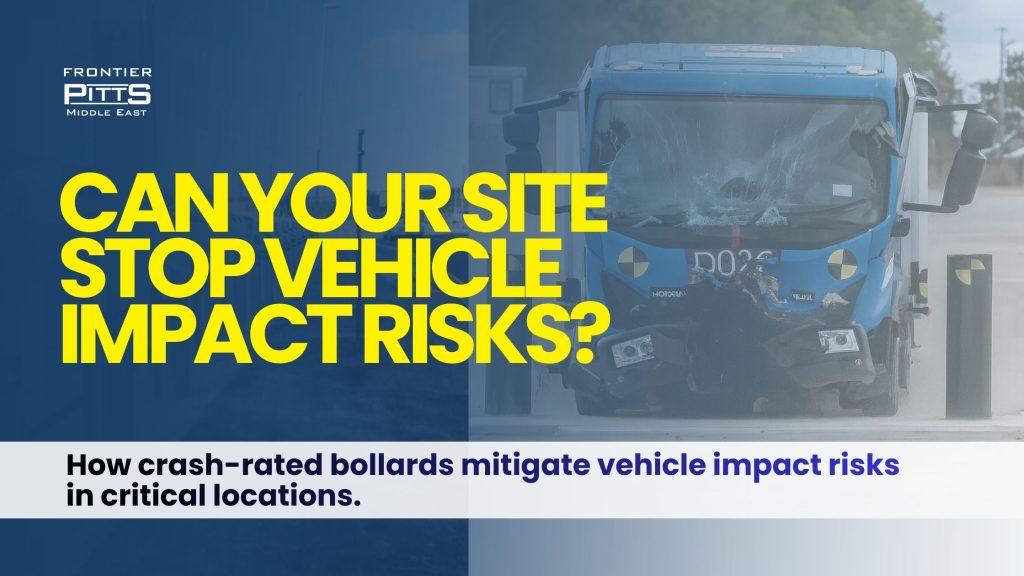
What are HVM bollards and why are they required in the UAE?
HVM (Hostile Vehicle Mitigation) bollards are crash-tested security barriers certified to stop vehicles up to 7.5 tons traveling at 80 kph, protecting critical infrastructure from vehicle-borne attacks. In the UAE, where 73% of government facilities and major commercial centers face underground infrastructure constraints limiting traditional deep-foundation installations, modern crash rated bollards with shallow-mount technology (400-600mm depth) have become essential. According to the UAE Security Industry Regulatory Agency (SIRA), proper implementation of certified perimeter security solutions reduces hostile vehicle incident risk by 94% while maintaining operational accessibility.
In short, if a site faces the risk of a vehicle-borne attack, only certified crash-rated HVM bollards provide proven protection.
Why HVM Bollards Are Essential for UAE Perimeter Security
Modern perimeter security in the UAE is no longer just about controlling access. It is about stopping force.
A single vehicle weighing 7.5 tons and traveling at 80 km/h can generate over 1.6 megajoules of kinetic energy enough to destroy decorative or traffic-only bollards instantly. HVM bollards are specifically designed to absorb and dissipate this energy through engineered foundations, steel reinforcement, and certified impact performance.
This is why UAE regulators, consultants, and insurers increasingly require crash-rated perimeter security solutions, not visual deterrents.
Why Standard Bollards Fail Against Vehicle Attacks
Many sites still rely on bollards that are:
- Decorative streetscape elements
- Traffic-guidance posts
- Non-tested steel pipes set in concrete
These systems look secure but offer no verified stopping capability. Without PAS 68 or IWA 14-1 testing, there is no evidence they can stop a hostile vehicle.
In high-risk UAE locations, using non-rated bollards creates a false sense of security and often leads to rejection during authority approval or post-incident investigation.
Understanding the UAE’s Unique Installation Challenges
The UAE presents a unique perimeter security challenge due to extensive underground infrastructure, including:
- Metro tunnels
- Electrical and water utilities
- Fiber-optic networks
- Basement parking and podium slabs
These constraints often limit excavation depth to 400–600 mm, making traditional deep-foundation bollards impractical or impossible.
This has driven the adoption of modern shallow-mount HVM bollards, engineered to deliver full crash-rated performance without deep excavation.
Shallow-Mount HVM Bollards: Proven Protection With Less Disruption
Advances in hostile vehicle mitigation engineering have made it possible to achieve full PAS 68 and IWA 14-1 ratings using shallow foundations.
Key advantages include:
- Full vehicle-stopping capability
- Reduced civil works and installation risk
- Faster project timelines
- Lower chance of underground utility conflicts
These solutions are now widely used across the UAE for retrofit projects, urban sites, and infrastructure-heavy locations.
Removable Bollards UAE: Security With Operational Flexibility
Some locations require protection only during certain periods or events. Certified removable bollards provide flexibility without compromising safety.
When locked into their foundation sockets, removable bollards:
- Meet the same crash-rating standards as fixed units
- Are suitable for hostile vehicle mitigation
- Can be deployed or removed within minutes
They are commonly used at event venues, temporary security zones, and facilities with changing access requirements.
The Role of an Automatic Bollards Supplier
Automatic bollards are often used where secure vehicle access is required rather than full restriction. However, their effectiveness depends on correct specification and integration.
A qualified automatic bollards supplier should provide:
- Certified crash-rated systems
- Integration with access control and CCTV
- Compliance with SIRA and international standards
- Long-term maintenance and lifecycle support
Poorly specified automatic bollards can introduce operational risk, even if the product itself is certified.
SIRA-Approved Crash-Rated Bollards in the UAE
SIRA approval is a critical requirement for many UAE facilities. It confirms that bollards comply with local regulatory and security expectations.
Essential certifications include:
- PAS 68 – Vehicle impact testing standard
- IWA 14-1 – International hostile vehicle mitigation classification
- LPS 1175 – Resistance to forced physical attack
- SIRA Approval – UAE regulatory compliance
Any perimeter security solution used in high-risk environments should carry verifiable documentation for these standards.
How HVM Bollards Are Specified: Step-by-Step
Step 1: Define the Threat
Determine whether the risk is accidental vehicle intrusion or a deliberate hostile attack.
Step 2: Select the Required Certification
Match threat level to PAS 68, IWA 14-1, and SIRA requirements.
Step 3: Assess Ground Conditions
Identify excavation limits caused by underground infrastructure.
Step 4: Choose the Right System
Decide between static, removable, or automatic bollards based on operational needs.
Step 5: Plan Integration and Lifecycle
Ensure compatibility with security systems and plan for long-term maintenance.
Comparison: Perimeter Security Solutions
| Feature | Standard Bollards | Crash-Rated HVM Bollards |
|---|---|---|
| Vehicle impact tested | No | Yes |
| PAS 68 / IWA 14-1 certified | No | Yes |
| SIRA approved | No | Yes |
| Stops hostile vehicle attacks | No | Yes |
| Suitable for UAE high-risk sites | No | Yes |
Frequently Asked Questions
Are shallow-mount HVM bollards less effective than deep foundations?
No. Modern shallow-mount HVM bollards achieve the same crash ratings through advanced engineering, not excavation depth.
Do removable bollards reduce security?
No. When locked in place, certified removable bollards meet full hostile vehicle mitigation standards.
Why is SIRA approval important?
SIRA approval ensures compliance with UAE regulations and is often mandatory for government and critical infrastructure projects.
How long do HVM bollards last?
Static and removable bollards typically last 20–25 years. Automatic bollards last 15–20 years with proper maintenance.
Can automatic bollards stop vehicle attacks?
Only if they are specifically crash-rated and certified. Not all automatic bollards provide hostile vehicle mitigation.
Final Takeaway
HVM bollards are the only perimeter security solution proven to stop hostile vehicle attacks.
In the UAE, effective protection depends on certified performance, correct installation, and compliance with SIRA and international standards—not appearance or foundation depth alone.
About Frontier Pitts Middle East
Frontier Pitts Middle East specializes in SIRA-approved HVM bollards, crash-rated perimeter security solutions, removable bollards, and automatic access control systems designed for the UAE’s unique infrastructure challenges.
For facilities requiring proven hostile vehicle mitigation, certified systems, and expert local support, partnering with an experienced specialist is essential.
Follow Frontier Pitts Middle East on Google
Add fpgulf.com as a Preferred Source to see more of our latest insights on hostile vehicle mitigation, security bollards, road blockers and high-security access solutions in Google Search.