
Shallow Mount Bollards in the Gulf: Four Site Conditions That Rule Out Deep Foundations
A crash rated bollard is only as good as the foundation it was tested on. On a greenfield site that is rarely a problem. Dig the pit, pour the concrete, set the bollards. On an existing site in the Gulf it often is. The ground under the line is already full, the surface on top is already finished, and the building behind it is already in use.
This is where shallow mount bollards earn their place. They are not a lighter version of a deep bollard. They are a different foundation design, crash tested with that shallow foundation in place. Here are the four site conditions that most often take a deep foundation off the table, and what still works when they do.
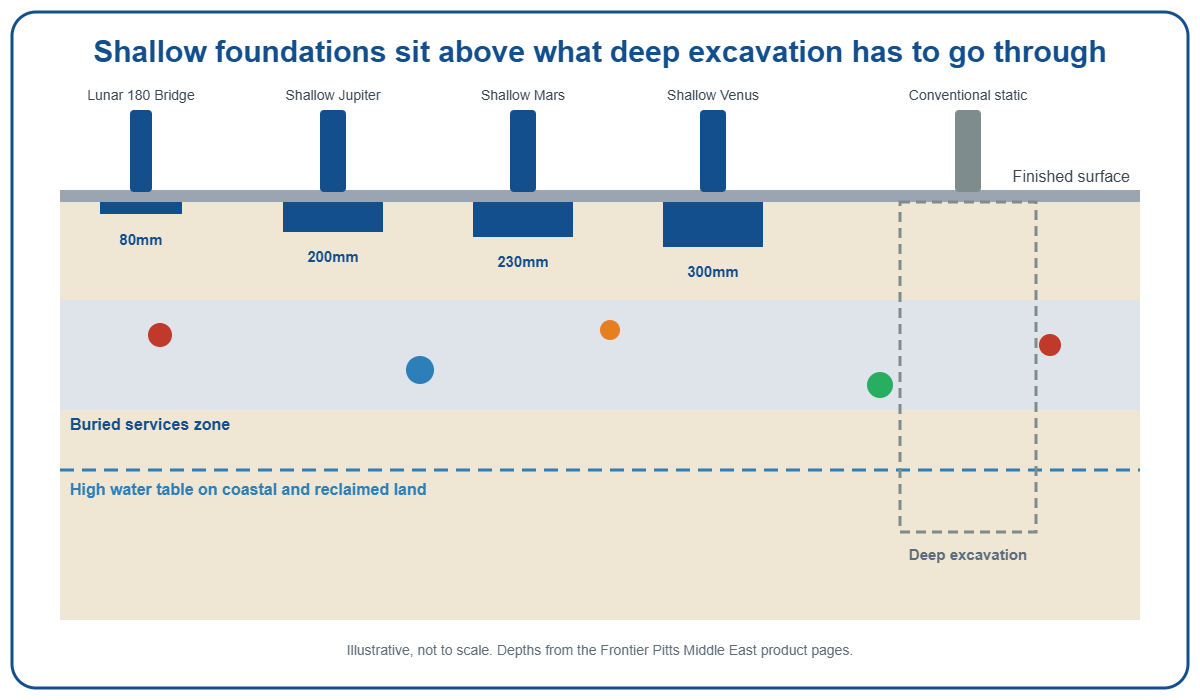
1. Buried services and incomplete record drawings
Most established sites in the UAE and Saudi Arabia carry a dense layer of services within the first metre: power, chilled water, irrigation, telecoms and drainage. On older plots the record drawings rarely match what is in the ground.
A deep foundation means excavating straight through that layer. Every service found has to be protected or diverted, and each diversion needs its own utility approval and programme time. On a perimeter line that crosses a forecourt or a public footway, that can be several services per metre.
A shallow foundation sits above most of it. The Terra Shallow Jupiter Bollard, IWA 14 tested at 7.2t and 80kph, needs a 200mm foundation. The Terra Shallow Mars Bollard, PAS 68 tested at 7.5t and 48kph, needs 230mm. At those depths a trial trench and a scan usually confirm a clear zone rather than open a diversion package.
2. Finished surfaces and reinstatement
Retrofit perimeter work in the Gulf often lands on surfaces nobody wants to lift: natural stone forecourts, decorative paving, landscaped plazas and heritage substrates around civic and religious buildings.
Every cubic metre excavated is a cubic metre to reinstate, and matched stone is slow to source. A deep foundation cuts a wide trench across the finish. A shallow foundation cuts a far narrower and shallower strip, so less of the finish is lifted, less is wasted and less has to be matched afterwards.
Where the finish cannot be cut at all, a surface mounted system avoids excavation entirely. The TerraGuard 900 is free standing, needs no ground fixings or foundations, installs in under an hour and is SIRA approved under SIRA/2024/11/00082.
3. High water tables on coastal and reclaimed land
Much of the Gulf’s prime real estate sits on reclaimed or coastal land, where groundwater can sit close to the surface. Dig deep enough and the excavation fills.
That brings dewatering: pumps, discharge approvals and a sequence where the pit is kept dry until the concrete has gained strength. It adds cost and programme, and on a live site it adds plant and noise next to people who are trying to work.
Shallow foundations often stay above the water table altogether. The Terra Shallow Venus Bollard, 7.5t at 48kph, needs 300mm of embedment, is PAS 68 tested and is SIRA approved under SIRA/2023/11/00028. Where the line crosses a bridge, where no footing is possible at all, the Terra Lunar 180 Bridge Bollard needs only 80mm and is IWA 14 tested at 7.2t and 48kph.
4. Live operations and the closure window
Hotels, malls, stadiums, schools and data centres rarely close for perimeter works. The contractor gets a night shift, a weekend or a lane closure, and the work has to fit inside it.
In that case the closure window, not the cost of the bollard, decides the design. A deep foundation needs excavation, shoring, concrete and curing before the area can reopen. A shallow foundation shortens every one of those steps, which makes it far easier to phase the line in short sections and hand each one back to the operator the same day.
Matching shallow mount bollards to the depth available
| Product | Standard and test rating | Foundation depth |
|---|---|---|
| Terra Lunar 180 Bridge Bollard | IWA 14, 7.2t at 48kph | 80mm |
| Terra Shallow Jupiter Bollard | IWA 14, 7.2t at 80kph | 200mm |
| Terra Shallow Mars Bollard | PAS 68, 7.5t at 48kph and 64kph | 230mm |
| Terra Shallow Venus Bollard | PAS 68, 7.5t at 48kph | 300mm |
| TerraGuard 900 | PAS 68, 7.5t at 48kph, 2.5t at 80kph, 1.5t at 112kph | None, surface mounted |
The right choice depends on the threat assessment, the vehicle approach and what the ground survey shows, so start with the survey rather than the product. Spacing matters as much as depth, and our bollard spacing guidelines for the UAE cover the gap between posts.
For one product in detail, see our shallow mount bollards specification guide for the UAE.
Two checks before you specify
Survey before you choose. A ground penetrating radar scan and trial pits along the line tell you which of the four conditions you actually have. Two of them often appear on the same site.
Specify the tested foundation. A crash rating covers the bollard and the foundation it was tested with. Write the foundation type and depth into the specification alongside the standard and rating (see our guide to PAS 68 and IWA 14-1 crash testing), so the bollard installation on site matches the one that was tested.
Frequently asked questions
What is a shallow mount bollard? A crash rated bollard designed and tested on a shallow foundation, typically a few hundred millimetres deep rather than the deep pit a conventional static bollard needs.
Are shallow mount bollards crash tested? Yes. Each product in the table above is tested to PAS 68 or IWA 14 with its shallow foundation in place. The rating applies to the bollard installed on that tested foundation.
When should I choose a shallow mount bollard? When buried services, finished surfaces, a high water table or a short closure window make deep excavation impractical, which covers most retrofit work on existing Gulf sites.
Which shallow mount bollards are SIRA approved? On the SIRA register, the Terra Shallow Venus Bollard (SIRA/2023/11/00028) and the TerraGuard 900 (SIRA/2024/11/00082). Always check the full product name against the register, because shallow and standard variants hold separate certificates.
For specifications on the full shallow range, see our static and shallow bollards or contact sales@frontierpitts.ae.
References
- National Protective Security Authority (NPSA), Hostile Vehicle Mitigation guidance. www.npsa.gov.uk/specialised-guidance/hostile-vehicle-mitigation-hvm
- ISO 22343-1:2023, Security and resilience, Vehicle security barriers, Part 1: Performance requirement, vehicle impact test method and performance rating. www.iso.org/standard/50080.html
- BSI PAS 68:2013, Impact test specifications for vehicle security barrier systems. knowledge.bsigroup.com/products/impact-test-specifications-for-vehicle-security-barrier-systems
- Security Industry Regulatory Agency (SIRA), Dubai, List of Approved Bollards.
Follow Frontier Pitts Middle East on Google
Add fpgulf.com as a Preferred Source to see more of our latest insights on hostile vehicle mitigation, security bollards, road blockers and high-security access solutions in Google Search.